The Current State of Minnesota Cannabis Cultivators and Manufacturers

Last reviewed September 25, 2026
By Drew Duffy, MHA, FACHE, Founder & Managing Director, CannaPath Regulatory Solutions
IN THIS ARTICLE • Two capped licenses behind every shelf • Cultivators are moving from licensing into operations • The plant is only the beginning • Manufacturing may be the smallest category, but not the simplest • Making edibles means following food rules • Testing is where production meets the rest of the supply chain • When a batch fails • The rules are still changing • Keeping the operation connected • Frequently asked questions • Where Minnesota's producers go from here |
When most people think about Minnesota’s cannabis industry, they think about the retail storefront. That makes sense. Retail is where consumers actually meet the legal market.
But every product on that shelf had to come from somewhere. It had to be cultivated, harvested, processed or manufactured, tested, tracked, packaged, and moved through a regulated supply chain before a customer ever had the chance to buy it. As Minnesota moves into its second year of statewide adult-use sales, the businesses behind that storefront are becoming more and more important to the stability of the market.
They are also facing a compliance environment that is a lot more complicated than growing a plant or making a product. Manufacturing in particular is the part of the supply chain that gets overlooked, and it may carry the most layered set of obligations of all.
Two capped licenses behind every shelf
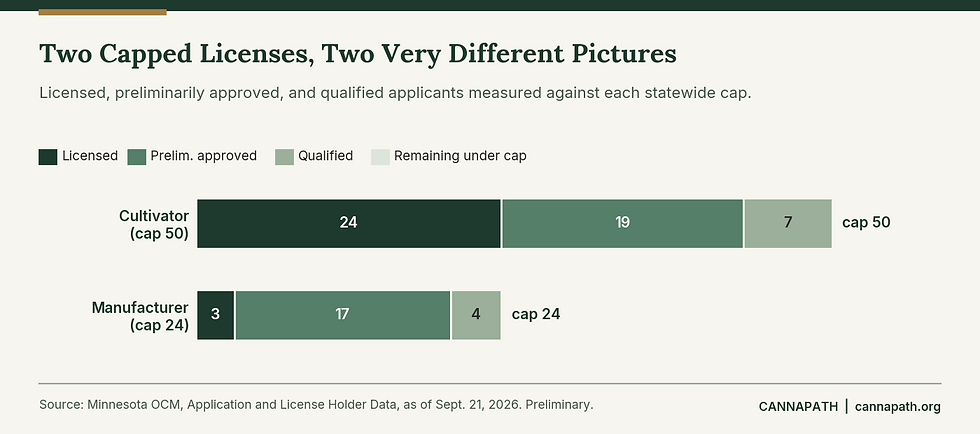
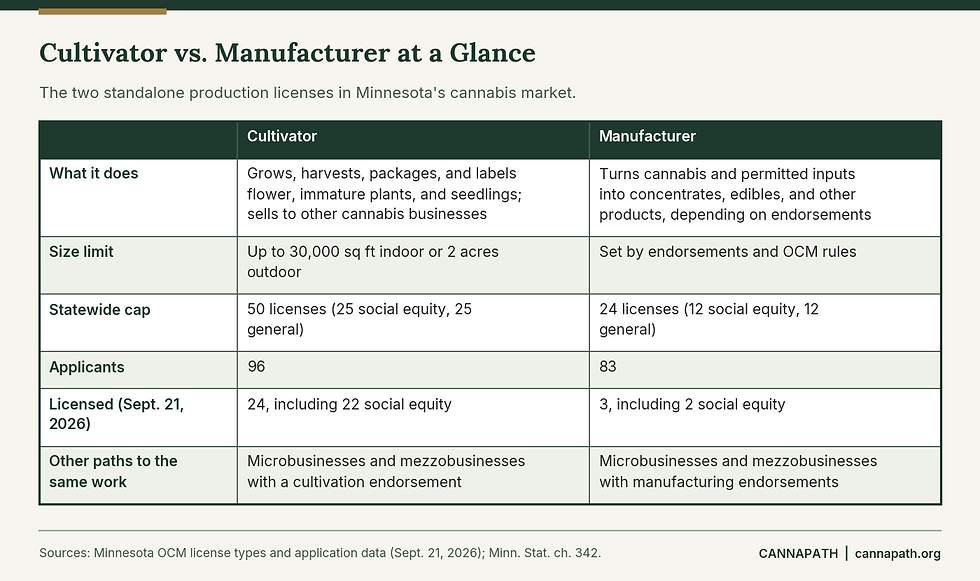
Minnesota caps both of the standalone production licenses. The state can issue up to 50 cultivator licenses and up to 24 manufacturer licenses, each split evenly between social equity and general applicants.
As of September 21, 2026, OCM reports 96 cultivator applicants. Twenty-four cultivator licenses have been issued, 19 more applicants are preliminarily approved, seven are qualified, and 43 were not selected in the lottery. One detail stands out: 22 of those 24 licensed cultivators are social equity businesses.
On the manufacturing side, OCM reports 83 applicants for the 24 manufacturer licenses. Three licenses have been issued, 17 applicants are preliminarily approved, four are qualified, and 54 were not selected in the lottery.
Those numbers need context. Minnesota doesn’t require every business that grows cannabis or makes cannabis products to hold one of these standalone licenses. Microbusinesses and mezzobusinesses can do both with the right endorsements, and most cultivation in the state is happening under those licenses.
So three standalone manufacturers does not mean Minnesota has only three businesses making cannabis products. It does tell us the standalone manufacturer license is a specialized part of the market, and that specialization comes with a matching compliance burden.
Cultivators are moving from licensing into operations
The standalone cultivator license is narrow compared with the microbusiness and mezzobusiness structures. A cultivator can grow cannabis from seed or immature plant through maturity, harvest flower, package and label flower and immature plants or seedlings, and sell those products to other cannabis businesses. The license allows up to 30,000 square feet of indoor canopy or up to two acres of mature flowering plants outdoors.
But the standalone license count misses the bigger story. OCM reports that nearly three-quarters of license holders endorsed for cultivation are microbusinesses, and that 95 newly licensed cultivating businesses entered the market in June, July, and August 2026 alone, about 60% of every business now growing cannabis in Minnesota.
That is a significant shift. Minnesota is moving from a market where cultivation lived mostly inside the state’s established medical cannabis businesses to one where a much broader group of independent operators is growing for the adult-use supply chain. We covered that shift in depth in The Current State of Minnesota Cannabis Cultivation, so here we’ll focus on where cultivation hands off to manufacturing.
OCM’s April 2026 guidance is a good example of how practical the questions have become. The agency clarified that licensed cultivators may buy immature plants and seedlings from other authorized cannabis businesses, and must record those purchases and sales in Metrc using the standard wholesale transfer process. For a cultivator, the question isn’t just whether a transaction is allowed. It is whether the business can show where a plant came from, how it entered inventory, where it went next, and whether the physical inventory matches the records.
The plant is only the beginning
Minnesota’s statewide monitoring system follows cannabis from cultivation through processing, testing, distribution, and sale. OCM describes it as a closed-loop system meant to make sure every product in the market was legally sourced, grown, manufactured, and sold.

That creates a very different compliance environment from traditional agriculture or ordinary food production. A cultivator can’t treat compliance as something that happens once a crop is ready for harvest, because compliance is being created throughout the crop cycle.
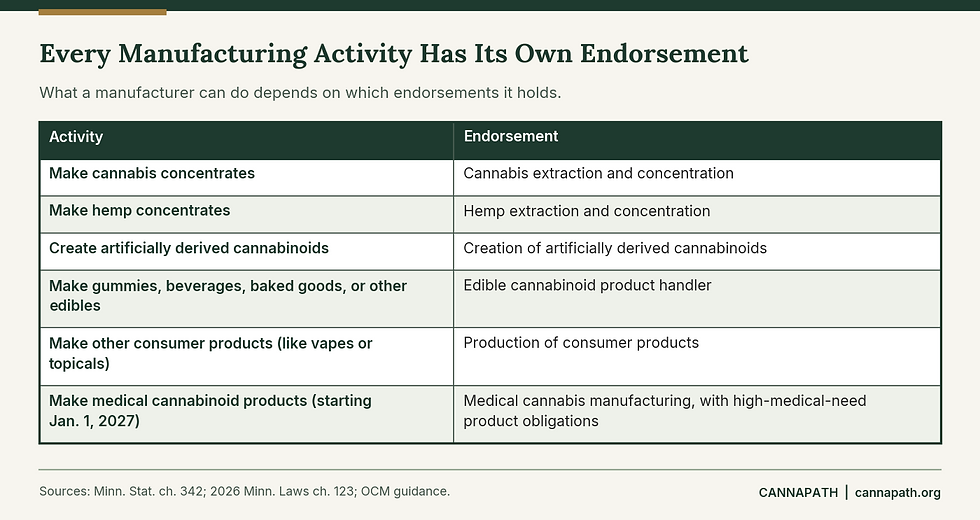
For manufacturers, it gets even more layered, because raw cannabis and other permitted inputs are being turned into finished products. Depending on its endorsements, a manufacturer may do cannabis extraction and concentration, edible production, production of consumer products, hemp extraction, or creation of artificially derived cannabinoids. Those products then face packaging, labeling, testing, inventory, and transfer requirements before they can move further through the supply chain.
In practical terms, a manufacturer operates somewhere between a regulated food plant, a controlled manufacturing facility, and a cannabis compliance operation. That combination matters.
Manufacturing may be the smallest category, but not the simplest
A production recipe can change. An ingredient can change. A batch can fail. A piece of equipment can be taken out of service. A supplier can change. A test can come back out of specification. And a product may need to be held, remediated with OCM’s approval, destroyed, or otherwise accounted for.
Every one of those events can create a compliance obligation.
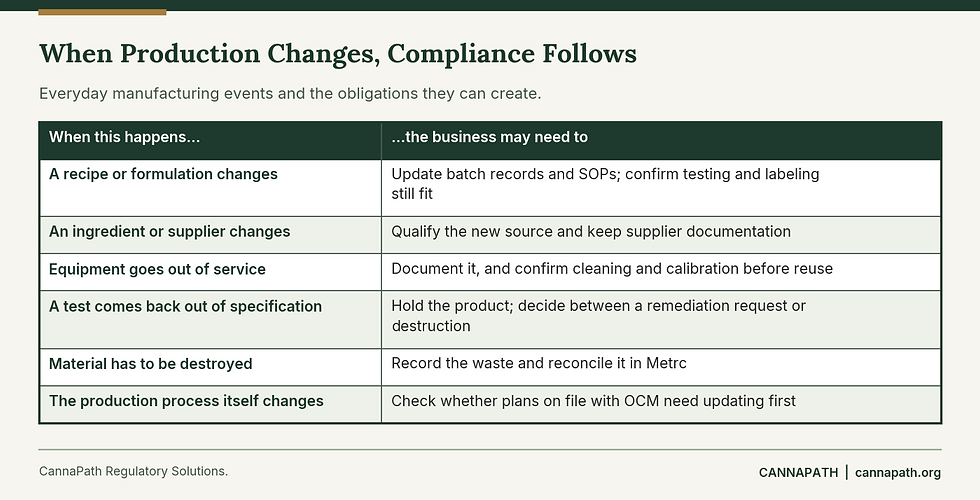
Manufacturers have to show control over raw materials, production processes, finished goods, equipment, sanitation, facility controls, inventory movement, batch records, testing, and release decisions. The more complicated the product and the process, the more it matters that the business can reconstruct exactly what happened after the fact.
That is where documentation stops being paperwork and becomes operational infrastructure.
Making edibles means following food rules
The “regulated food plant” comparison isn’t a figure of speech. It is written into Minnesota law.
Anyone who manufactures, processes, handles, or stores an edible cannabis product before it is in final packaging needs an edible cannabinoid product handler endorsement. OCM issues it to license holders at no extra cost, and the statute requires OCM to regulate those handlers in a way that is consistent with how the Minnesota Department of Agriculture regulates food handlers.
There is one rule in particular that surprises people coming from food manufacturing. Edible cannabis products can’t be manufactured at the same premises where regular food is manufactured, except for limited batches made only for product development, sampling, or testing. That limit doesn’t apply to lower-potency hemp edibles, which can share a facility with food.
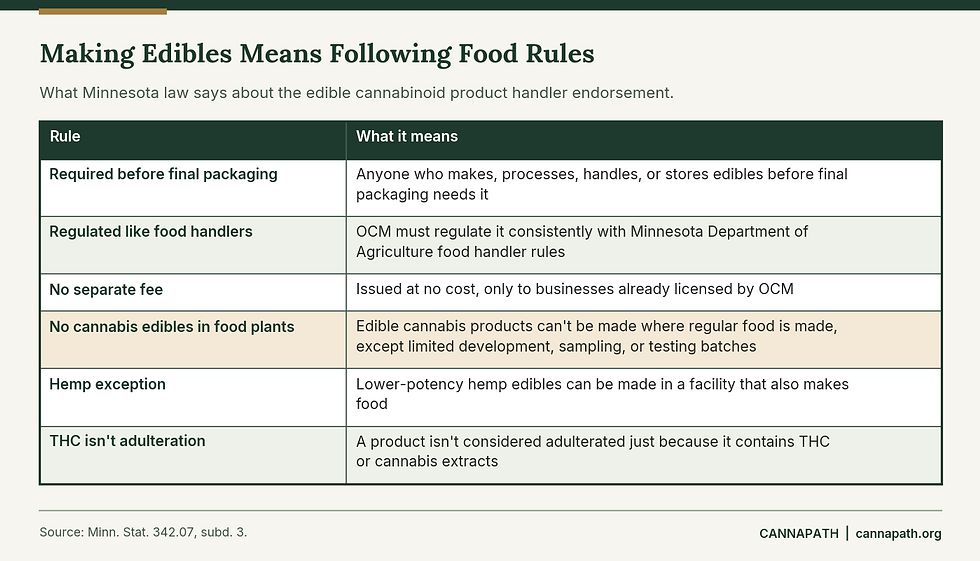
So a manufacturer making gummies, beverages, or baked goods is running a food-safety program and a cannabis compliance program at the same time, and they have to agree with each other. Sanitation, allergen control, ingredient handling, and batch records aren’t side topics. They are part of the license.
Testing is where production meets the rest of the supply chain
Minnesota requires cultivators and manufacturers to follow OCM’s sampling requirements and to contract with an OCM-licensed testing facility for required testing. OCM’s technical standards cover potency and contaminants including pesticides, microbes, heavy metals, toxins, and residual solvents, and results are reported through Metrc.
Manufactured products carry their own testing path. Finished products need potency and microbial testing, homogeneity testing for products with serving units, and stability testing in their final packaging to support an expiration date. Until the data support something longer, products carry a six-month expiration. Edibles also have to stay within 10 milligrams of THC per serving and 200 milligrams per package.
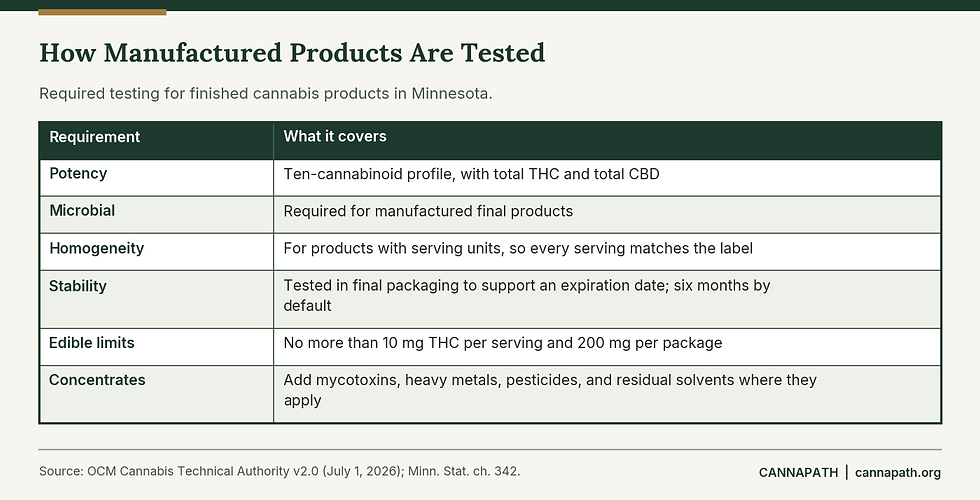
For a cultivator, a failed or questionable result can affect an entire batch. For a manufacturer, the impact can spread across multiple products or production runs, depending on how the affected material was used. We looked at the lab side of this in The Current State of Cannabis Testing in Minnesota, including the testing bottleneck producers dealt with earlier this year.
That is why a mature compliance program doesn’t treat testing as a box to check right before a product goes to market. The stronger model builds testing into production planning, sampling, inventory control, batch management, and release decisions from the start. That is the difference between reacting to a compliance problem and running an operation that prevents one.
When a batch fails
Failures happen, and Minnesota has a defined process for them.
When a product fails its initial testing, the license holder may ask OCM to approve a remediation plan, meaning a process that removes or reduces a contaminant or an excess cannabinoid. OCM reviews each request case by case, and it has to give explicit approval before any remediation begins. The business must then record the remediation steps and the results of the retest in Metrc. A product that isn’t approved for remediation, or that fails again, doesn’t go to market.
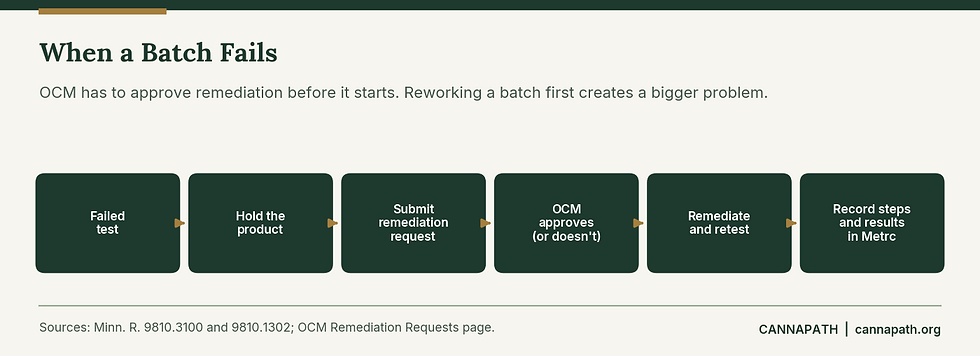
For a manufacturer, the important word there is “before.” A well-meaning production lead who reworks a failed batch without approval has created a much bigger problem than the original test result.
The rules are still changing
There is another reason this part of the market deserves attention right now: Minnesota’s cannabis framework is still moving.
Legislation passed in the 2026 session created the new cannabis macrobusiness license and changes the relationship between the state’s medical and adult-use supply chains. The medical cannabis combination business transitions to the macrobusiness structure on January 1, 2027. The same law reorganizes cultivation and manufacturing endorsements and creates a medical cannabis manufacturing endorsement, which comes with an obligation to produce the high-medical-need products OCM identifies.
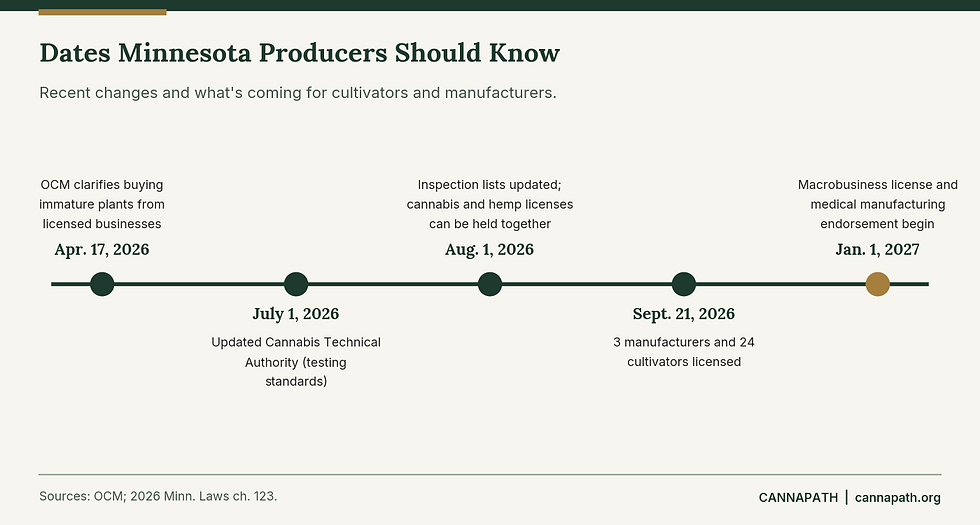
For established operators, that means licensing can’t be treated as a one-time project. A business may have been compliant when it opened and still need to reassess its operation when the law, OCM guidance, or its own business model changes.
That matters especially for cultivation and manufacturing, because these businesses have more physical infrastructure, equipment, inventory, and procedures tied directly to their licenses than most other cannabis businesses. A change that looks small on paper can have a real effect on the floor.
Keeping the operation connected
This may be the biggest lesson coming out of Minnesota’s cultivation and manufacturing market. The hard part usually isn’t knowing that a rule exists. It is making sure the whole business runs according to it.
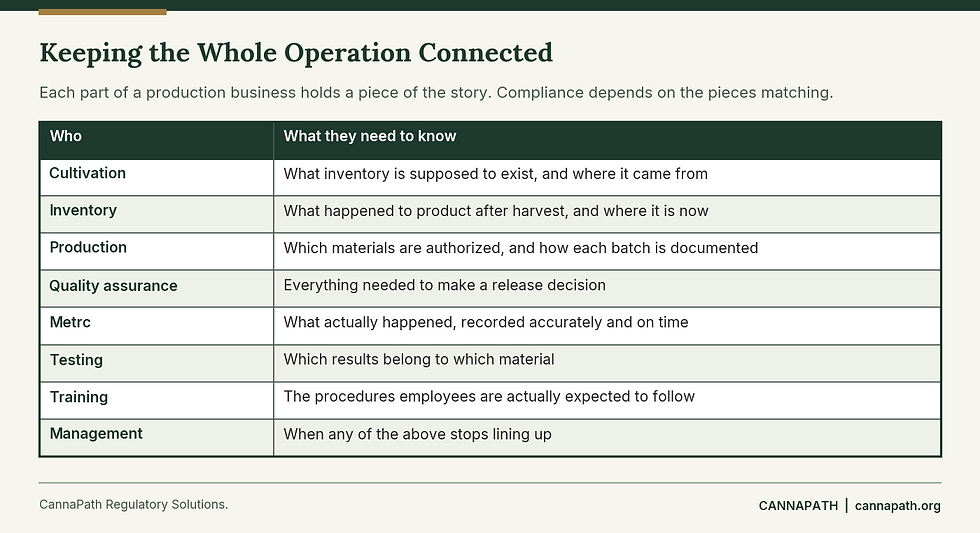
And management needs a way to know when one of those pieces stops lining up. That is where compliance becomes an operating system instead of a binder on a shelf.
OCM’s pre-license inspection materials make the same point indirectly. The inspection lists go well beyond a single licensing question. They cover the physical premises and the broader operational requirements that have to be in place before a business opens, and routine compliance inspections continue after licensure. The current cultivator and manufacturer inspection materials were updated August 1, 2026.
So for a new cultivator or manufacturer, the goal shouldn’t simply be to pass the pre-license inspection. It should be to build an operation that would still make sense if an inspector walked through the facility six months later.
Frequently asked questions
How many cannabis manufacturer licenses does Minnesota allow?
Minnesota caps standalone cannabis manufacturer licenses at 24, split evenly between social equity and general applicants. As of September 21, 2026, OCM reports three issued and 17 applicants preliminarily approved.
Is the Minnesota cannabis cultivator license capped?
Yes. Minnesota caps cultivator licenses at 50, split evenly between social equity and general applicants. As of September 21, 2026, 24 have been issued, and 22 of those are held by social equity businesses.
Do you need a manufacturer license to make cannabis products in Minnesota?
No. Microbusinesses and mezzobusinesses can also manufacture cannabis products if they hold the right endorsements. The standalone manufacturer license is one of several paths.
Can cannabis edibles be made in a regular food facility in Minnesota?
No. Edible cannabis products can’t be manufactured at the same premises where food is manufactured, except for limited batches made for product development, sampling, or testing. Lower-potency hemp edibles are the exception and can share a facility with food.
What happens when a cannabis batch fails testing in Minnesota?
The license holder may request OCM approval of a remediation plan. OCM must approve it before any remediation begins, and the business must record the remediation steps and retest results in Metrc. Product that isn’t remediated and passed doesn’t go to market.
Where Minnesota's producers go from here
Minnesota’s cannabis supply chain is no longer theoretical. The state reported more than $250 million in combined adult-use and medical sales in the first year of statewide adult-use sales, and cultivation has grown dramatically as new license holders entered the market.
The next stage is less about proving Minnesota can produce cannabis and more about proving the industry can do it consistently. That means reliable cultivation, manufacturers that can make repeatable products, and testing that keeps pace with the supply chain. Most of all, it means businesses whose records, inventory, procedures, people, and physical operations all tell the same story.
WHAT THIS MEANS FOR YOU In a regulated cannabis business, doing the right thing is only half of it. You need to be able to show it. |
That is the work CannaPath does with Minnesota cannabis businesses: turning regulatory requirements into practical operating systems that hold up on a busy production day, not just on inspection day.
Keep reading
More on where Minnesota’s cannabis market stands this fall:
One more thing. If you want a quick outside read on one piece of your program, like your batch record and product release procedure or your sanitation SOP for edible production, that is what Sentinel Scout does. Send us one module or standalone policy, plus up to three supporting documents that go with it, and we will send back a gap analysis within three business days. No contract. It is $99 through October 31 ($199 after), and the fee credits toward a larger engagement if you ever want one. You can find it at cannapath.org/sentinel.
Scout is the first piece of CannaPath Sentinel, the cannabis compliance and business operating platform we are building for full release in March 2027. If you would like to know when it is ready, email thewatch@cannapath.org.
And if you get into something you would rather not sort out alone, we are here. Reach out.
-Drew
Last reviewed September 25, 2026. OCM application and licensing figures are preliminary data published September 21, 2026 and are subject to change. Minnesota cannabis law and OCM guidance continue to evolve, including significant changes taking effect January 1, 2027. This article is for general informational purposes and is not legal advice.
Sources: Minnesota Office of Cannabis Management, including Application and License Holder Data (Sept. 21, 2026), one-year market update (Sept. 2026), Guidance Memo GM-2025-05 (updated Apr. 17, 2026), Cannabis Technical Authority v2.0 (July 1, 2026), Remediation Requests, and pre-license inspection materials (Aug. 2026); Minnesota Statutes chapter 342, including section 342.07; Minnesota Rules chapter 9810; 2026 Minnesota Laws chapter 123.