The 0.4 Milligram Problem: What the New Federal Hemp Definition Could Mean for Minnesota Products

Updated: 1 day ago
Last reviewed September 22, 2026
By Drew Duffy, MHA, FACHE, Founder & Managing Director, CannaPath Regulatory Solutions
In our last article, we looked at how dramatically Minnesota’s lower-potency hemp market has changed. Minnesota has moved from an early registration model into a licensed, regulated industry, and it continues to recognize lower-potency hemp edibles as a lawful product category under state law.
But another piece of the story deserves a lot more attention.
The federal government is changing the definition of hemp itself.
And inside that change is a number that is hard to appreciate until you set it next to the products being sold in Minnesota right now: 0.4 milligrams per container.
That is not a typo. It isn’t 4 milligrams. It isn’t 0.4 milligrams per serving. And it isn’t a federal version of Minnesota’s 5-milligram rule.
Under the amended federal definition, most of which takes effect December 12, 2026, a final hemp-derived cannabinoid product containing more than 0.4 milligrams of the covered cannabinoids per container will no longer fit the federal definition of hemp. The amended definition also changes how THC is calculated, pulls in THCA, and addresses cannabinoids that are synthesized or manufactured outside the plant.
That difference is enormous.
Start with the number
Minnesota’s lower-potency hemp framework is built around much larger amounts.
Under Minnesota law, a qualifying non-beverage lower-potency hemp edible can contain up to 5 milligrams of THC per serving, and a multiple-serving package can contain up to 50 milligrams. A beverage can contain up to 10 milligrams in a single container, and the 2026 law added a large-format beverage of at least 750 milliliters that can hold up to 17 servings of 5 milligrams each. The statute also carries additional cannabinoid and product-category requirements.
Now set that beside the coming federal definition.
The federal statute doesn’t say a serving may contain 0.4 milligrams. It says a final hemp-derived cannabinoid product containing more than 0.4 milligrams per container, combined, of total tetrahydrocannabinols (including THCA) and certain other cannabinoids that have, or are marketed as having, similar effects to THC falls outside the federal definition of hemp.
So, a Minnesota product with 5 milligrams of THC in a single serving already contains 12.5 times the federal amount, before counting any other covered cannabinoid. A 50-milligram Minnesota-compliant package contains 125 times that amount. A 10-milligram beverage contains 25 times.

Those comparisons don’t mean Minnesota products are unlawful today. They aren’t. They show how far apart the two systems are.
Minnesota asks whether a product fits its definition of a lower-potency hemp edible, and then whether it meets Minnesota’s product, testing, packaging, licensing, and other requirements.
Federal law is getting ready to ask a very different question: does this product still qualify as hemp at all?
This is where “delta-9 THC” stops being the whole story
For years, most of the hemp conversation revolved around one familiar number: 0.3% delta-9 THC on a dry-weight basis. That was the federal definition the 2018 Farm Bill created.
The amended definition changes that. It uses total tetrahydrocannabinols, including THCA, for the 0.3% standard that applies to hemp plants and intermediate products, and it expressly includes THCA in the total used for the final-product threshold.

That matters because THCA isn’t just another acronym on a lab report. THCA can convert to THC through decarboxylation, which is why USDA’s hemp testing rules already require methods that account for that conversion when they calculate total THC.
For businesses that have spent years thinking mostly about delta-9, the move to a broader total-THC framework is a big deal. A product can look harmless on a delta-9-only report and present a very different picture once THCA is counted.
That is one reason “under 0.3% delta-9” is becoming an inadequate shorthand for federal hemp compliance.
The federal law reaches the supply chain before the product reaches the customer
This part could matter most for manufacturers.
The amended statute doesn’t only set a threshold for the finished retail product. It separately addresses intermediate hemp-derived cannabinoid products. An intermediate product containing more than 0.3% combined total of the covered cannabinoids is excluded from the federal definition of hemp, and so is an intermediate product marketed or sold as a final product or directly to consumers. The law defines “intermediate” broadly enough to include materials that aren’t yet in final form and products meant to be mixed, dissolved, formulated, or otherwise worked into another product before use.

So the issue can come up well before a gummy is packaged or a beverage is canned.
Picture a manufacturer that buys a cannabinoid ingredient and later works it into a compliant Minnesota edible. Under Minnesota law, that ingredient may fit the state’s regulated hemp framework. Under the new federal definition, the ingredient itself may have a problem if it exceeds the federal threshold or falls into one of the federal exclusions.
That is one reason supply-chain documentation is likely to matter more, not less. A manufacturer may need to know a lot more than an ingredient’s name and the number on its certificate of analysis. The source, the production method, the cannabinoid composition, the testing method, and the ingredient’s regulatory status may all matter.
Then there is the “synthetic” problem, although that word doesn’t tell the whole story
This is another place where the popular discussion gets too simple.
You’ll hear people say the new federal law bans “synthetic cannabinoids.” That is directionally understandable, but the statutory language is more specific, and it actually contains two different exclusions.
The first excludes cannabinoids that the Cannabis sativa plant can’t naturally produce at all. The second excludes cannabinoids that can occur naturally in the plant when they were synthesized or manufactured outside the plant. The same ideas show up in the rules for intermediate products.
Those two exclusions don’t even share a start date. Under the September federal funding bill, according to trade coverage of it, the exclusion for cannabinoids the plant can’t produce still begins November 12, 2026, while the exclusion for naturally occurring cannabinoids made outside the plant arrives with the rest of the definition on December 11.

That is a much broader idea than asking whether somebody calls a product “synthetic.” The production method matters.
It is especially relevant for cannabinoids that occur naturally in cannabis but are produced commercially through chemical conversion or other manufacturing processes. FDA has described delta-8 THC products as commonly made by converting other cannabinoids, like CBD, through chemical synthesis, and has raised concerns about the contaminants and by-products those processes can leave behind.
Minnesota’s law is not identical to the coming federal standard. Minnesota’s current definition of a lower-potency hemp edible expressly allows artificially derived delta-9 THC under specific conditions, including limits on the ratio of delta-9 to other artificially derived cannabinoids created in the process.

That is another clear example of the state-federal mismatch. Something can satisfy Minnesota’s definition today and still run into a separate federal classification problem later.
That is why “Minnesota compliant” and “federally hemp compliant” can’t be treated as the same statement.
The word “container” matters more than it may appear
There is another detail in the statute that deserves attention. The 0.4-milligram threshold is measured per container.
Federal law defines the container as the innermost wrapping, packaging, or vessel in direct contact with the final hemp-derived cannabinoid product and enclosed for retail sale to consumers. The statute’s examples include a jar, bottle, bag, box, packet, can, carton, or cartridge. Bulk shipping containers and certain outer wrappings are excluded.

That may sound like a packaging technicality. It isn’t. Businesses will need to understand exactly what federal law treats as the retail container when they evaluate a product’s cannabinoid content.
It is also important not to assume that changing the packaging solves a product’s federal classification problem. The product itself, its cannabinoid composition, how it was made, and the statutory definition all still matter.
For a manufacturer, that can become a product-development issue. For a wholesaler, a supply-chain issue. For a retailer, an inventory issue.
What about cannabinoids other than THC?
This may turn out to be one of the most complicated pieces of the new definition.
The statute doesn’t stop at tetrahydrocannabinols. It also reaches other cannabinoids that have similar effects to THC, or are marketed as having similar effects, as determined by the Secretary of Health and Human Services. Those cannabinoids count toward both the 0.3% standard for certain hemp materials and the 0.4-milligram-per-container total for final products.
That is a moving part, because the statute doesn’t give a permanent, closed list of every cannabinoid that will count.
The 2025 law directed FDA, working with other federal agencies, to publish lists of the cannabinoids the plant naturally produces, the THC-class cannabinoids known to occur naturally, and other cannabinoids with similar or marketed-similar effects to THC, along with more detail on what “container” means. Those were due within 90 days, by February 10, 2026. According to the Congressional Research Service, FDA had still not published them as of August 2026.
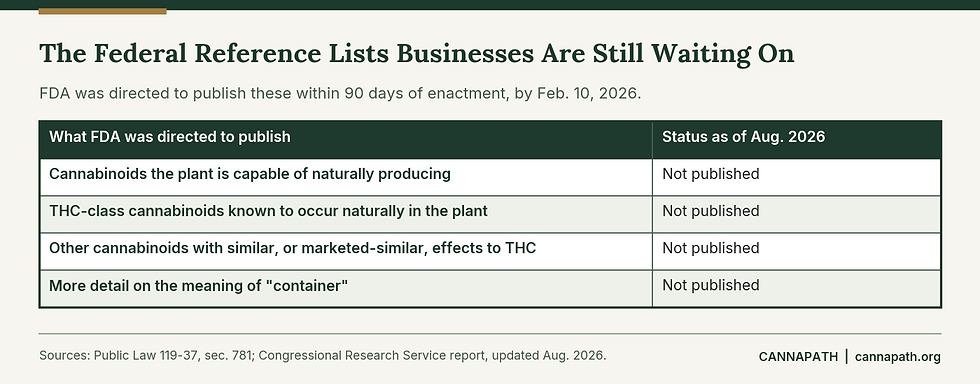
So businesses are being asked to plan for a definition whose own reference lists haven’t been released.
For a business, that means the analysis can’t stop at the front of the package. A formula containing delta-9 THC, CBD, CBG, THCA, or another cannabinoid isn’t necessarily evaluated one ingredient at a time. The federal definition is starting to look much more like a whole-product classification exercise.
This is why Minnesota’s position is so important
OCM has been very direct about the situation.
The federal change doesn’t change Minnesota’s definition of a lower-potency hemp edible. OCM says Minnesota’s LPHE definitions, and the legality of qualifying LPHE products under Minnesota law, will continue after the federal definition changes on December 11, 2026.
That statement matters because it heads off one of the most common misunderstandings. The federal government isn’t changing Minnesota’s statute. Minnesota hasn’t rewritten its 5-milligram or 10-milligram rules to become 0.4 milligrams.
Instead, the two systems are moving farther apart. Minnesota can keep authorizing a product under state law while the federal government no longer considers that product hemp.
And that leaves an uncomfortable space in between.
A state license can’t change federal classification
This may be the single most important operational point for Minnesota hemp businesses.
A Minnesota LPHE license authorizes a business to do what Minnesota law permits. It doesn’t create federal hemp status.
OCM’s guidance specifically warns that products that comply with Minnesota law may become federally noncompliant after the federal change, and it points to possible consequences for federally insured banking and financial services, point-of-sale services, federal tax deductions, and interstate commerce.

That doesn’t mean every bank account closes on December 11, or every payment processor ends service, or every Minnesota hemp company becomes illegal under every federal law at midnight. Those conclusions go well beyond what the evidence shows today.
What OCM is saying is that federal noncompliance creates business and legal risk that state licensure doesn’t remove.
That distinction is critical.
Interstate commerce gets especially complicated
Minnesota’s hemp licensing system lets certain businesses import qualifying products and export qualifying hemp products to places where those products meet the local requirements. OCM has specifically cautioned businesses holding those interstate endorsements that the federal change could materially affect that part of the market.
That makes sense once the two definitions sit side by side. A product made in another state may satisfy Minnesota’s requirements and qualify for Minnesota’s LPHE system. But if that same product no longer qualifies as hemp under federal law, moving it across state lines raises a different legal question.
The same thing can happen in reverse. A Minnesota manufacturer may have a product that stays legal to make and sell inside Minnesota under state law, while its interstate status gets much harder to evaluate once federal hemp status changes.
For companies built around national distribution, that could matter a lot more than what happens on a Minnesota retail shelf.
The FDA issue doesn’t disappear either
There is another reason to resist the idea that this is just a federal “hemp definition” problem.
FDA has separately taken the position that the federal Food, Drug, and Cosmetic Act restricts certain cannabinoid products marketed as conventional food. It has specifically said that delta-8 THC added to conventional food is an unapproved food additive, and it has kept issuing warning letters over those products.
So federal legality has never been settled by the line that used to appear in every hemp pitch deck: “It’s under 0.3% delta-9.” Multiple federal statutes and agencies are involved. The new hemp definition adds another major layer. It doesn’t erase the others.
So what does the federal change mean for a Minnesota product?
It depends on the product.
That may sound frustratingly simple, but it is the key point. A Minnesota business shouldn’t look at its whole catalog and ask whether “hemp” survives. It should ask what happens to each product and each ingredient pathway.

A product with 5 milligrams of delta-9 THC per serving can be a compliant Minnesota LPHE today, and that still doesn’t answer whether it meets the federal definition after December 11. A product containing THCA needs a different look, because the federal definition counts THCA in total THC. A product made with a cannabinoid that was chemically converted outside the plant raises a different issue again. An intermediate ingredient raises its own issue under the separate 0.3% threshold. And a product containing other cannabinoids marketed as producing THC-like effects may need further analysis as federal agencies decide how those are treated.
This is no longer a one-number compliance exercise.
There is still time, but the clock is real
As of September 22, 2026, most of the federal change takes effect December 11, 2026, unless Congress acts again.
That date isn’t speculative. Congress already moved the original November 12 date to December 11 in a stopgap funding bill signed in early September, and OCM has updated its guidance to match.
Federal bills have also been introduced that could change things again. OCM identifies the Lawful Hemp Protection Act, which would create a different federal structure for hemp-derived consumer products, and the Beverage Regulatory Parity Act, which would treat hemp beverages separately. Neither has become law.
That is important context, but it shouldn’t be confused with the law on the books. A business should make decisions based on enacted law and verified requirements and keep watching the proposals.
That may sound obvious. In this market, it isn’t.
The most important question may be what happens before December 11
The temptation for a business owner is to wait. Federal legislation could change. Guidance could change. A pending bill could move. A new interpretation could emerge.
All of that is possible. But waiting doesn’t remove the need to understand the products already in the business.
OCM is already encouraging businesses to evaluate their options before the federal change, and to think through the consequences for banking, payment systems, federal taxes, and interstate commerce, all while it keeps implementing Minnesota’s Chapter 342 requirements.

For manufacturers, the federal question belongs in product development conversations now. For wholesalers, it belongs in supplier and purchasing conversations. For retailers, it belongs in inventory and vendor conversations.
Not because Minnesota has declared these products illegal. It hasn’t. The reason is simpler than that: the legal definition that lets the product exist as hemp is changing.
This is where hemp compliance starts to look like compliance everywhere else
One thing we’ve seen again and again in regulated industries is that compliance problems rarely happen because someone has never heard of the rule.
They happen because one part of the business is working from one assumption while another part is working from a different one.

That is especially true here. A purchasing employee sees a supplier’s certificate of analysis and concludes the ingredient is compliant. A product developer looks at the finished formula and concludes it meets Minnesota’s LPHE limits. A retailer looks at the Minnesota license and concludes the product is authorized for sale. Finance assumes state licensure settles the banking question. Shipping assumes Minnesota authorization makes interstate movement fine.
Each of those assumptions makes sense on its own. They don’t necessarily answer the same legal question.
That is the compliance challenge now emerging for Minnesota hemp businesses. The question is no longer just whether a product is “legal hemp.”
WHAT THIS MEANS FOR YOU The business must know which hemp definition is being applied, by whom, to which material, at which point in the supply chain, and under which law. That is a much harder question, and it is the one that matters most. |
What happens next?
The federal hemp amendment has created a deadline. It hasn’t created certainty.
Minnesota is continuing to regulate and license the lower-potency hemp market. Businesses can still operate under Minnesota law. The state keeps adjusting its framework, and the Legislature has already created new hemp-related product categories that take effect in 2027. At the federal level, meanwhile, the definition of hemp is scheduled to get much narrower on December 11, 2026.
So the next phase of the hemp market is unlikely to be one sweeping decision that hits every company the same way. It is going to be about products, formulas, ingredients, manufacturing methods, testing, packaging, distribution, and business structure.
And that is where the details start to matter.
In our next lower-potency hemp article, we’ll get into one of the most practical pieces of that puzzle: the certificate of analysis. We’ll look at what a COA tells a Minnesota hemp business, what it doesn’t, why testing a finished product is different from understanding an ingredient, and why “we have a COA” isn’t the same thing as proving a product is compliant.
One more thing. If you want a quick outside read on one piece of your program, like your supplier qualification procedure or how you review incoming COAs, that is what Sentinel Scout does. Send us one module or standalone policy, plus up to three supporting documents that go with it, and we will send back a gap analysis within three business days. No contract. It is $99 through October 31 ($199 after), and the fee credits toward a larger engagement if you ever want one. You can find it at cannapath.org/sentinel.
Scout is the first piece of CannaPath Sentinel, the cannabis compliance and business operating platform we are building for full release in March 2027. If you would like to know when it is ready, email thewatch@cannapath.org.
And if you get into something you would rather not sort out alone, we are here. Reach out. We are here if you need us.
-Drew
Last reviewed September 22, 2026. This article is for general informational purposes and is not legal advice. Federal and Minnesota hemp laws, regulations, guidance, and pending legislation continue to develop, and businesses should get legal advice for product-specific questions.
Primary sources: Public Law 119-37, section 781; Minnesota Statutes chapter 342, including section 342.01, subdivision 50; 2026 Minnesota Laws chapter 123; Minnesota Office of Cannabis Management, Federal Hemp Changes (updated Sept. 2026); U.S. Department of Agriculture hemp testing rules; U.S. Food and Drug Administration; Congressional Research Service (Aug. 2026).