The Current State of Minnesota Cannabis Cultivation

Last reviewed September 23, 2026
By Drew Duffy, MHA, FACHE, Founder & Managing Director, CannaPath Regulatory Solutions
Minnesota cannabis cultivation has entered a very different phase than the one we were talking about a year ago.
For a long time, cultivation was mostly a planning exercise. Businesses worked through licensing, property, local approvals, cultivation plans, and facility design while everyone waited for the legal market to become an operating one. There was a tremendous amount of talk about what Minnesota would look like once cannabis was being grown and sold at real scale.
We now have a much better answer.
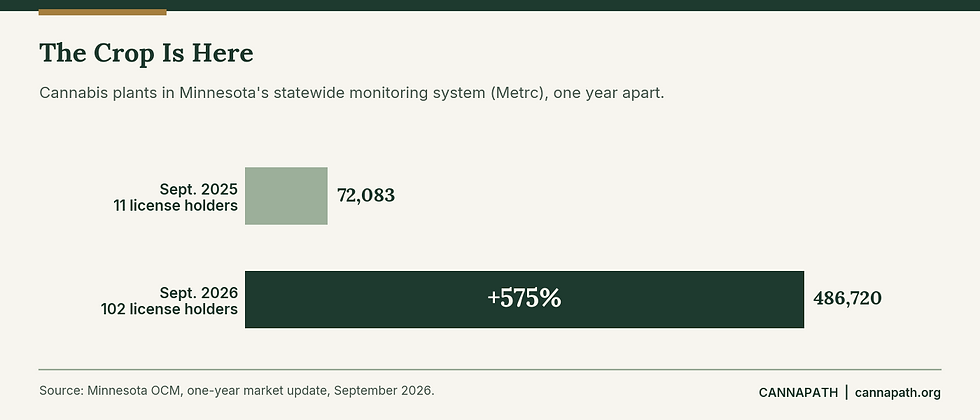
Adult-use sales began at state-licensed businesses on September 16, 2025. One year later, the state reports more than $250 million in combined adult-use and medical sales, about 3,000 pre-licensure, routine, and regulatory inspections, and a dramatic jump in cultivation. The number of cannabis plants in the state’s seed-to-sale system grew from 72,083 at 11 license holders to 486,720 at 102 license holders, a 575% increase. OCM also reported 95 newly licensed cultivating businesses in June, July, and August 2026 alone, which is 60% of all the businesses now growing cannabis in Minnesota.

That last number is particularly important.
Minnesota is no longer waiting for cannabis cultivation to arrive. The crop is here.
And now the industry gets to deal with the much less glamorous question of what happens when all of those plants have to become compliant, testable, saleable inventory.
Minnesota’s cultivation market is being built by smaller operators
One of the most interesting things about the Minnesota market is the role small cultivation businesses are playing.
According to OCM, nearly three-quarters of license holders endorsed for cultivation are microbusinesses, and the agency reads that as a sign that small and craft businesses are forming the foundation of Minnesota’s cultivation industry.
That is significant because it says something about the intended shape of the market.
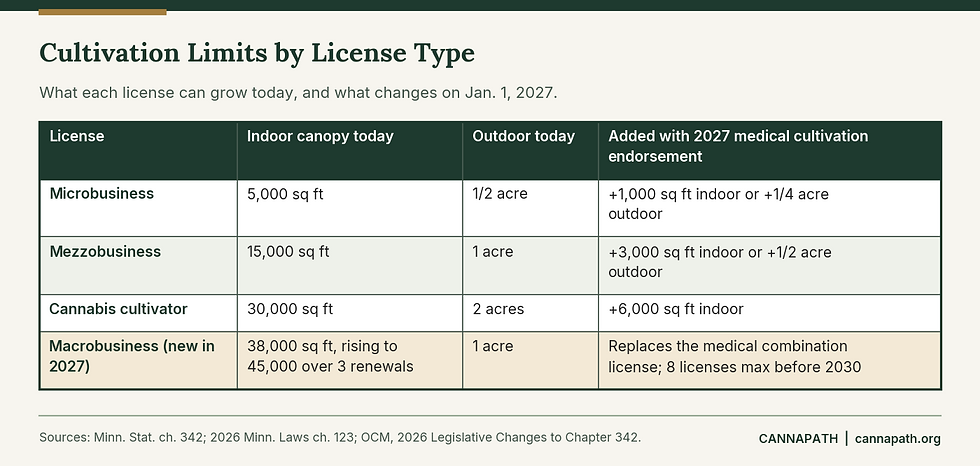
Minnesota didn’t build its licensing structure around a handful of enormous commercial grows. It created several ways to take part in cultivation, including the microbusiness, the mezzobusiness, and the dedicated cultivator. A microbusiness can currently grow up to 5,000 square feet of indoor plant canopy or one-half acre of mature flowering plants outdoors. A mezzobusiness can grow up to 15,000 square feet indoors or one acre outdoors, and a dedicated cultivator up to 30,000 square feet indoors or two acres outdoors.
That creates a real opportunity for Minnesota agriculture and small business. It also creates a very common misconception.
Small does not mean simple.
A 3,000- or 5,000-square-foot operation may have far fewer employees than a major commercial facility, but the plant inventory still has to be tracked, and the cultivation plan, crop inputs, testing, security, and wastewater all still matter. Employees still have to be trained. Records still have to exist.
The regulator doesn’t get to look at a small operation and say, “Well, you’re little, so we’ll expect less.”
The physical scale may be different. The responsibility is the same.
The biggest change is that cultivation is becoming an operating discipline
Minnesota’s cultivation rules are very clear on one point that is easy to underestimate: a licensed cultivator can’t get a license, build a facility, and then run the business however it chooses.
The cultivator has to submit a cultivation plan, and the rules allow the business to conduct only the activities OCM approved through that plan. The plan has to describe the actual operation, and changes to business activities can trigger additional review.
That matters much more now than it did when businesses were preparing applications, because real cultivation businesses change.
A room meant for one purpose may make more sense for another. A facility adds equipment. A grower changes production methods. Irrigation gets redesigned, storage moves, security gets modified, or the business decides to add an activity that wasn’t part of its original model.
In ordinary agriculture, most of those are just management decisions. In regulated cannabis, the question is different. It becomes whether the operation still matches what the state understands and approved.
That is why I expect cultivation compliance to become less about having a giant binder and more about having a functioning management system. The business has to know what it is doing, why it is doing it, who is responsible, and whether the documented plan still reflects reality.
That last part is where a lot of businesses eventually get into trouble. The facility changes, the people change, and the processes change, but the paperwork doesn’t. Eventually the two stop matching.
Metrc has moved from “software” to part of the crop
Another major shift is that Minnesota’s seed-to-sale tracking system is no longer something businesses are preparing to use someday. It is part of everyday cultivation.
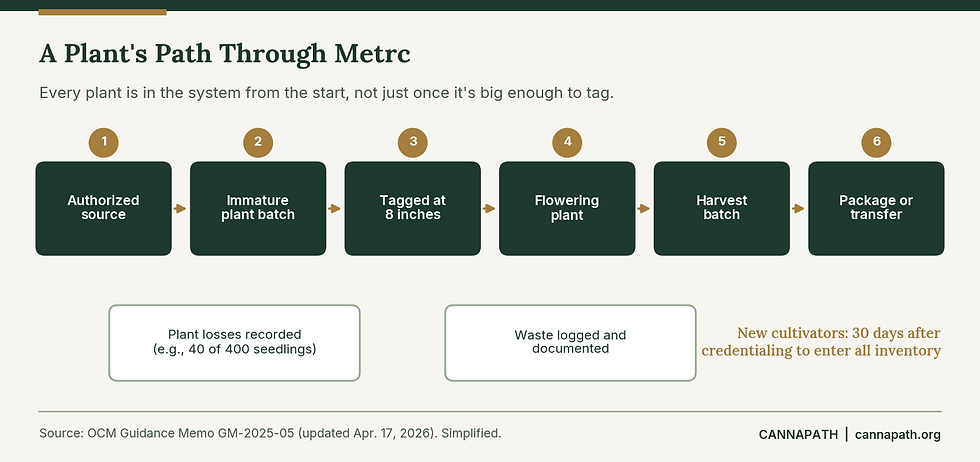
Minnesota runs a closed-loop cannabis system, meaning cannabis in the regulated supply chain has to be traceable from its authorized source through cultivation and on into manufacturing, retail, or another authorized destination. OCM’s cultivation-source guidance requires propagative material to come from an authorized source, and newly credentialed cultivators have 30 days to enter their existing inventory into Metrc.
There is an important detail here that is easy to miss.
A plant doesn’t suddenly become “real” in Metrc only once it is big enough to tag. OCM explains that all plants must enter the system as immature plant batches, whether they came from seed or clones. Once genetic material reaches eight inches tall or wide, it has to be individually tagged, but smaller plants still have to be accounted for in inventory.
That distinction matters operationally. A grower can have an excellent biological understanding of what is happening in a room and still have a poor inventory-control system. They aren’t the same thing.
If a propagation room holds 400 seedlings, the business needs to know what those 400 plants are. If 40 don’t survive, that loss has to be recorded properly. When plants move into another stage of production, the transition has to make sense. And when plants are harvested, the resulting material has to stay connected to the right batch and inventory records.
The physical plant and the digital record need to tell the same story. That is becoming one of the central realities of Minnesota cultivation.
The genetics supply chain is becoming more important, too
Minnesota has also tightened the question of where cultivation material comes from.
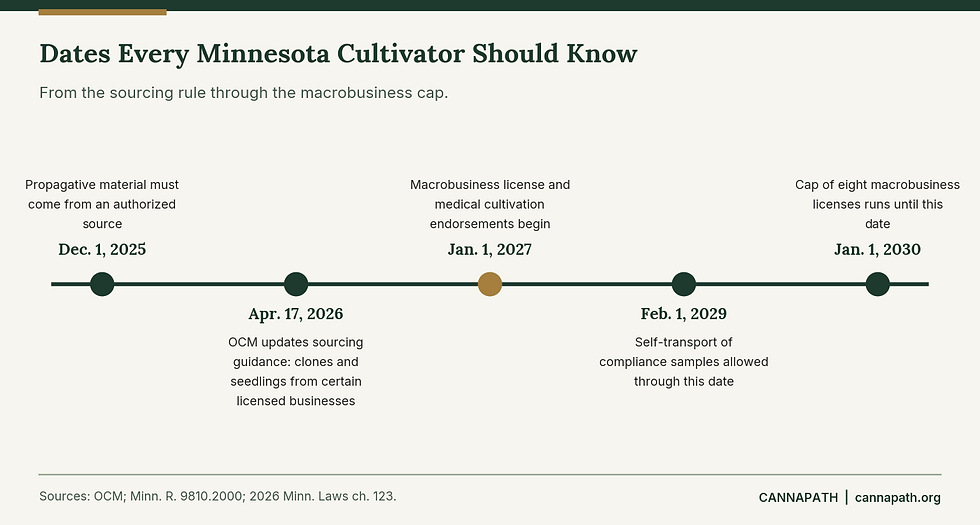
Since December 1, 2025, cultivators have had to obtain propagative material from an authorized source. After the initial 30-day window, a business has three options: use its own internal genetics, buy clones from certain other licensed cannabis businesses (which OCM clarified in April 2026 includes immature plants and seedlings), or buy seeds from a commercial seed seller.
For a cultivator, that means genetics aren’t just a horticultural purchasing decision anymore.
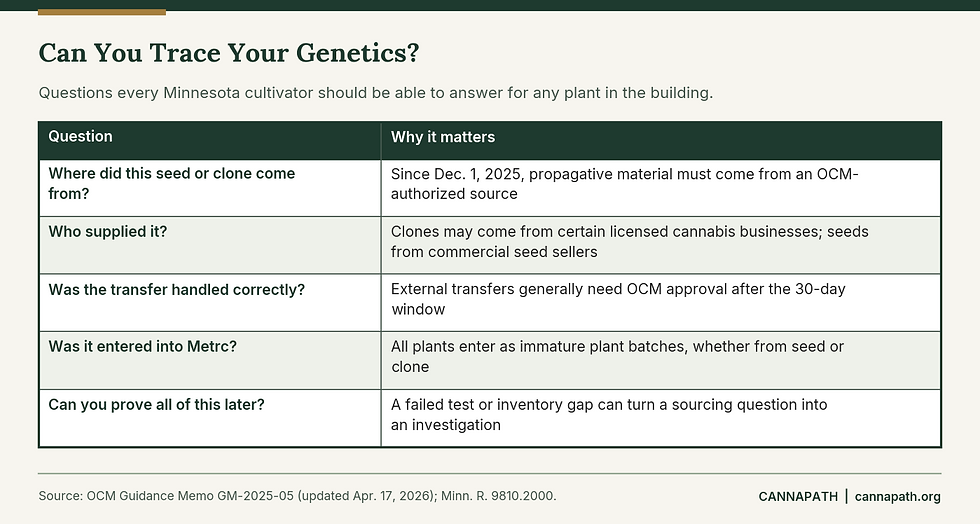
Those questions matter most when a crop eventually runs into a problem. A failed test, a quality concern, or an inventory discrepancy can turn a simple question about where a plant came from into a much bigger investigation.
Good cultivation records do more than demonstrate compliance. They let the cultivator reconstruct what happened.
Crop inputs are not an afterthought
This is another area where cannabis cultivation increasingly looks different from ordinary commercial farming.
Cultivators work with fertilizers, soil amendments, plant amendments, and pest-control products, but cannabis isn’t just another crop when it comes to what can be applied to it. Minnesota law requires cannabis cultivation businesses to follow the applicable agricultural chemical and pesticide laws, and the 2026 legislation reinforces the Minnesota Department of Agriculture’s role here. MDA also warns that cannabis growers have limited pesticide options and offers guidance on products that may potentially be used based on their labeling and other requirements.
The practical takeaway is pretty straightforward: “We’ve always used this product” is not a compliance justification.
Minnesota’s cultivation record requirements make this even more important. State law requires cultivation records for each batch, kept for at least five years, including the pesticides, fertilizer, soil amendments, and plant amendments used on it.
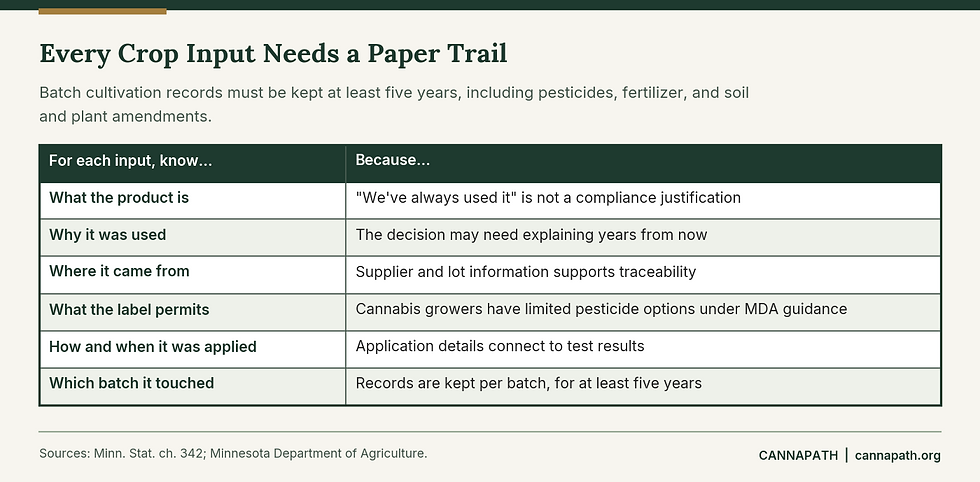
That is a long memory. A decision made today may still have to be explained years from now.
Testing is where the grower finally meets the consumer
For a cultivator, testing can feel like something that happens after the hard work is done. In reality, it should shape how the crop is managed from the start.
Minnesota’s current Cannabis Technical Authority, updated July 1, 2026, sets testing requirements for cannabis and hemp products and covers both safety and potency. OCM’s testing standards are designed to catch contaminants like pesticides, microbes, heavy metals, toxins, and residual solvents, and to provide reliable potency information. Licensed cannabis businesses must use an OCM-licensed Minnesota testing facility for required testing. The 2026 law also lets license holders transport their own compliance samples to the lab through February 1, 2029.
That puts pressure on cultivation practices long before the product reaches the lab.
A good grower doesn’t wait for a failed test to find out something in production needs attention. Environmental controls, sanitation, irrigation, crop inputs, harvesting, drying, curing, storage, and handling all become part of a quality system. The lab result may be where a problem is discovered, but the cause may have happened weeks earlier.
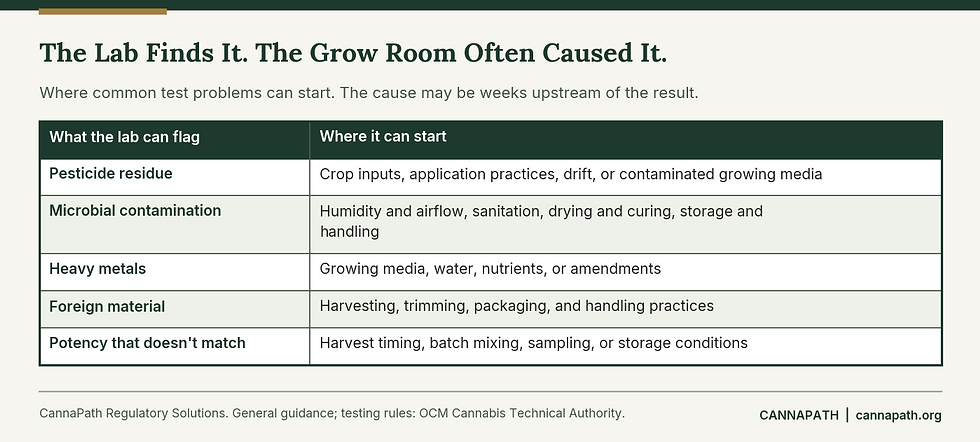
OCM’s testing framework has also kept developing through 2026. The agency updated its technical authority, issued additional lab bulletins, and clarified confirmatory testing procedures for microbial findings. That is another reason cultivators need to keep watching the regulatory environment instead of assuming the testing rules are settled.
Security has become an operational issue, not just a facility issue
When people hear “cannabis security,” they usually think first about cameras, locks, and fences. Those things matter.
But OCM’s current inspection materials show how operational security has become. The August 2026 cultivator inspection checklist covers camera performance, recording quality, timestamps, backup recording, lighting, commercial-grade locks, electronic access controls, and secured outdoor cultivation areas, which have to meet specific fencing and visibility requirements.
That changes how a cultivator should think about security. A camera on a wall, a locked door, and a six-foot fence are equipment. The security program is everything around them.
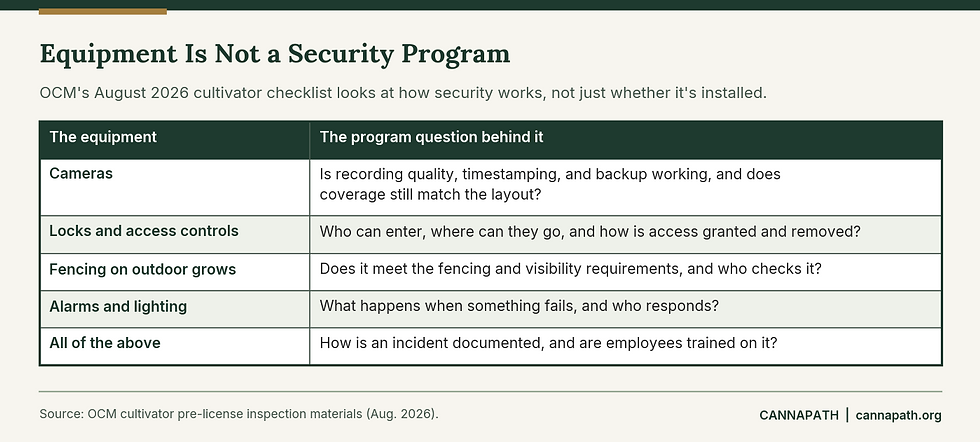
That matters more as staffing grows. The more employees an operation has, the more chances there are for ordinary human behavior to run into security controls.
Sometimes the biggest security problem in a regulated facility isn’t a sophisticated theft attempt. It is someone propping open the wrong door because their hands are full.
That is where written procedures, training, and actual management matter much more than the equipment itself.
The building matters just as much as the plants
There is also a tendency to look at cannabis cultivation mainly through a horticultural lens. That can be a mistake.
A Minnesota cultivation facility is also a building, with electrical systems, HVAC, water, drainage, ventilation, fire-safety requirements, security infrastructure, and waste streams. OCM’s pre-license process includes a full inspection after the applicant submits final plans, registers the site, and gets local government approval, and every business stays subject to routine compliance inspections after opening. The 2026 law also requires a business with a cultivation endorsement to choose whether it will grow indoors or outdoors.
That is why the inexpensive warehouse or farm property that looks perfect on paper deserves a very careful look before anyone spends money turning it into a grow.
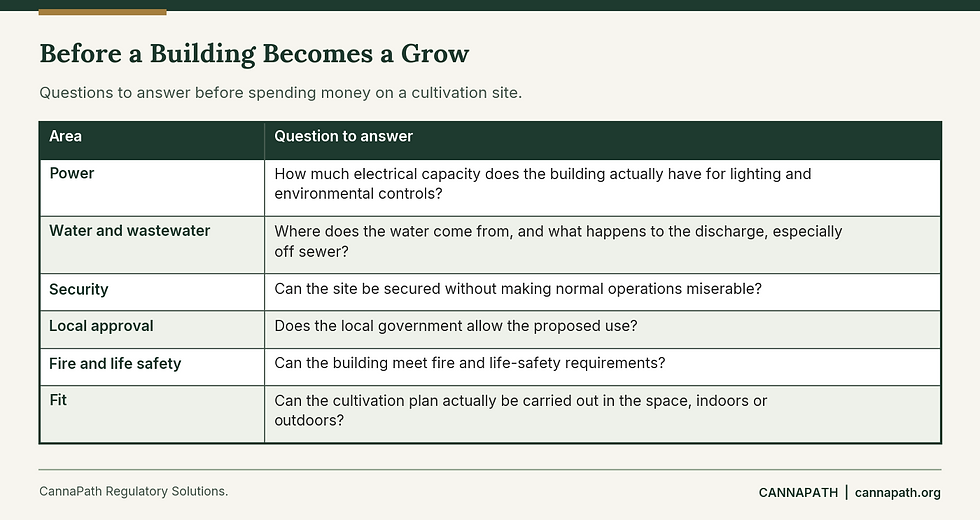
Those are business questions long before they become compliance questions.
Environmental compliance is becoming more visible
Cultivation also sits inside Minnesota’s broader environmental regulatory structure.
The MPCA notes that cannabis cultivation and processing can generate solid waste, hazardous waste, and wastewater that may contain cannabinoids, pesticides, nutrients, cleaning agents, and other contaminants. The agency also makes clear that cannabis wastewater falls under existing environmental requirements, not a separate cannabis-only system.
For indoor cultivation, that can become a surprisingly big issue. A facility may use a lot of water, generate nutrient-rich discharge, run water-treatment equipment, and produce plant material and other waste. In an unsewered location it gets more complicated, because the industrial portion of the wastewater can’t simply be treated like household sewage going into a septic system.
Outdoor cultivation brings its own questions about irrigation and environmental management. The right land for an outdoor grow isn’t necessarily the land with the best sun. Water, drainage, local requirements, security, and environmental considerations all belong in the analysis.
The economics are beginning to show themselves
Maybe the biggest difference between Minnesota cultivation in 2025 and in late 2026 is that the market now has enough activity for the economics to become visible.
The state reports more than $250 million in combined adult-use and medical sales in the first year. OCM also expects the surge in cultivation inventory to mean more flower available this fall, as manufacturers start turning more of it into concentrates and other products.
More supply is good news for the market. It also raises a question every cultivator eventually has to answer: what does it actually cost to produce compliant cannabis?
Not what it costs to grow the plant. What it costs to grow the regulated product. Those are different numbers.
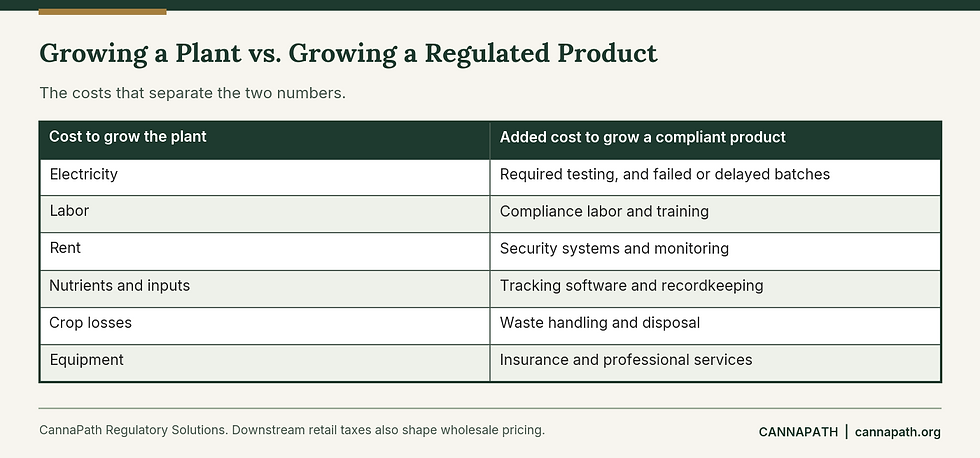
Minnesota’s retail cannabis sales also carry a 15% gross receipts tax on top of the 6.875% state sales tax and any local sales taxes. A cultivator doesn’t remit the retail tax just because it grew the flower, but those downstream costs are part of the market where wholesale prices get set.
That is why I think Minnesota’s cultivation market is entering a period of separation. The question will be less about who can grow cannabis and more about who can grow it consistently, compliantly, and economically enough to build a business that lasts.
January 1, 2027 changes the cultivation conversation
There is also a major change coming that cultivators should already be planning around.
Beginning January 1, 2027, Minnesota changes how medical and adult-use cannabis businesses fit together. The medical cannabis combination business converts to the new macrobusiness, and the state creates medical cannabis cultivation, manufacturing, and retail endorsements that qualifying businesses can add.
For cultivation, the medical endorsement comes with more canopy. A microbusiness gets an additional 1,000 square feet indoors or one-quarter acre outdoors. A mezzobusiness gets 3,000 square feet indoors or one-half acre outdoors. A dedicated cultivator gets an additional 6,000 square feet indoors.
But there is a catch, and it is an important one. OCM says a business with the medical cultivation endorsement must make sure one-quarter of its canopy supplies businesses that hold medical endorsements.
In other words, the added canopy isn’t free production capacity. There is a business obligation attached to it.
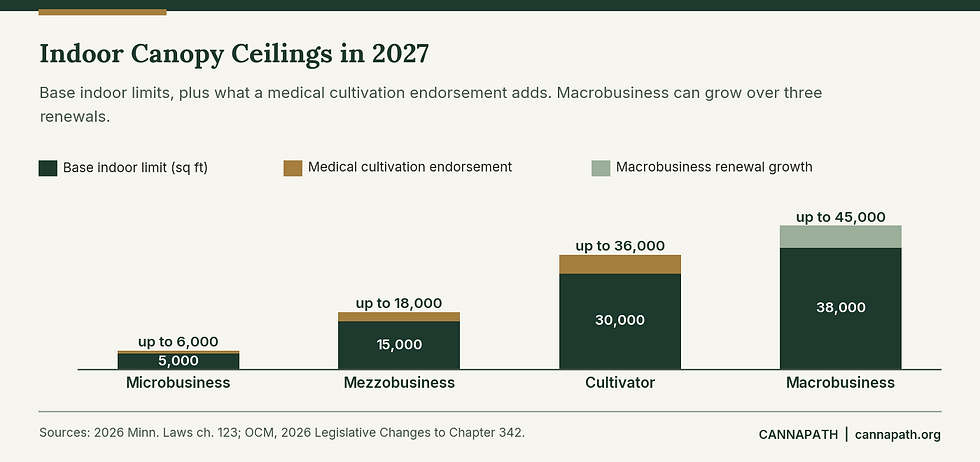
The new macrobusiness also creates a much larger cultivation category. Starting in 2027, a macrobusiness can cultivate up to 38,000 square feet indoors or one acre outdoors, growing to 45,000 square feet over its first three renewals if it stays in good standing. That is well below the 90,000 square feet the old medical combination license allowed. The law also caps macrobusiness licenses at eight before 2030.
That will create another interesting dynamic. Minnesota is encouraging smaller, craft-oriented cultivation while also setting a path for a small number of very large operators.
What that means for pricing, product availability, and competition remains to be seen. What we can say now is that the cultivation landscape will look different on January 1, 2027 than it did on January 1, 2026.
The real compliance challenge may be keeping up with your own business
There is one issue I think deserves more attention than it usually gets: compliance drift.
It is easy to think of compliance as a box you check when you get your license. You have your plans and policies, the facility was inspected, you opened the doors, and you’re done.
It doesn’t work that way.
Minnesota’s cannabis market is changing quickly. OCM keeps issuing guidance and updating operational materials. Testing standards are being clarified, cultivation-source requirements have been updated, transportation rules have changed, and new license structures and endorsements arrive in January.
At the same time, the business itself keeps changing. People leave and new people arrive. Rooms get repurposed and equipment gets replaced. Vendors change, production methods change, crops fail, new genetics come in, and the business grows.
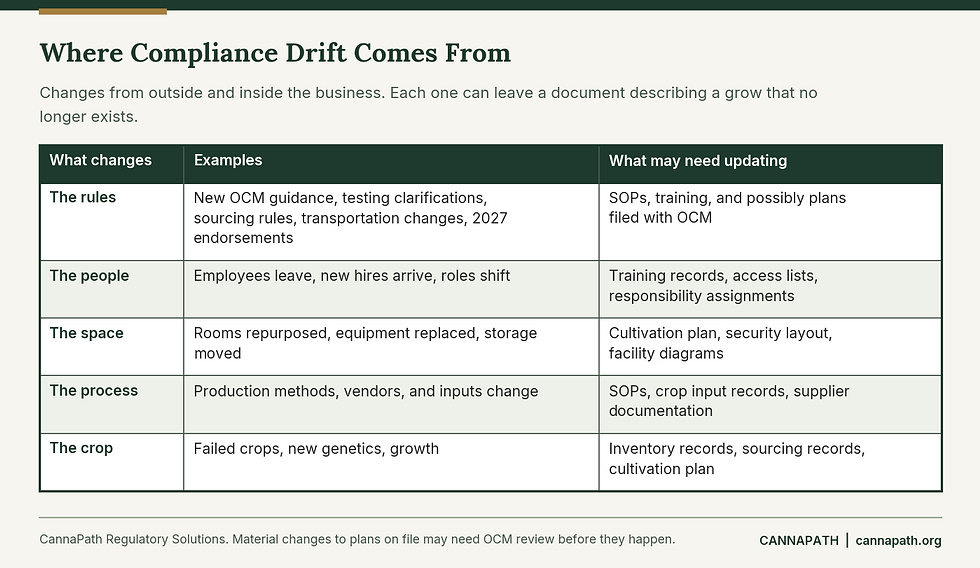
Every one of those changes is a chance for the written compliance system and the actual operation to slowly move apart. Nothing dramatic has to happen, and there may never be one big violation. The business simply gets a little different every month while the documents stay frozen in the version written before opening.
That is compliance drift. As Minnesota moves into a much more active cultivation environment, I think preventing it will become one of the most important jobs a cultivator has, not because the regulator expects perfection, but because the business needs to know what is actually happening inside its own four walls.
So where are Minnesota cultivators today?
Minnesota cannabis cultivation is in an interesting place.
It is no longer theoretical. Hundreds of thousands of plants are being tracked in the state system, dozens of new cultivators are entering the market, the regulator has thousands of inspections behind it, and a fast-growing pool of cannabis will eventually become flower, concentrates, and finished products.
At the same time, the industry is still young enough that nobody should confuse activity with stability. The rules are still evolving. The supply chain is still taking shape. The 2027 restructuring is coming. And cultivators are learning what testing, inventory management, environmental controls, and labor actually look like inside a functioning Minnesota business, not an application.
That is probably the most important thing to understand about cultivation right now. Minnesota is moving from “Can we legally grow cannabis?” to “Can we run a cannabis cultivation business well?” Those are very different questions.
The answer to the first is increasingly straightforward. The second takes something much harder: a business that can grow a consistent crop while keeping control of people, plants, inventory, security, quality, documentation, facilities, and money at the same time.
WHAT THIS MEANS FOR YOU That is where cultivation becomes more than horticulture. It becomes operations, and in a regulated industry, good operations are what make compliance possible. |
At CannaPath, that is the lens we use. The goal isn’t to make a cultivator memorize another stack of rules. It is to help the business understand how those rules fit into the way the facility runs every day.
Because when OCM asks what happened to a batch, where a plant came from, what went into the crop, who had access to it, why an inventory number changed, or how the business responded when something went wrong, the best answer isn’t a document pulled out of a binder. It is a business that already knows.
One more thing, since drift came up. If you want a quick outside read on whether one piece of your program still matches how your grow actually runs, like your cultivation plan procedures or your crop input records, that is what Sentinel Scout does. Send us one module or standalone policy, plus up to three supporting documents that go with it, and we will send back a gap analysis within three business days. No contract. It is $99 through October 31 ($199 after), and the fee credits toward a larger engagement if you ever want one. You can find it at cannapath.org/sentinel.
Scout is the first piece of CannaPath Sentinel, the cannabis compliance and business operating platform we are building for full release in March 2027. If you would like to know when it is ready, email thewatch@cannapath.org.
And if you get into something you would rather not sort out alone, we are here. Reach out.
-Drew
Last reviewed September 23, 2026. Figures are from OCM’s September 2026 one-year market update and are subject to change. Minnesota cannabis law and OCM guidance continue to evolve, including significant changes taking effect January 1, 2027. This article is for general informational purposes and is not legal advice.
Sources: Minnesota Office of Cannabis Management, one-year market update (Sept. 2026), Guidance Memo GM-2025-05 (updated Apr. 17, 2026), Cannabis Technical Authority (updated July 1, 2026), and cultivator pre-license inspection materials (Aug. 2026); OCM, 2026 Legislative Changes to Chapter 342; Minnesota Statutes chapter 342 and Minnesota Rules chapter 9810; 2026 Minnesota Laws chapter 123; Minnesota Department of Agriculture; Minnesota Pollution Control Agency; Minnesota Department of Revenue.