The Current State of Cannabis Testing in Minnesota

Last reviewed September 23, 2026
By Drew Duffy, MHA, FACHE, Founder & Managing Director, CannaPath Regulatory Solutions
There is a part of Minnesota’s cannabis industry that most consumers will never see.
They don’t see the analyst preparing a sample, or the instrument being calibrated. They don’t see the quality-control data, the proficiency-testing results, the chain of custody, the method verification, the corrective action report, or the technical manager deciding whether a result is defensible.
They see a package on a dispensary shelf. That package got there, in part, because a laboratory said the product met Minnesota’s testing requirements.
That makes cannabis testing one of the most important parts of the state’s regulated market, and one of the easiest to overlook. It is also becoming one of the most interesting.
Minnesota’s adult-use market has now been operating at state-licensed businesses for a full year. OCM reported more than $250 million in combined adult-use and medical cannabis sales through September 15, 2026. At the same time, the state’s tracked cannabis inventory has exploded. The number of plants in the seed-to-sale system grew 575%, from 72,083 plants to 486,720, with 102 license holders now carrying plants in inventory. OCM also reported 95 newly licensed cultivating businesses in June, July, and August alone.
All of those plants eventually create something very important for laboratories: samples.
And Minnesota has learned something in the first year of the adult-use market that was fairly predictable from the start. Testing capacity matters. A lot.
The lab license is a very different animal
The Minnesota cannabis testing facility license is not just another cannabis business license.
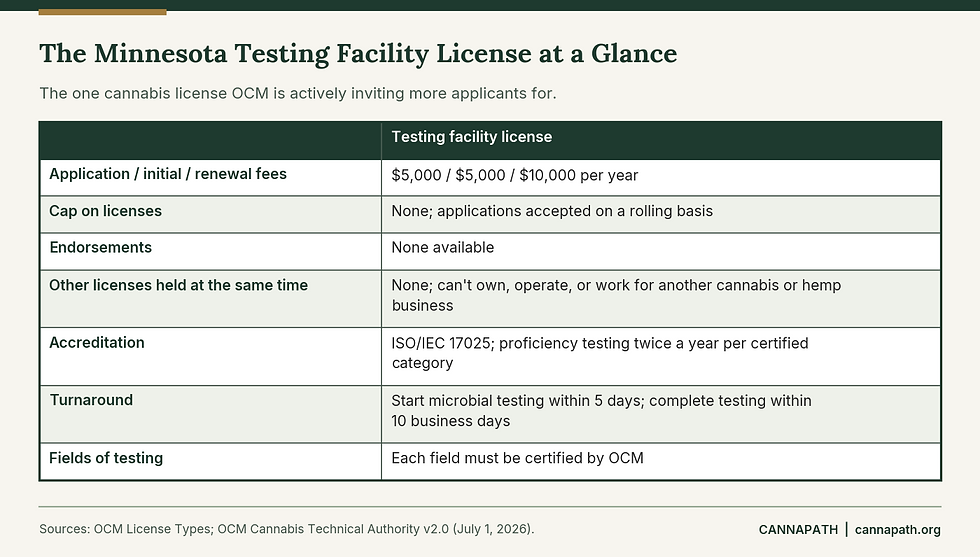
OCM describes it as a license for businesses that obtain and test immature cannabis plants and seedlings, cannabis flower, cannabis products, hemp plant parts, hemp concentrates, artificially derived cannabinoids, lower-potency hemp edibles, and hemp-derived consumer products. There are no testing endorsements, and no other cannabis or hemp license can be held alongside it. The application fee is $5,000, the initial license fee is $5,000, and the annual renewal fee is $10,000. OCM accepts testing-facility applications on an ongoing basis because the license isn’t capped.
That last point is worth pausing on. Minnesota has created a license category where the state is actively inviting more applicants.
That isn’t an accident. OCM’s own 2025 market analysis identified testing as a critical part of the cannabis supply chain and warned that too little testing capacity could create bottlenecks. At the end of 2025, OCM said it had three licensed testing facilities, nine with preliminary approval, and five more at qualified-applicant status, and that it was still assessing whether Minnesota would have enough testing capacity for the market.
The market has changed a lot since then. As of September 14, 2026, OCM’s public application data show 18 testing-facility applicants. Five licenses have been issued, seven applicants are preliminarily approved, five are at qualified-applicant status, and one has withdrawn. Five of the 18 are social equity applicants, and none of those five is licensed yet.
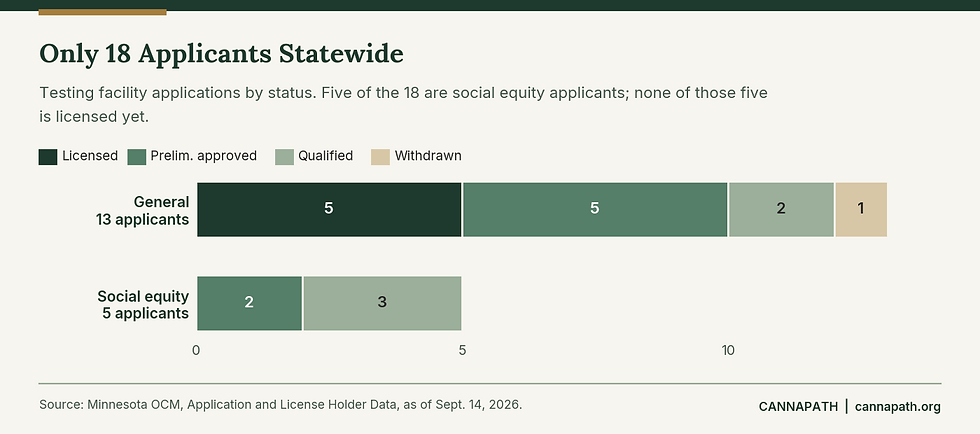
So the pipeline is there. The question is whether it turns into actual laboratories with actual analytical capacity. Those are not the same thing.
There are five licensed labs now. That number needs context.
OCM’s current public roster lists five licensed testing facilities: Adams Independent Testing in Moorhead, ChRi Labs in St. Paul, FINA Analytics in Waseca, PhytoLab MN in Chisago City, and True North Analytical in Roseville.
Five sounds much better than two. And it is.
But counting licenses doesn’t tell the whole story, because the labs aren’t all authorized for the same testing fields. OCM’s roster shows Adams and True North authorized across every listed field. ChRi is authorized for most fields but not residual solvents or terpenes, and operates under an OCM variance. FINA is authorized for potency and microbial testing, and PhytoLab for potency and microbial testing on finished products only.
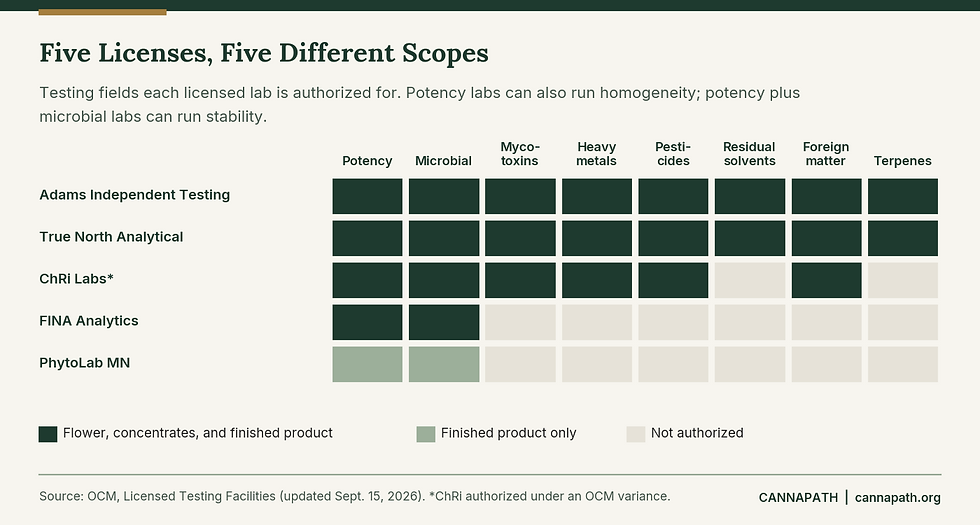
That distinction is incredibly important for understanding Minnesota’s real capacity. Five testing licenses do not mean five interchangeable full-service laboratories.
For some products, potency and microbial testing may cover the required lab work. For others, the required analytical picture is much broader. Minnesota’s rules and technical authority address microbial contaminants, mycotoxins, heavy metals, pesticide residues, residual solvents, foreign material, potency, homogeneity, stability, and, where applicable, terpenes. Which tests apply depends on what is being tested and how it was produced.
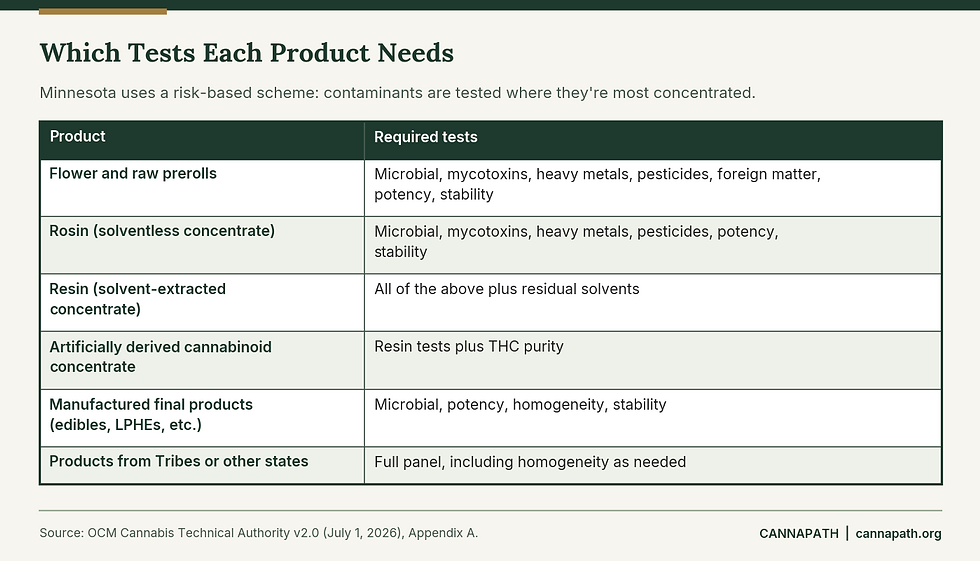
That is why “five labs” can be misleading. The more useful question is how much usable testing capacity Minnesota actually has for each required field of testing.
That is a much harder question, because OCM doesn’t publish a statewide capacity number for each lab. And that limitation matters. It means we can identify the pressure on the system, but we shouldn’t pretend we can calculate exactly how many labs Minnesota “needs” from public data alone.
Minnesota has already had a real testing bottleneck
We don’t have to speculate about whether testing capacity has been a problem. It has.
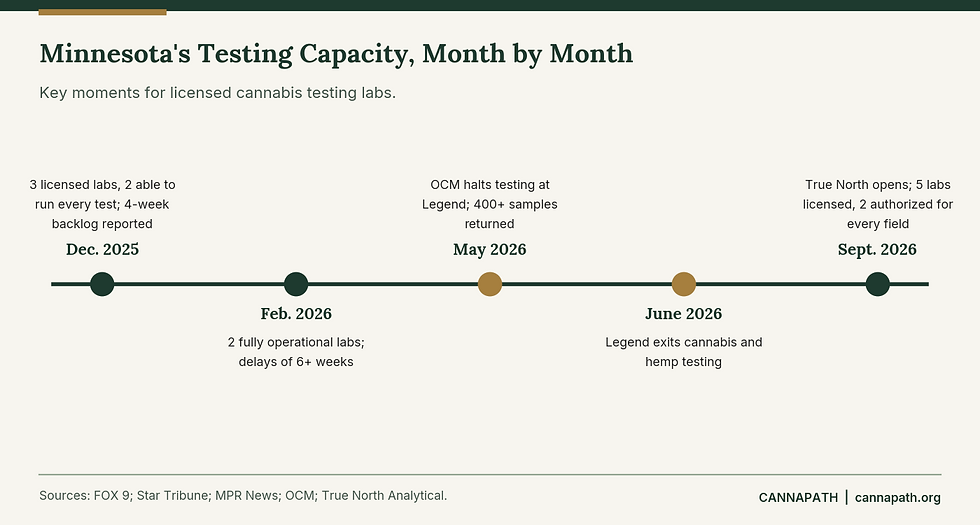
In February 2026, the Star Tribune reported that only two fully operational state-licensed facilities were available for the full panel of required cannabis testing, and that cultivators were seeing delays of six weeks or more. One cultivator waited 49 days for results on two cannabis strains. A cannabis extractor told the newspaper that testing two concentrate samples at another licensed lab had taken four to five weeks.
The regulator saw it too. That same month, OCM’s director told a House committee that testing turnaround times were running six to nine weeks, and told Axios there was a capacity challenge in the market.
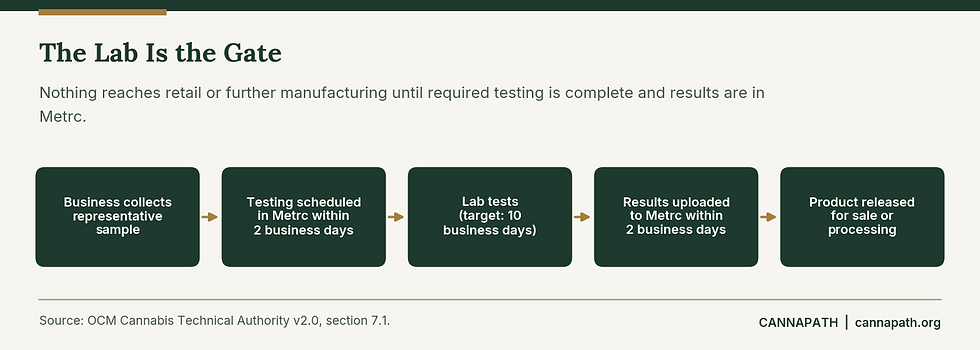
The state’s formal expectations are much shorter. Under the July 2026 Cannabis Technical Authority, a licensed lab must start microbial testing within five days of receiving a sample, and all testing should be completed within ten business days. If a lab can’t meet that timeline because of equipment failure or another reason, it must notify OCM before the reporting deadline and give an estimated timeframe.
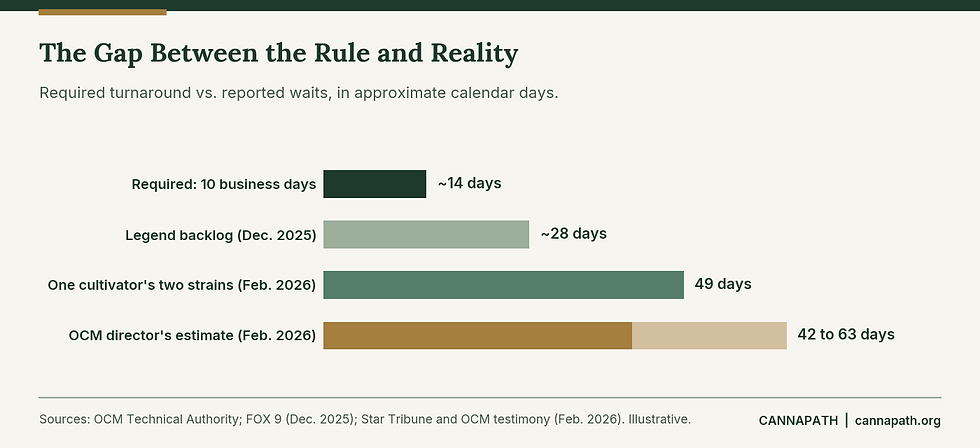
That gap between the regulatory expectation and what businesses experienced earlier this year is probably the single most important fact in the current story of Minnesota cannabis labs.
Because the problem wasn’t simply that someone wanted faster service. The delay affected the entire supply chain. A cultivator could have a finished crop sitting in inventory. A manufacturer could have finished product waiting for release. A retailer could be waiting for stock. And somewhere in the middle sat a lab that had to perform scientifically defensible testing before any of it could move.
The laboratory became the gate.
Then Minnesota lost one
It got more complicated in May.
OCM ordered Legend Technical Services, one of Minnesota’s established testing labs, to stop cannabis testing after determining the lab was no longer authorized to operate under its variances because of outstanding security and testing requirements. The Star Tribune reported that Legend had been one of only four state-licensed facilities authorized for the full battery of testing most cannabis products need. The shutdown sent more than 400 samples back to clients.
Legend ultimately chose not to seek reinstatement and left the cannabis and hemp testing market in June. The company said the Minnesota program no longer fit its long-term plans and that it didn’t believe it could keep meeting client expectations in an economically viable way under the regulatory framework. OCM said the integrity and public health of the market required every testing-facility licensee to meet the same standards.
Both things can be true. A regulator can have legitimate compliance concerns, and a lab can conclude that the cost and operational burden of meeting the framework no longer make sense for its business.
That is an important lesson for anyone considering this license. A cannabis lab isn’t a normal analytical lab with a cannabis license taped to the front door. It is its own regulatory ecosystem.
Labs carry a remarkable amount of responsibility
Minnesota has built a serious quality system around this license.
The testing facility rules incorporate ISO/IEC 17025 for laboratory competence and ISO/IEC 17043 for proficiency-testing providers. A lab must run formal management systems, keep written procedures for receiving and handling samples, perform representative subsampling where appropriate, maintain sample identity and integrity, and demonstrate analytical capability. It must participate in proficiency testing twice a year for every category it is certified in, document corrective and preventive action whenever a result falls outside the acceptable range, and operate under a technical manager responsible for the lab’s quality and analytical standards.
Then there is method validation. Minnesota doesn’t just tell a lab to “run a pesticide test.” The lab has to use methods that meet Minnesota’s requirements, including published peer-reviewed methods where applicable, independent validation for cannabis testing, internal verification, and enough specificity and sensitivity to meet reporting limits. OCM approval is required for each field of testing.
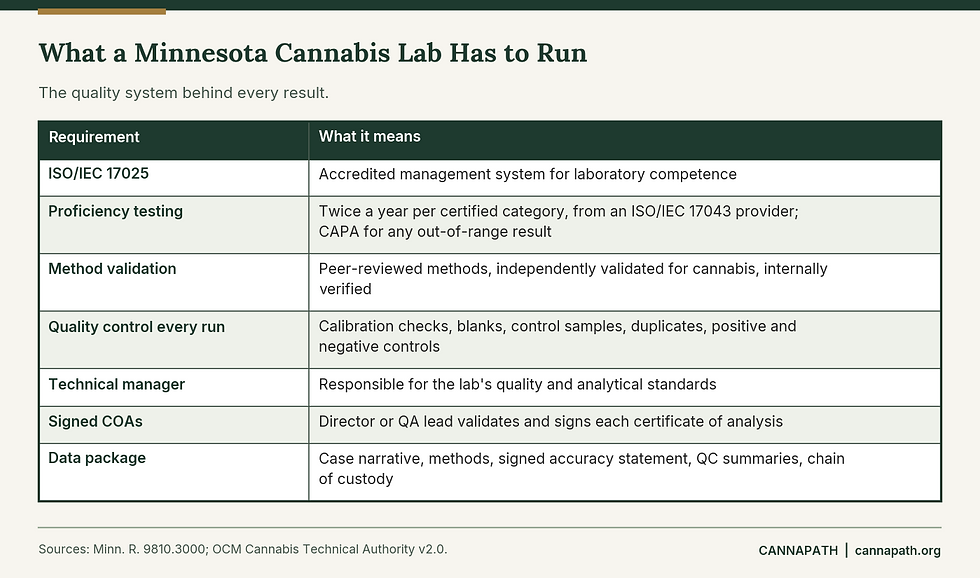
This is real laboratory quality work, not checkbox compliance. It is method control, instrument control, analyst competency, quality control, proficiency testing, data review, and defensible reporting.
The state is also explicit about documentation. A lab’s data package has to include a case narrative, the analytical methods, a signed statement verifying the accuracy and completeness of the results, analytical summaries with quality-control information, and the sample report. Reporting must also include chain-of-custody information, or comparable information on the requested analyses, and documentation of sample collection and receipt.
So a Minnesota cannabis lab has to answer more than “What was the result?” It has to answer “How do you know?” That is a very different standard.
Sampling can become a compliance problem too
There is another part of the testing system that deserves more attention: the lab isn’t solely responsible for collecting a representative sample.
Minnesota’s rules put significant responsibility on the cannabis or hemp business to make sure the sample represents the batch. Collection has to account for variability and confidence, use appropriate equipment, maintain sample integrity, prevent contamination, and be documented, and it has to happen where the required cameras can see it.
Once the sample reaches the lab, the lab takes on a different kind of responsibility. OCM’s inspection materials look at intake, chain of custody, secure storage, sample identity and integrity, representative subsampling, testing procedures, acceptance criteria, and disposal of untested sample material. Inspectors may also watch analysts perform methods and review how they document sample receipt, instrumentation, and data analysis.
That creates an important relationship between a lab and its customers. A good lab can have excellent analytical procedures and still receive a bad or improperly collected sample. A customer can have a sound sampling plan and still run into an analytical issue. The lab has to be able to spot those problems rather than just push the sample through. That is part of what quality actually means.
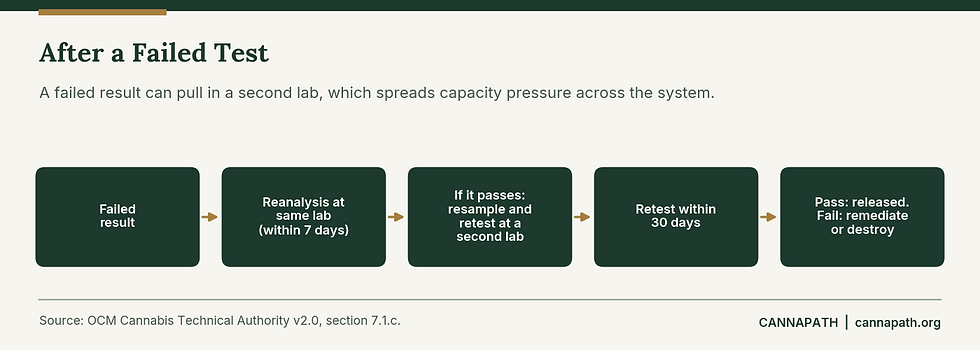
It also matters when something fails. A failed result can be reanalyzed once at the same lab, but if that reanalysis passes, the batch has to be resampled and retested at a second, separate lab. Labs can also subcontract tests they aren’t certified for to another licensed lab. Both mean that a capacity problem at one lab ripples into the others.
The scope of testing is bigger than “THC and contaminants”
Minnesota’s testing framework is also much broader than the popular idea of cannabis testing.
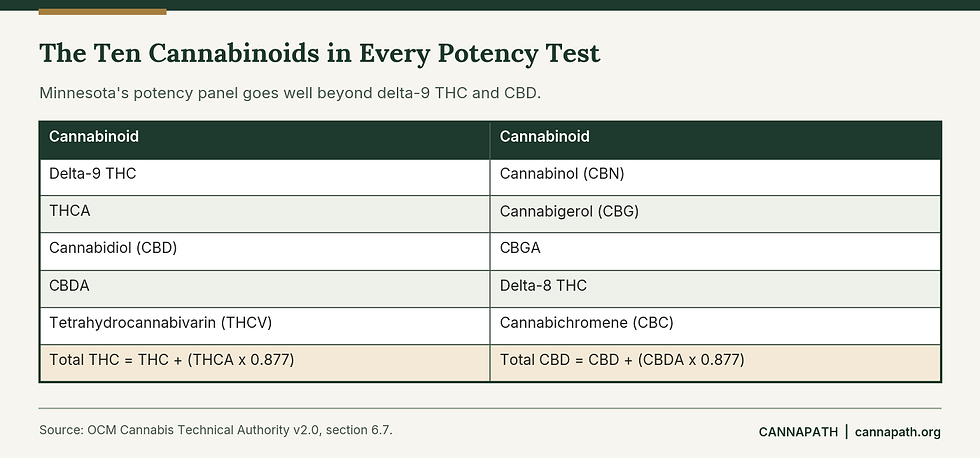
Potency testing covers a cannabinoid profile well beyond delta-9 THC and CBD. The current technical authority requires screening for ten cannabinoids (THC, THCA, CBD, CBDA, CBN, CBG, CBGA, delta-8 THC, THCV, and CBC), along with calculated total THC and total CBD. Products that contain artificially derived cannabinoids also require purity testing.
Then there is stability. Minnesota requires stability testing for products, evaluated in the final packaged form, to set an expiration or use-by date. The testing looks at microbial content, the cannabinoid profile, and, where it applies, contaminants that could migrate from packaging. Until the data support a longer period, products carry a six-month expiration.
Homogeneity matters too, particularly for products with serving units. And the contaminant picture changes with the product. A flower batch has a different analytical profile than a solvent-extracted resin. A manufactured edible follows a different testing pathway than a raw concentrate. Products entering Minnesota from Tribal entities or other states carry full-panel requirements.
That complexity is one reason the lab license doesn’t scale just by “adding more work.” Every new testing field brings its own method, instrumentation, validation, personnel competency, quality control, and documentation requirements.
The rules move every year
One thing I suspect lab operators understand better than almost anyone else in this industry is that compliance isn’t static.
Minnesota’s testing thresholds and requirements run on an annual cycle. OCM publishes an annual report on testing thresholds no later than July 1, and licensed labs must update their protocols and SOPs to reflect changes no later than August 1. The current Cannabis Technical Authority was updated July 1, 2026, and OCM is already issuing lab bulletins to clarify how particular testing situations should be handled.

In July, for example, OCM clarified confirmatory testing after a pathogen turns up in microbial screening. A molecular initial analysis can be followed by either molecular testing or plating, while an initial plating result must be confirmed by molecular testing.
That may sound like a small technical clarification to someone outside the lab. It isn’t small to the lab. A clarification like that touches methods, SOPs, training, competency, documentation, and the quality system, and it may change how results are communicated to customers.
This is where a mature quality management system becomes tremendously valuable. A lab shouldn’t have to reinvent itself every time the state changes a technical requirement.
Security matters, even for a laboratory
A testing facility may feel very different from a dispensary or a grow, but Minnesota still treats it as a regulated cannabis premises.
The August 2026 OCM inspection checklist requires a testing facility to demonstrate building and fire-code compliance, controlled product storage, security, working alarms, video surveillance, restricted-access controls, and protection of electronic and paper records. Surveillance must run continuously, keep at least 90 days of recordings, and meet specific camera performance standards.
That matters because a lab is handling controlled product and sensitive information at the same time: physical samples, customer data, analytical results, chain-of-custody information, and proprietary methods and quality records.
And because a lab’s job is to produce an independent result, the state puts real weight on impartiality. A testing facility must keep a conflict-of-interest policy, and a license holder can’t own, operate, or be employed by another cannabis or hemp business. OCM’s technical authority goes further, naming situations that could compromise impartiality, including shared ownership or investment interests and certain immediate-family relationships. Results from a lab that violates the impartiality requirements can be invalid.
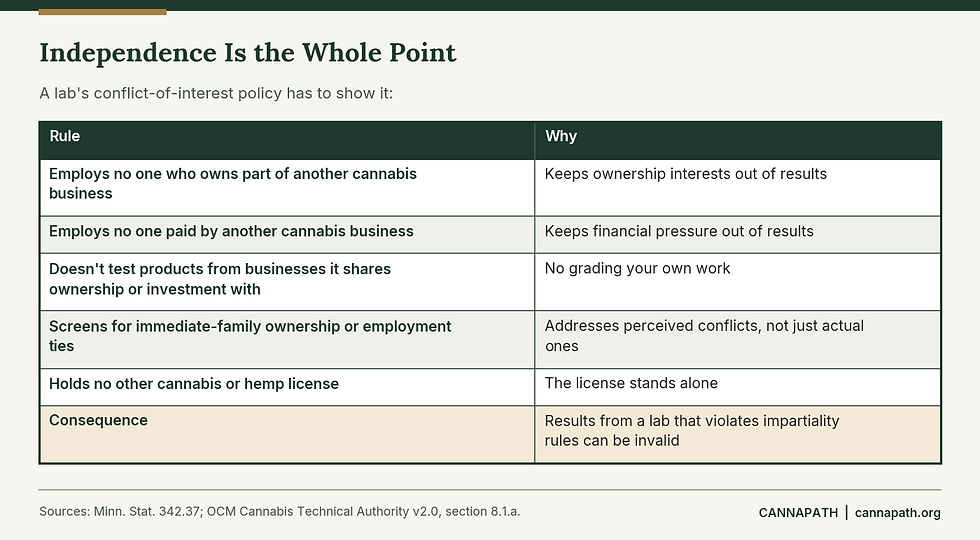
That is a powerful rule. The lab isn’t just another vendor in the supply chain. It has to stay independent from the businesses whose products it tests.
The economics may be the hardest part
The state license fee isn’t what makes a cannabis lab hard to build. Five thousand dollars to apply and five thousand more for the initial license are manageable next to what it takes to build and run a lab that can meet Minnesota’s expectations.
The real investment is analytical and organizational. A lab needs the right instruments, validated methods, qualified people, a quality system, accreditation, proficiency testing, secure sample handling, compliant software and data management, maintenance and calibration, and enough capacity to meet its turnaround commitments without compromising the analysis.
And then there is the most uncomfortable problem in laboratory management. You can’t keep increasing volume forever without eventually putting quality at risk.
That is where laboratory operations experience becomes extraordinarily valuable. Minnesota requires a lab to maintain the identity and integrity of every sample, keep records, demonstrate analytical capability, maintain training, respond to complaints, keep corrective-action records, and be ready for inspection. OCM’s current checklist even reviews analytical records for instruments and equipment, complaints, corrective actions, internal and external audits, and proficiency testing.
A lab that grows faster than its quality system can support isn’t necessarily becoming a more successful lab. It may simply be becoming a larger risk.
So, does Minnesota actually need more labs?
The frustration with lab capacity hasn’t stayed inside regulatory documents. FOX 9 reported in late 2025 that industry participants were warning of a substantial backlog as Minnesota prepared to bring more hemp products into the state testing system, and a Legend representative told the station the state needed at least eight labs to handle expected demand. That was one industry estimate at that point in the rollout, not an OCM determination, and the market has changed since.
That distinction matters. We shouldn’t take an old statement that “Minnesota needs eight labs” and treat it as a scientifically established number today. It isn’t.
What the evidence does establish is that Minnesota has had a genuine shortage of testing capacity at points in the rollout, that the state itself identified testing as a possible bottleneck, and that the number of products and plants moving through the system has grown dramatically.
So yes, there is a strong, evidence-based case for continued expansion of lab capacity in Minnesota. What I wouldn’t say is that the state definitively needs “X more labs.” We don’t have enough public throughput data to make that calculation responsibly.
What we do have is more useful. Minnesota has five licensed testing facilities, seven more applicants at preliminary approval, and a rolling application window. It has more than $250 million in first-year sales and a 575% increase in tracked plants. It already saw delays of six weeks or more when only two full-service facilities were running, including an independently documented 49-day wait. One established full-service lab then left the market after its regulatory shutdown. And even now, five licenses don’t mean five labs with the same analytical scope.
That is the part I would pay attention to. Minnesota may not simply need more labs. It needs more reliable lab capacity, more analytical redundancy, and more competition in the testing fields that actually hold up product movement.
There is a difference. A sixth lab that performs one narrow analytical function does something useful. A sixth lab that can perform the full range of testing a broad part of the market needs does something very different. And a lab in Greater Minnesota may create a different kind of value than another one in the Twin Cities, once turnaround, transportation, and customer access are considered.
So the opportunity is real. But it belongs to the operator who understands that the answer isn’t to open the doors and buy instruments. It belongs to the lab that can build a defensible quality system and then run it at scale.
True North’s arrival is worth watching. It opened in Roseville on September 1 and describes itself as the state’s first lab dedicated entirely to cannabis and hemp testing, offering the full range of testing Minnesota requires and keeping to the state’s ten-business-day timeline. That is a meaningful development, and a reminder that this landscape is changing quickly. The bottleneck we talked about in February isn’t necessarily the bottleneck we’ll be talking about in December.
New labs are coming online and existing ones are adjusting capacity. The state keeps changing technical requirements, businesses are increasing production, hemp testing rules are shifting, the 2027 supply-chain changes are coming, and federal changes to the definition of hemp add another layer of uncertainty for labs that serve that side of the market. A lab planning for Minnesota today has to build a business that can adapt.
The people behind these laboratories
I want to close the main part of this article with something that gets lost whenever cannabis testing turns into a conversation about bottlenecks.
The people running these labs aren’t standing between the industry and the consumer. They are part of the safety system.
They are the ones who have to make the uncomfortable call when a result isn’t right, and then defend it. They have to stay impartial when a customer really wants a particular number, tell a client a sample can’t be accepted, investigate analytical problems, manage complaints, and document corrective actions. And they have to prepare for an inspection where someone may ask them to show exactly how an analyst produced a particular result, all while running a business.
That is a difficult balance. The lab license may be one of the smallest visible pieces of Minnesota’s cannabis industry, but it carries an enormous amount of responsibility. Every cultivator depends on it. Every manufacturer and every retailer depends on it. And in the end, every consumer does too.
Frequently asked questions
How much does a Minnesota cannabis testing facility license cost?
The application fee is $5,000, the initial license fee is $5,000, and the annual renewal fee is $10,000. The fees are nonrefundable.
Is OCM accepting testing facility applications right now?
Yes. As of September 2026, OCM accepts cannabis testing facility applications on an ongoing, rolling basis, and the license has no cap.
How many licensed cannabis testing labs does Minnesota have?
Five as of September 2026: Adams Independent Testing, ChRi Labs, FINA Analytics, PhytoLab MN, and True North Analytical. Only Adams and True North are authorized for every listed testing field.
How fast does a Minnesota lab have to return results?
Under the July 2026 Cannabis Technical Authority, a lab must start microbial testing within five days of receiving a sample, and all testing should be completed within ten business days. A lab that can’t meet that timeline must notify OCM before the deadline.
Can a testing lab owner hold another cannabis license?
No. A testing facility license can’t be held with any other cannabis or hemp license, and the license holder can’t own, operate, or be employed by another cannabis or hemp business. Labs must also keep a conflict-of-interest policy.
What accreditation does a Minnesota cannabis lab need?
Minnesota’s rules incorporate ISO/IEC 17025 for laboratory competence. Labs must also take part in proficiency testing from an ISO/IEC 17043-accredited provider twice a year for every category they are certified in.
Where CannaPath fits
Lab operators have told us something that stuck with us: it isn’t easy to find a compliance firm that will even take on a laboratory. Most firms work with retailers, growers, and manufacturers, and stop at the lab door.
We don’t. Laboratory compliance is one of the areas where CannaPath brings experience that is hard to build quickly. Two of our consultants spent years running laboratory operations and lab compliance inside one of the most respected health systems in the world, and together they bring decades of that work. They know what a lab looks like on a good day, and they know what it looks like on a bad one.
That matters because lab compliance isn’t just about understanding cannabis rules. It is about quality systems, accreditation, method validation and verification, analyst competency, corrective and preventive action, proficiency testing, and data integrity. It is complaints, change control, document control, internal audits, and management review. And it is building a system that works when the lab is slammed, not just when an inspector is standing in the hallway.
That is the kind of work our team has spent years doing. We don’t take a generic cannabis compliance framework and paste it onto a lab. A laboratory needs a compliance system that understands laboratory operations first and cannabis regulation second.
We also take impartiality as seriously as the state does. Our laboratory engagements are kept completely separate from our work with the businesses that send samples to labs.
WHAT THIS MEANS FOR YOU A lab’s job isn’t to make a product pass. It is to produce a result that can be trusted, accurately, consistently, independently, and on time. Minnesota is going to need a lot more of those results as the market grows. |
One more thing. If you want a quick outside read on one piece of your lab’s program, like your sample receipt and chain-of-custody procedure or your CAPA process, that is what Sentinel Scout does. Send us one module or standalone policy, plus up to three supporting documents that go with it, and we will send back a gap analysis within three business days. No contract. It is $99 through October 31 ($199 after), and the fee credits toward a larger engagement if you ever want one. You can find it at cannapath.org/sentinel.
And if you get into something you would rather not sort out alone, we are here. Reach out.
-Drew
Last reviewed September 23, 2026. OCM application and licensing figures are preliminary data published September 14, 2026 and are subject to change. Minnesota cannabis law, rules, and OCM testing standards continue to evolve. This article is for general informational purposes and is not legal advice.
Sources: Minnesota Office of Cannabis Management, including License Types, Licensed Testing Facilities, Application and License Holder Data (Sept. 14, 2026), and the Cannabis Technical Authority v2.0 (July 1, 2026); Minnesota Rules chapter 9810; Minnesota Statutes chapter 342; Minnesota Star Tribune (Feb. and May 2026); MPR News (June 2026); Axios Twin Cities (Feb. 2026); FOX 9 (Dec. 2025); True North Analytical (Sept. 2026).