The Current State of Minnesota Cannabis Retailers

One year into the adult-use market, Minnesota’s cannabis retailers are moving from opening the doors to proving the operation works
By Drew Duffy, MHA, FACHE, Founder & Managing Director, CannaPath Regulatory Solutions
Minnesota’s cannabis retail market is no longer theoretical.
On September 16, 2025, state-licensed cannabis businesses began adult-use retail sales across Minnesota. One year later, the Office of Cannabis Management (OCM) says consumers and patients have purchased more than $250 million in combined adult-use and medical cannabis products through state-licensed businesses, including approximately $150 million in adult-use sales and $100 million in medical sales. OCM also reports more than 90,000 registered medical cannabis patients. That is a functioning market, even though it is still a young one.
The licensing numbers tell another part of the story.
As of OCM’s September 14, 2026 application update, there were 854 cannabis retailer applicants across the preapproval and general licensing cycles. OCM reported 80 preliminarily approved applicants and 16 licenses issued, while 38 applicants were qualified and still moving through the process. The same dataset shows 494 applicants not selected in the lottery, 132 withdrawals, and 94 denials. One detail stands out: 121 of those 132 withdrawals came from social equity applicants. OCM cautions that these figures are preliminary and will keep changing as applications are processed.
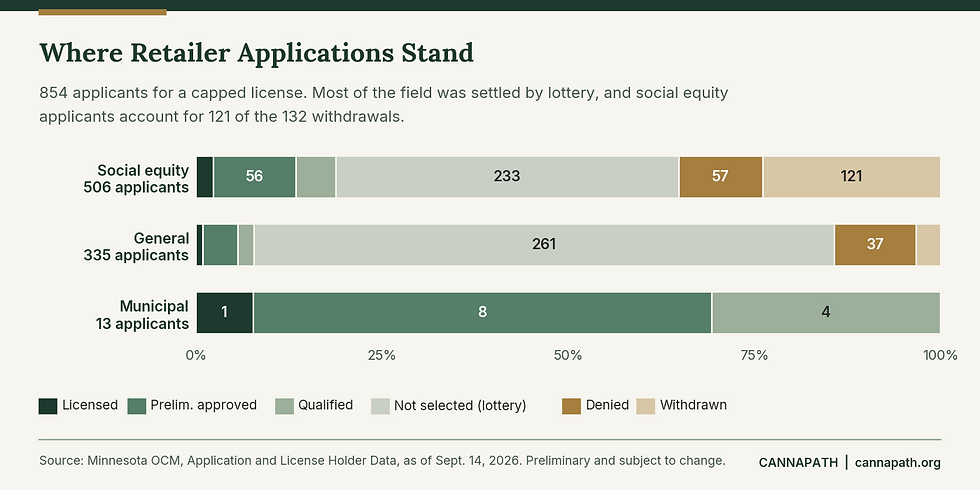
Those numbers are worth looking at carefully, because the retailer license is one of Minnesota’s capped license types. Under current law, the state may issue up to 150 retailer licenses in the present allocation period, divided equally between social equity and general applicants. The 2026 Legislature extended that capped period through June 30, 2027. Beginning July 1, 2027, OCM must decide how many retailer licenses to make available based on the statutory goals for the market.
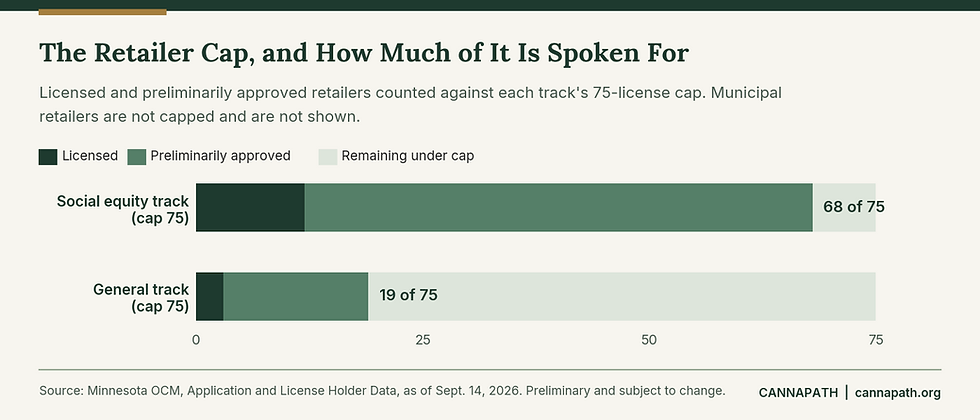
There is also a clock running for the 38 qualified applicants. Under the 2026 law, qualified applicant status now expires. Status granted before June 1, 2026 expires January 1, 2027, and status granted after that expires six months after it was granted. Once it lapses, OCM must deny the application, although the applicant can apply again in a future window.
In other words, Minnesota is no longer asking whether cannabis retail will exist.
The more interesting question now is what it takes to operate a store well.
And that answer is considerably more complicated than the phrase “cannabis retailer” makes it sound.
A cannabis retailer is not simply a retail store with cannabis on the shelves
OCM’s description of the retailer license is fairly straightforward. Depending on the endorsements held, a cannabis retailer can sell cannabis flower, plants and seedlings, cannabis products, lower-potency hemp edibles, and hemp-derived consumer products to adults 21 and older. With the appropriate medical cannabis retail endorsement, the business can also sell qualifying products to registered medical patients. A retailer can operate up to five retail locations, but no one may own or operate more than one cannabis retail business in a single city, or more than three in a single county. Every location also needs its own local retail registration.
That last part is important.
The state license authorizes the business to operate as a retailer. It does not turn every building into an approved cannabis store.
Before a cannabis retailer can make sales, its retail establishment must be registered with the city, town, or county. The local government can perform a preliminary compliance check, and Minnesota law requires local governments to conduct compliance checks of registered cannabis retailers, including an unannounced age-verification check at least once each calendar year. A retailer cannot legally sell without both its state authorization and a valid local retail registration.

That creates an important distinction between licensing a business and operating a location.
A retailer can have its state license and still have a problem with a particular site. A building can look perfect from a business perspective and still run into local requirements. A location can be operationally sound while the business’s registration or documentation is not current. And because local registration is tied to the physical store, opening a second or third location is not a matter of copying the first one.
The regulatory footprint grows with the business.
The retailer is where the state’s entire supply chain becomes visible
This is probably the most important way to think about Minnesota cannabis retail.
A retailer is the point where cultivation, manufacturing, testing, packaging, inventory management, transportation, security, tax, and customer-facing requirements all eventually collide.
The retailer receives product. The business has to know what it received, where it came from, what it is authorized to sell, and how that product enters the store’s inventory. That inventory then has to stay accurate as product moves from storage to the sales floor and from the sales floor to the customer. Minnesota’s Metrc system exists precisely because the state wants cannabis tracked through the regulated supply chain, and OCM requires licensed businesses to use it for the applicable inventory and product-tracking functions.
That sounds simple until the store is busy.
One product comes in with a receiving discrepancy. Another has a damaged package. An employee moves an item from one area to another. A product goes on hold. Something reaches its expiration date. A recall comes through. A package gets entered incorrectly. A product is physically in the store but not where the system says it is.
None of these situations requires bad intentions.
They require controls.
That is the real shift happening in Minnesota’s retail market. Compliance is becoming less about knowing what the law says and more about whether the business has built an operation that produces the right result over and over again.
OCM’s inspection process makes that very clear
OCM’s current pre-license inspection materials, updated August 1, 2026, show how broad the inspection environment has become. The retailer inspection is not limited to checking whether a business has a camera system or an employee handbook. It reaches into the physical premises, security configuration, restricted areas, alarm systems, surveillance, access controls, sanitation, product storage, inventory procedures, Metrc access, and training documentation.
The important word here is actual.
OCM can inspect the premises, not just the application that described the premises. The business has to be able to show that the physical store matches the operating model it presented during licensing.
And the inspections don’t stop once the doors are open. We understand from OCM that enforcement checks on currently operating stores are set to begin after the week of September 28, 2026. For a store that opened months ago, the question is no longer whether it passed inspection back then. It is whether the store still matches what was approved.
A security policy can say one thing while a door has been moved. A camera plan can say one thing while a new shelf blocks part of the field of view. An employee policy can say one thing while the person working the counter was trained differently. An inventory procedure can say one thing while the staff have found a faster shortcut.
This is one of the reasons we talk so much about compliance drift at CannaPath.
Drift does not usually begin with someone deciding to disregard the rules.
It often begins with someone trying to make the business work.
Security is not a room. It is an operating system.
Cannabis retailers understandably spend a great deal of time thinking about cameras, alarms, locks, and controlled-access areas.
They should.
But the compliance question is larger than whether those things exist. The state’s inspection framework treats security as a functioning system. Surveillance has to cover required areas. Alarm systems have to work. Access to restricted areas has to be controlled. The business needs procedures for responding to security events. Recordings have to be retained the required way. And the physical environment has to stay consistent with the approved security design.
That creates an interesting operational problem.
Security equipment is physical, and businesses are constantly changing their physical environments. Retailers move displays, add fixtures, reorganize storage, change entrances, renovate, replace technology, hire new people, and let others go.
The compliance system has to keep pace with those changes.
That is why a retailer shouldn’t think of its security plan as a document finished before opening and then put in a drawer. It is a description of how the physical business is supposed to function.
Once the physical business changes, the compliance question changes with it.
Then there is the customer standing at the counter
Minnesota’s retail law gets very specific at the moment of sale.
Before starting an adult-use sale, an employee must verify that the customer is at least 21 using one of the forms of identification the law allows. The state also sets transaction limits: no more than two ounces of adult-use cannabis flower, eight grams of adult-use cannabis concentrate, and edible cannabis products containing up to 800 milligrams of THC in a single transaction. Edible products generally cannot exceed 10 milligrams of THC per serving or 200 milligrams per package, and beverages are limited to 10 milligrams per serving and two servings per container.

Those rules are easy to read.
They are harder to execute consistently.
The person checking ID may be new. The customer may have an unfamiliar form of ID. The POS system may be configured incorrectly. A busy line may create pressure to move people through faster. The employee may know the transaction limit but not understand how several different products combine against it. And a medical patient may walk into the same store and be subject to a different set of rules.
That is what makes retail compliance different from memorizing the law. The employee needs a process that works under normal conditions and under pressure.
The POS system and Metrc are not separate problems
This is another place where Minnesota retailers can get into trouble without realizing that two small problems are really one large one.
OCM’s current retailer inspection materials contemplate a point-of-sale system integrated with Metrc and require procedures for accurate data entry into the statewide monitoring system.
The practical significance is easy to overlook. The POS tells the business what was sold. The inventory system tells the business what should be there. Metrc holds the regulatory record for tracked cannabis inventory. And the physical shelf tells you what is actually there.
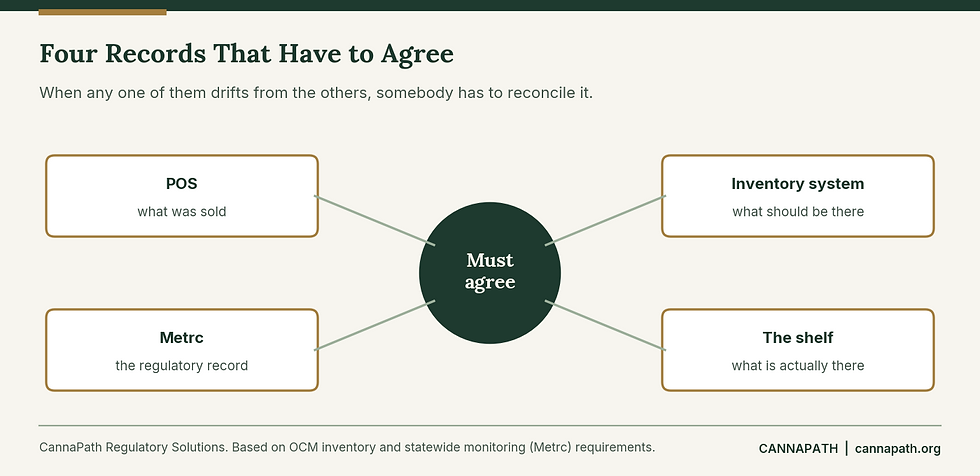
When those four stop agreeing, someone has to reconcile them.
That is why inventory compliance isn’t simply an accounting function, and it isn’t simply a Metrc function. It is an operational control.
A retailer that consistently knows what it has, where it has it, what its systems say it has, and why those numbers agree is operating very differently from a retailer that finds discrepancies only when someone happens to notice a problem.
The second business may still have an excellent compliance manual. The first one actually has a compliance system.
Product problems are going to happen. The question is what happens next.
Every retailer eventually runs into product that shouldn’t be sold.
Minnesota’s inspection framework addresses damaged products, broken or compromised packaging, contaminated products, expired products, recalled products, and other inventory that has to come out of ordinary sale. The business is expected to have procedures that control what happens to that product, and records showing those procedures were followed.
This is another area where the maturity of a compliance program shows.
The strongest program isn’t the one that assumes nothing will ever go wrong. It is the one that makes the right response almost boring.
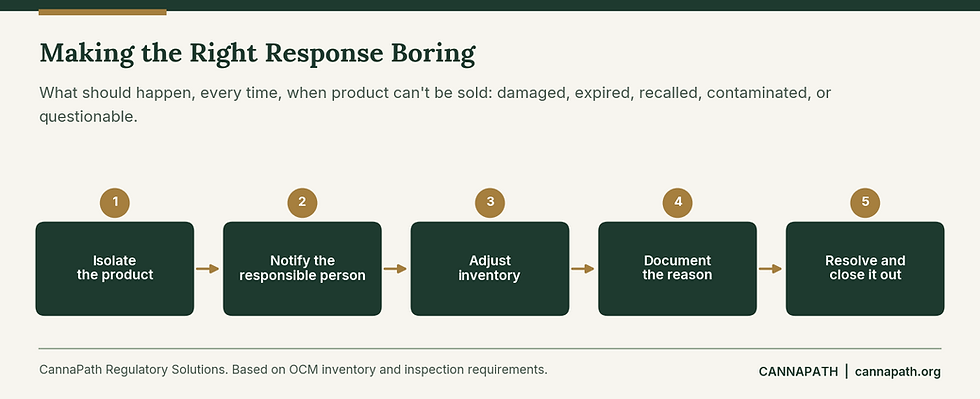
An employee sees something questionable. The product is isolated. The responsible person is notified. The inventory is adjusted correctly. The reason is documented. The next step is understood. And later, the business can explain what happened without trying to reconstruct the event from memory.
That is what a functioning control looks like.
It does not have to be dramatic. It has to work.
Retail employees are part of the control structure
Minnesota also places real responsibility on the retailer’s workforce.
Cannabis workers are subject to state eligibility and background-check requirements, and the compliance program has to account for those before an employee steps into a role that involves regulated cannabis activity. OCM’s inspection materials also expect retailers to keep training records and provide role-appropriate training covering applicable cannabis law, privacy and confidentiality, security controls, emergency procedures, recalls, and the business’s own operating procedures.
There is a common mistake here.
Businesses often treat training as an event. An employee attends, a form gets signed, and the requirement is considered done.
But retail businesses aren’t static, and neither are their procedures.
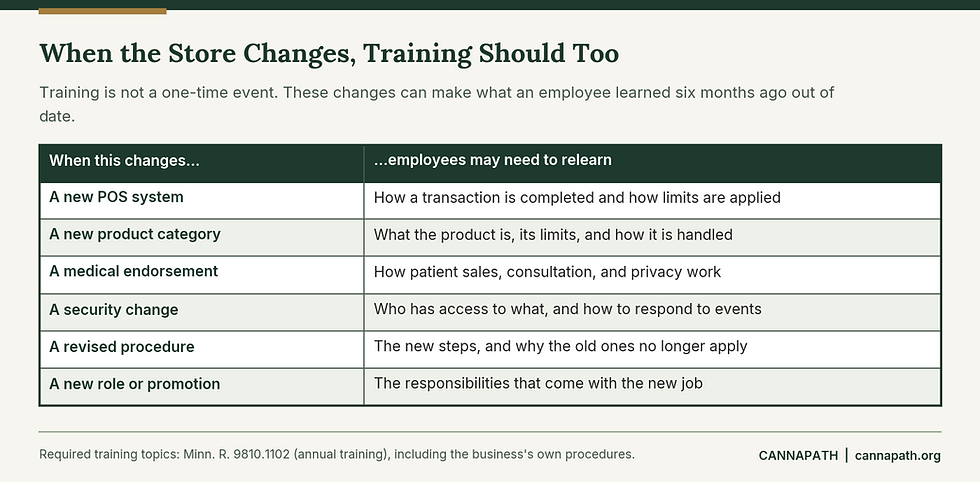
That is why training works best when it is tied to the actual operation instead of treated as a separate compliance task.
The employee at the counter may be one of the most important compliance controls the business has.
The training system should recognize that.
Advertising brings the same problem to the public side of the business
Retailers naturally want customers. That is what a retail business is built to do.
Minnesota’s cannabis advertising rules, however, don’t let retailers use the playbook they might use in conventional retail. OCM’s advertising guidance requires the applicable warning language and prohibits false or misleading statements, unverified health or therapeutic claims, promotion of over-consumption, depictions of people under 21 consuming cannabis, and imagery or designs likely to appeal to people under 21. OCM also prohibits pop-up advertising for cannabis and requires age verification before direct advertising, including certain location-based advertising.
That creates a subtle compliance challenge, because marketing usually moves faster than compliance review. A promotion gets designed. Someone wants it published. A social post is scheduled, a new sign is printed, or a vendor supplies artwork.
The question is no longer whether the marketing person understands cannabis law.
The question is whether there is a reliable review step between the idea and the public.
That is a systems question. And it is a recurring theme in cannabis compliance.
Taxes are another place where retail operations cross organizational lines
Cannabis retailers also live with a tax environment more complicated than a conventional retail sale.
The Minnesota Department of Revenue states that taxable cannabis products are subject to a 15 percent cannabis gross receipts tax, on top of the 6.875 percent state general sales tax and any applicable local sales taxes. Medical cannabis sold to registered patients is exempt from the 15 percent cannabis tax, and OCM says that exemption carries forward under the 2027 changes. For a store with a medical endorsement, that means the POS has to treat a patient sale differently from an adult-use sale.
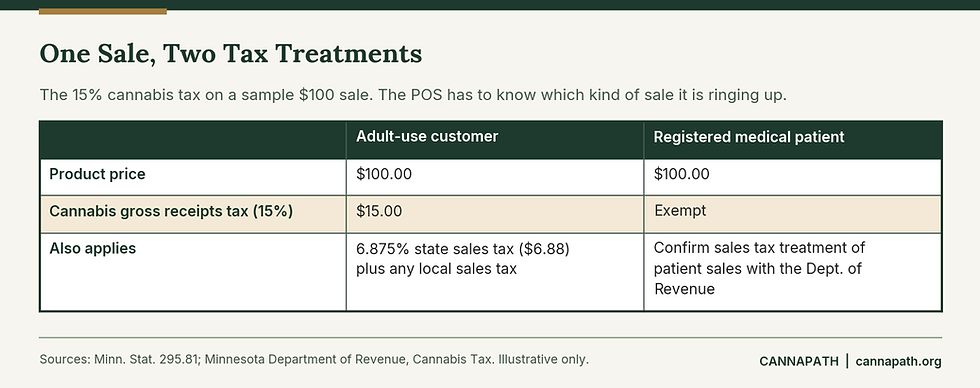
The important compliance issue isn’t knowing the tax rate.
The store’s actual transactions have to be captured correctly. The POS has to apply the proper treatment. The accounting records have to reconcile with the sales records. The tax filings have to be supported by those records. And management needs enough visibility to know when something is wrong.
This is one of the places where a business’s usual organizational lines can mislead. The tax issue belongs to accounting. The sale happens in retail. The transaction is recorded by the POS. The inventory is reflected in Metrc. The product sits physically in a secured location.
It is all the same transaction. The systems just see different pieces of it.
A federal date retailers should have on the calendar
Most retailers sell lower-potency hemp edibles and hemp-derived consumer products alongside cannabis, and that puts a federal change on their calendar. A new federal definition of hemp is now scheduled to take effect December 11, 2026, unless Congress acts again. OCM says it will effectively exclude final hemp-derived products containing more than 0.4 milligrams of total THC per container from the federal definition of hemp.
OCM is clear that this doesn’t change Minnesota’s definition of lower-potency hemp edibles or make those products illegal under state law. But a product can stay lawful in Minnesota while becoming federally noncompliant, and OCM warns of possible effects on banking, payment services, federal tax deductions, and interstate commerce. For a store where hemp products are a real share of the shelf, that is worth planning around now.
The medical market is about to change the retailer’s job
For retailers, the biggest near-term development may be what happens on January 1, 2027.
Minnesota’s 2026 cannabis legislation restructures the medical side of the system. The medical cannabis combination business transitions into the new macrobusiness license, and medical cultivation, medical manufacturing, and medical retail become endorsements that qualifying cannabis businesses can hold. Cannabis retailers will be eligible to apply for the new medical cannabis retail endorsement.
That matters because Minnesota’s medical market is not going away. OCM reports more than 90,000 registered medical patients, and first-year sales included about $100 million in medical cannabis alongside roughly $150 million in adult-use.
The state is changing the structure of a functioning market.
A retailer that gets the medical cannabis retail endorsement takes on additional obligations to patients and caregivers. The framework includes patient consultation, access to a pharmacist or certified medical cannabis consultant, patient-specific labeling, priority service for patients, and carrying the products OCM identifies as high medical need. According to the bill’s House sponsor and reporting on the new law, OCM can take action if a store fails to make a listed high-medical-need product available within 24 hours of a patient’s request. The medical transaction is not simply an adult-use sale with a different customer.

That difference is going to show up on the sales floor.
Employees will need to know when a customer is buying adult-use cannabis and when the transaction falls under the medical framework. The business will need processes that protect patient information. Training will need to reflect the medical requirements. Inventory controls may need to handle a more complicated product pathway. And the store’s workflow has to absorb all of it without turning the customer experience into chaos.
Again, the challenge usually isn’t understanding the individual rule.
It is making the individual rules work together.
The 2027 expansion opportunity is significant, but it isn’t free
The medical retail endorsement also opens a path to physical expansion.
A qualifying cannabis retailer with the medical cannabis retail endorsement can operate up to three additional retail locations beyond the ordinary five, when the statutory high-medical-need-area requirements are met. A retailer could potentially operate as many as eight locations under the new structure. The city and county limits still apply, though. With no more than one store per city and three per county, an eight-store operation has to span at least three counties.

That is a meaningful change.
But it is also exactly where a growing cannabis business can create problems for itself.
Eight locations don’t simply mean eight times the revenue opportunity. They also mean eight physical environments that each have to stay controlled.
The temptation with growth is to copy the original store: same SOP, same training, same security concept, same workflow. That gets harder the farther a business grows. The first store may have the owner standing ten feet from the register. The fifth store won’t. At the first location every manager may be personally involved in inventory. A larger operation can’t sustainably run that way.
Growth changes what compliance has to accomplish.
The system has to get stronger as the owner’s direct visibility gets weaker.
Minnesota is creating a closer relationship between compliance and change
That may ultimately be the defining issue for the retail market.
OCM’s licensing process doesn’t treat approved plans as disposable application material. The agency has a separate process for businesses making changes after licensure, including material changes to approved plans of record and changes involving locations or endorsements.
That matters because successful businesses change. A retailer may find its storage layout doesn’t work. It may change vendors, replace surveillance equipment, add a product line, adjust its employee workflow, restructure management, add another location, or pursue the medical endorsement.
None of those decisions is inherently a compliance problem.
The problem starts when the business changes faster than the compliance system changes with it.
That is where drift begins.
And retail may be especially vulnerable, because retail businesses are built around constant small adjustments. Shelves move. Products change. Employees come and go. Promotions change. Customer volume changes. Technology changes.
The regulatory environment doesn’t pause while the business adapts.

The current state of Minnesota cannabis retail is a little different from what many people expected
The industry is still new enough that people sometimes talk about retailers as though they are waiting for the real business to begin.
The real business has already begun.
Minnesota has had a full year of state-licensed adult-use sales. The market has produced more than a quarter of a billion dollars in combined adult-use and medical sales. Hundreds of cannabis business licenses have been issued, and OCM is now managing an operating market instead of building a future one. We have come a long way, and there is still distance to cover.
That changes the compliance conversation.
The early question was, “Can we get licensed?” The next question was, “Can we open?” The question now is becoming, “Can we operate consistently?”
Those are three very different questions.
A retailer can get through licensing and still find its inventory process is fragile. It can pass a pre-license inspection and later find its physical operation has drifted from the approved plan. It can train employees and still find two managers teaching the same procedure differently. It can have an integrated POS and still have reconciliation problems. It can have excellent policies and still lack the evidence to show those policies are being followed.
None of that means the business has failed.
It means the business has reached the stage where compliance has to become part of the operating model.
What we would be looking at right now
At CannaPath, we wouldn’t start a review of a Minnesota cannabis retailer by asking, “Do you have your SOPs?”
We would start by looking at whether the business can tell one consistent story.
Does the physical store match the approved operating plan? Does the security environment still work the way the plan says it does? Does the inventory in the building reconcile with the inventory in the systems? Does the POS tell the same story as Metrc? Do employees know how to handle the situations that fall outside an ordinary sale? Can the business show that required training actually happened? Does management know what changed in the last six months, and whether any of those changes should have been reported to OCM? Does the marketing process account for Minnesota’s restrictions before an ad reaches the public? And with 2027 approaching, has the business thought through what the medical cannabis retail endorsement would mean operationally, instead of treating it as one more line on a license?
Those questions sound less impressive than a giant compliance checklist.
We think that is the point.
A checklist can tell you whether a control exists. An operating review asks whether the controls work together.
The retailer’s real compliance program is the business itself
That may be the most important thing to understand about Minnesota cannabis retail in September 2026.
Compliance doesn’t live in the SOP binder. It lives in the store. It lives in the employee who checks an ID, the manager who notices an inventory discrepancy, the security system that alerts when something happens after closing, and the person responsible for updating the POS. It lives in the procedure that decides what happens to a recalled product, the training record that shows an employee was ready for the job, and the decision to review a business change before it becomes permanent.
And it lives in the evidence left behind when all of those people and systems do what they are supposed to do.
That is why we believe the next phase of Minnesota cannabis compliance will be less about creating more paperwork and more about creating better operating systems.
WHAT THIS MEANS FOR YOU The retailer that succeeds in a mature regulatory environment won’t necessarily have the thickest compliance manual. It will be the one whose people, processes, technology, physical environment, and documentation all keep agreeing with one another. |
Minnesota gave cannabis retailers permission to open the door. Now the industry is learning what it takes to keep everything behind that door aligned.
That is where CannaPath Regulatory Solutions works. We help businesses understand what the rules mean when they meet the reality of a busy Tuesday afternoon, a new employee, a broken camera, an inventory discrepancy, a product recall, or a new regulatory requirement.
Looking compliant on paper is the easy part. The goal is a store where the operation and the compliance program tell the same story.
One more thing, since drift came up. If you want a quick outside read on whether one piece of your program still matches how your store actually runs, that is what Sentinel Scout does. Send us one module or standalone policy, like your security plan or your inventory procedure, plus up to three supporting documents that go with it, and we will send back a gap analysis within three business days. No contract. It is $99 through October 31 ($199 after), and the fee credits toward a larger engagement if you ever want one. You can find it at cannapath.org/sentinel.
Scout is the first piece of CannaPath Sentinel, the cannabis compliance and business operating platform we are building for full release in March 2027. Sentinel brings compliance documents, people and training records, inventory, POS and Metrc data, security, and a single calendar for every regulatory, employee, and business deadline into one place, so an operator can see at a glance whether the store and the compliance program still agree. If you would like to know when it is ready, email thewatch@cannapath.org.
And if you get into something you would rather not sort out alone, we are here. Reach out. hello@cannapath.org
-Drew
Last reviewed September 22, 2026. OCM application and licensing figures are OCM data published September 14, 2026 and are preliminary and subject to change. Minnesota cannabis law and OCM guidance continue to evolve, including significant changes taking effect January 1, 2027; verify current requirements with OCM. This article is for general informational purposes and is not legal advice.
Sources: Minnesota Office of Cannabis Management, Application and License Holder Data (Sept. 14, 2026); Minnesota Statutes chapter 342, including sections 342.22, 342.27, and 342.32; 2026 Minnesota Laws chapter 123 (SF 4401); OCM, 2026 Legislative Changes to Chapter 342 (May 2026); OCM retailer pre-license inspection materials (updated Aug. 1, 2026); OCM advertising guidance; Minnesota Department of Revenue, Cannabis Tax; OCM Federal Hemp Changes (updated Sept. 2026); OCM first-year sales announcement (Sept. 2026); Minnesota House Session Daily (May 2026).