Minnesota Lower-Potency Hemp in 2026: The Rules Changed, the Market Changed, and the Federal Clock Is Now Ticking

Last reviewed September 22, 2026
By Drew Duffy, MHA, FACHE, Founder & Managing Director, CannaPath Regulatory Solutions
Minnesota’s lower-potency hemp market is in a very different place than it was even a year ago.
The products are still legal under Minnesota law. The state still licenses businesses that manufacture, wholesale, and sell them. Adults 21 and older can still legally buy qualifying lower-potency hemp edibles. Minnesota has not abandoned the market.
But almost everything around that market has become more formal.
The state moved from a temporary registration system to a permanent licensing structure. Testing requirements got much more serious. Local retail registration became part of the operating framework. Packaging and labeling rules became more detailed. The state cannabis tax went from 10% to 15%. And in 2026, Minnesota made several changes that deliberately brought the hemp and cannabis markets closer together.
At the same time, the federal government moved in the opposite direction. A federal law enacted in November 2025 rewrote the definition of hemp and left a dramatically smaller federal legal space for hemp-derived cannabinoid products. The main federal date is now December 11, 2026, after later federal legislation moved it back a month, although how parts of the amended definition apply to a particular product deserves careful legal review. Minnesota has been very explicit about one point: the federal change does not automatically repeal or alter Minnesota’s definition of lower-potency hemp edibles.
That distinction is at the heart of what is happening.
Minnesota is building a regulated lower-potency hemp market at essentially the same time as the federal government is narrowing what can legally be called hemp.
For businesses, that makes for a regulatory environment that is more mature than the old registration system, and considerably more complicated.
The story starts with the 2018 Farm Bill, but Minnesota took it somewhere very different
The modern hemp cannabinoid market grew out of the federal definition created by the 2018 Farm Bill. Under that framework, hemp was separated from marijuana by a concentration of no more than 0.3% delta-9 THC on a dry-weight basis.
That definition was extraordinarily important. It created a legal category for hemp while leaving a lot of room for products built on other cannabinoids. As the market grew, businesses began selling products containing cannabinoids like delta-8 THC, and products with meaningful amounts of THC that still kept delta-9 under the 0.3% threshold.
Minnesota chose not to leave that marketplace largely unregulated.
In 2022, Minnesota began allowing certain hemp-derived edible cannabinoid products to be sold to adults 21 and older, built around a limit of 5 milligrams of THC per serving and 50 milligrams per package. The 2023 law that legalized adult-use cannabis then created Chapter 342 and OCM and put these products under the state’s cannabis gross receipts tax.
What happened next matters, because Minnesota didn’t keep that early system in place indefinitely.
The state moved hemp-derived cannabinoid products into the same regulatory structure it built for licensed cannabis businesses, with OCM as the regulator, and away from the older framework in Minnesota Statutes section 151.72. The 2026 Legislature formally repealed those old section 151.72 hemp provisions.
That transition is now substantially complete.

Minnesota’s “lower-potency hemp edible” is a specific legal category
One of the easiest mistakes to make when talking about hemp in Minnesota is treating every hemp-derived product as the same thing.
It isn’t.
Minnesota law distinguishes among lower-potency hemp edibles, hemp-derived consumer products, hemp-derived topical products, hemp concentrate, artificially derived cannabinoids, and other categories. A lower-potency hemp edible is specifically a food or beverage product containing hemp concentrate or an artificially derived cannabinoid combined with food ingredients, subject to the statute’s limits on cannabinoid content and approved product types.
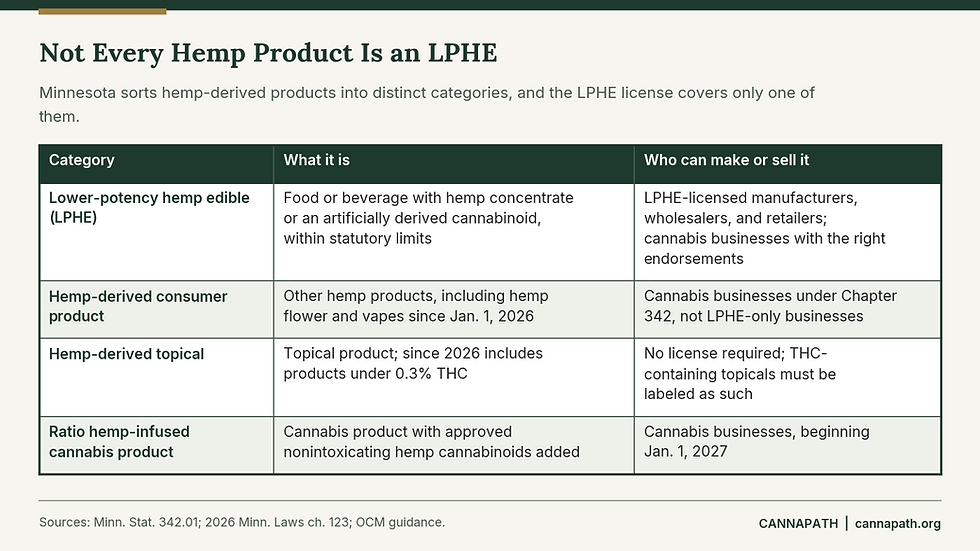
That distinction matters. A hemp topical isn’t regulated the same way as an edible. A hemp-derived consumer product isn’t automatically a lower-potency hemp edible just because it comes from hemp. And Minnesota’s hemp business licenses are built around the lower-potency hemp edible market specifically, not as a universal license for every possible hemp-derived product. OCM made that line very visible on January 1, 2026, when hemp flower and vapes were classified as hemp-derived consumer products under Chapter 342, which means LPHE businesses can no longer buy or sell them.
The terminology also matters when reading federal law, because “lower-potency hemp edible” is Minnesota’s term. The federal government doesn’t use it. Federal law asks whether a product qualifies as “hemp” under the federal definition.
Does Minnesota classify this as an LPHE? Does federal law still classify it as hemp? Those are increasingly two separate questions.
Minnesota has moved from hemp registration to real business licensing
This is probably the biggest operational change Minnesota hemp businesses have been through.
Under the old system, businesses registered hemp-derived cannabinoid products under a temporary framework. That registration system closed August 31, 2025. Businesses that wanted to keep selling qualifying products had to apply for the new lower-potency hemp edible licenses during the October 2025 licensing window.
OCM received more than 2,600 applications in that window, the large majority from retailers. The transition period that gave businesses extra time to move from the old section 151.72 system into Chapter 342 ended March 31, 2026. After that, licensed businesses were expected to operate fully under Chapter 342.
The market did not collapse when licensing arrived. OCM’s September 14, 2026, data show 2,623 total LPHE applicants across retailer, manufacturer, and wholesaler categories, and 2,013 licenses issued: 1,893 retailers, 69 manufacturers, and 51 wholesalers. OCM notes that the data are preliminary and subject to change.

That number deserves attention, because it shows something easy to lose amid the federal headlines: Minnesota has already built a substantial licensed lower-potency hemp industry.
The question now is how much of it can keep operating under the federal definition that takes effect later this year.
The Minnesota market is still legal today
As of September 22, 2026, Minnesota continues to recognize lower-potency hemp edibles as a lawful, regulated product category.
OCM accepts applications for LPHE manufacturers, wholesalers, and retailers on an ongoing basis. A licensed LPHE retailer may sell qualifying products to customers 21 and older, subject to Chapter 342 and the applicable rules.
Under Minnesota’s current consumer guidance, qualifying THC products may contain up to 5 milligrams of THC per serving and no more than 50 milligrams of THC per package for non-beverage products. Beverages may contain up to 10 milligrams of THC per container. The 2026 law also added a large-format option: a multi-serving LPHE beverage of at least 750 milliliters with no more than 5 milligrams per serving and a maximum of 17 servings, sold for off-site consumption only. These products remain subject to the state’s product approval, testing, packaging, and labeling framework.
That is very different from the federal standard that is coming.
And the difference is not a rounding error.

A Minnesota-compliant package can contain tens of milligrams of THC and still be lawful under Minnesota law. The federal definition scheduled to take effect in December would generally exclude a finished hemp-derived cannabinoid product containing more than 0.4 milligrams of the covered cannabinoids per container.
A product can therefore be legal in Minnesota and, at the same time, stop qualifying as federally legal hemp.
That is the central compliance problem businesses need to understand.

The state has also made compliance a lot more concrete
The move to licensing brought a much more recognizable compliance system with it. Testing is a good example.
Minnesota requires qualifying cannabinoid products to be tested for contaminants, potency, homogeneity, and the accuracy of the cannabinoid profile. The requirements cover residual solvents, microbiological contaminants, heavy metals, pesticide residue, mycotoxins, and foreign material. Businesses subject to testing must keep test results for at least five years and make them available for public review, in plain language, on request.
The testing system has also been under implementation pressure, because Minnesota’s licensed laboratory capacity wasn’t initially big enough for the volume of products moving into the regulated market.
The Legislature responded in 2026 by letting LPHE manufacturers keep using qualifying out-of-state ISO/IEC 17025-accredited laboratories through May 31, 2027, under OCM’s criteria. The point was to relieve testing bottlenecks while Minnesota’s own lab capacity catches up.
That says something about Minnesota’s regulatory approach. The state didn’t drop testing because it was hard to administer. It kept the requirement and created more capacity to make compliance possible.
For a business owner, that distinction matters. A requirement that exists only on paper is one thing. A requirement backed by licensing, lab documentation, five-year recordkeeping, and inspection authority is another.
Retail compliance is no longer just about having a product on the shelf
A Minnesota LPHE retailer also has to deal with the local government layer.
Before making retail sales, an LPHE retailer operating a retail establishment needs a local retail registration in addition to its state license. A sale can’t legally happen without both, and Minnesota law allows local government to impose a civil penalty of up to $2,000 for each violation.
This matters most for businesses that used to think of hemp as an add-on product line rather than a regulated operation.
The regulatory burden is no longer just “make sure the product has the right amount of THC.” The state framework now reaches licensing, local authorization, product sourcing, testing, labels, records, employees, sales practices, tax compliance, and operational controls.
That is much closer to the way traditional regulated industries are run.
Minnesota’s tax burden changed too
There is another change that is easy to overlook because it isn’t usually described as a “hemp law.”
Minnesota’s cannabis gross receipts tax rose from 10% to 15% on July 1, 2025, and it applies to taxable hemp-derived products, including lower-potency hemp edibles. The 15% cannabis tax is charged on top of the 6.875% state general sales tax and any applicable local sales taxes.

So a compliant Minnesota hemp retailer isn’t operating in a simple, low-tax consumer-product environment.
For operators who built their business models under the 10% rate, this was a meaningful change in margins and pricing. For manufacturers and wholesalers, it reinforces the broader point: Minnesota now treats this as a regulated cannabinoid industry, not a novelty category sitting outside the normal regulatory system.
The rules changed again in 2026
Minnesota’s 2026 legislative changes are especially interesting because they don’t all point toward tighter restriction.
One of the most important took effect August 1, 2026: a business can now hold both cannabis and lower-potency hemp licenses at the same time, and businesses with the same majority owners can operate both in the same space.
That is a substantial structural change. It means Minnesota is acknowledging that the long-term market may not consist of separate “hemp companies” and “cannabis companies.” Some businesses will operate across both categories, if they meet the licensing and operational requirements for each.
The Legislature also changed labeling rules in 2026. LPHE products can now provide certain source information through a scannable QR code. Hemp-derived topical products containing THC must be labeled as such. And LPHE products that contain only nonintoxicating cannabinoids and no THC no longer have to display the universal THC symbol. Minnesota also expanded hemp-derived topical products, which don’t require a license to make or sell, to include products with less than 0.3% THC.

These changes matter because they show Minnesota isn’t simply freezing the hemp market in place while it waits for federal action.
The state is continuing to develop it.
Minnesota is even looking past the current LPHE structure
The 2026 legislation includes an interesting preview of where Minnesota’s cannabinoid market could go next.
Beginning January 1, 2027, Minnesota law creates a category called a “ratio hemp-infused cannabis product.” These are cannabis products that contain approved nonintoxicating cannabinoids derived from hemp. The statute sets separate limits depending on whether the product is an edible, a beverage, a topical, or a vaporized product.
The same legislation also reshapes the broader cannabis business structure starting January 1, 2027, including creating the cannabis macrobusiness license.
None of that means Minnesota is turning lower-potency hemp into marijuana or eliminating the LPHE category.
It means the state is starting to build a more integrated cannabinoid marketplace, where hemp-derived and cannabis-derived ingredients can appear together in regulated products under defined circumstances.
That is an important development to watch.
Then the federal government changed the equation
Everything above describes where Minnesota is going. The federal government has created a very different problem.
On November 12, 2025, President Trump signed Public Law 119-37, and Section 781 rewrote the federal definition of hemp. The amended statute changes the measurement from delta-9 THC to total tetrahydrocannabinols, expressly including THCA, and creates several new exclusions for hemp-derived cannabinoid products.
For plant material and intermediate products, the new framework uses a total-THC standard instead of looking only at delta-9. That matters because THCA now counts.
The law also excludes cannabinoids that can’t naturally be produced by Cannabis sativa, as well as cannabinoids that can occur naturally in the plant but were synthesized or manufactured outside it. And most dramatically for today’s consumer market, it excludes finished hemp-derived cannabinoid products containing more than 0.4 milligrams per container of the combined total of THC and certain other cannabinoids with similar effects, as the statute and the eventual determinations of the Secretary of Health and Human Services define them.

There is an important detail here that gets misstated a lot.
The federal number is 0.4 milligrams per container, not per serving.
It also isn’t simply a statement that “hemp can contain 0.4 mg of delta-9 THC.” The statutory language reaches combined totals of THC and other covered cannabinoids, and it separately addresses where a cannabinoid came from and how it was produced.
That is why businesses should be very careful about relying on social-media summaries of the federal change.
The date moved, but the problem didn’t go away
Section 781 originally took effect 365 days after enactment, which pointed to November 12, 2026.
Congress later passed a stopgap funding bill that moved most of the change back to December 11, 2026, and OCM updated its guidance to tell Minnesota hemp businesses to plan around that date. One piece did not move: according to trade coverage of that bill, the exclusions for certain synthetic cannabinoids still begin November 12. That is exactly the kind of detail worth confirming with counsel for a specific product.
The extra month helps, but it doesn’t resolve the underlying issue.
Minnesota is continuing to license LPHE businesses under state law while telling them, at the same time, that many products perfectly legal under Minnesota’s current rules will no longer meet the federal definition of hemp once the change takes effect.
That creates a regulatory split many Minnesota business owners have probably never dealt with before.
A state license can tell you that you are authorized to do something under state law. It can’t make a product “federally hemp” when Congress has defined hemp differently.
There is another federal layer that predates the new hemp law
There is also a federal issue that has nothing to do with the 0.4-milligram provision.
The FDA has long maintained that the federal Food, Drug, and Cosmetic Act separately restricts adding THC or CBD to conventional food, and that THC and CBD are excluded from the federal definition of a dietary supplement. FDA has continued to enforce that position, including warning letters over delta-8 THC products marketed as food.
So “this product qualifies as hemp under the Farm Bill” has never been a complete answer to the federal question.
Hemp status and FDA food legality are separate issues.
That matters especially for Minnesota LPHE manufacturers, because Minnesota regulates these as lawful state products while federal agencies keep their own jurisdiction and requirements. The federal definition change doesn’t create the whole federal problem overnight. It adds another major layer to an already complicated one.
What happens to a Minnesota product that exceeds the future federal limit?
This is where legal and business advice matters much more than a generic statement that “the federal government is banning hemp.”
Minnesota’s position is clear: its definition of LPHE doesn’t change just because federal law changes. OCM says Minnesota’s LPHE products, licenses, and state framework remain in place after December 11, 2026.
But OCM also warns that products compliant under Minnesota law may become federally noncompliant, and it points to possible consequences for banking and federally insured financial services, payment systems, federal tax treatment, and interstate commerce.
For a Minnesota business, then, the question may not simply be whether state regulators will let the product stay on the shelf. The business may also have to figure out whether the product can still be manufactured, transported, financed, run through payment systems, shipped across state lines, or otherwise handled inside the federal legal environment.
Those are different compliance questions.
And that is exactly why a business owner shouldn’t assume a Minnesota license answers all of them.
Minnesota is not waiting for federal certainty
One of the most interesting parts of the current situation is that OCM isn’t telling hemp businesses to shut down and wait.
OCM’s federal hemp guidance lays out several paths for businesses to consider with their legal and business advisers: staying in the hemp market, entering Minnesota’s adult-use cannabis industry, or exiting the hemp market. OCM also notes that many prospective cannabis businesses are still moving through licensing and may be open to partnership or investment, and it is convening an industry forum on the federal changes in late September.

OCM also identifies active federal proposals that could change the landscape before the new definition takes effect, including the Lawful Hemp Protection Act, which would build a federal regulatory framework for hemp-derived consumer products, and the Beverage Regulatory Parity Act, which would take a separate approach for hemp beverages. Neither has received a vote in either chamber. Other bills have circulated too. H.R. 6209, the American Hemp Protection Act of 2025, would repeal Section 781, and H.R. 7024 would replace the original 365-day implementation period with three years. Together they show the range of approaches on the table, from repeal to delay to an entirely new regulatory structure.

None of those proposals is current law.
That point is especially important right now, because the federal hemp market is often discussed as though every detail has already been decided.
It hasn’t.
The law that is actually enacted is what matters. Pending legislation is something to monitor, not something a business can rely on.
So where does lower-potency hemp stand?
As of September 22, 2026, Minnesota has a functioning, licensed lower-potency hemp market.
The temporary registration era is over. Retailers need state licensing and local registration. Manufacturers and wholesalers operate under Chapter 342. Products have to meet Minnesota’s testing, packaging, labeling, product-category, and cannabinoid requirements. The state charges a 15% cannabis gross receipts tax on taxable hemp-derived products. And OCM continues to issue licenses to a market that already numbers in the thousands.
Minnesota is also still building. It now allows businesses to hold both cannabis and hemp licenses under the new ownership rules. It adjusted labeling requirements, expanded the treatment of certain topicals, created a path for ratio hemp-infused cannabis products beginning in 2027, and extended access to qualifying out-of-state labs through May 2027.
At the federal level, the definition of hemp is moving the other way.
Unless federal law changes again, December 11, 2026, brings a much narrower definition of federally lawful hemp for cannabinoid products, including the 0.4-milligram-per-container threshold and broader total-THC rules.

That leaves Minnesota businesses facing something more complicated than a simple “hemp ban.” They are operating in a state that deliberately built a regulated lower-potency hemp market while the federal government redefines the category underneath them.
So the practical question for a business is no longer just, “Is hemp legal?” That question is too simple to be useful.
The better questions are these. What kind of hemp product is this? What does Minnesota classify it as, and what does the federal government classify it as? How is it manufactured, and what cannabinoids are present? How much is in the container? How is the product sold and transported? Which licenses and registrations apply? And what happens to the business if state legality and federal hemp status stop pointing in the same direction?
Those are the questions that will increasingly decide whether a hemp business is operating inside its compliance boundaries.
WHAT THIS MEANS FOR YOU The hard part is no longer finding the one rule that applies. It is making all of the rules agree with each other, and that is where this industry is becoming like every other regulated industry. |
In our next lower-potency hemp article, we’ll take a much closer look at the federal change itself: the 0.4-milligram-per-container standard, total THC, THCA, synthetic and chemically converted cannabinoids, and what those changes could mean for products that are legal in Minnesota today.
One more thing. If you want a quick outside read on one piece of your program, like your product sourcing procedure or how you keep your testing records, that is what Sentinel Scout does. Send us one module or standalone policy, plus up to three supporting documents that go with it, and we will send back a gap analysis within three business days. No contract. It is $99 through October 31 ($199 after), and the fee credits toward a larger engagement if you ever want one. You can find it at cannapath.org/sentinel.
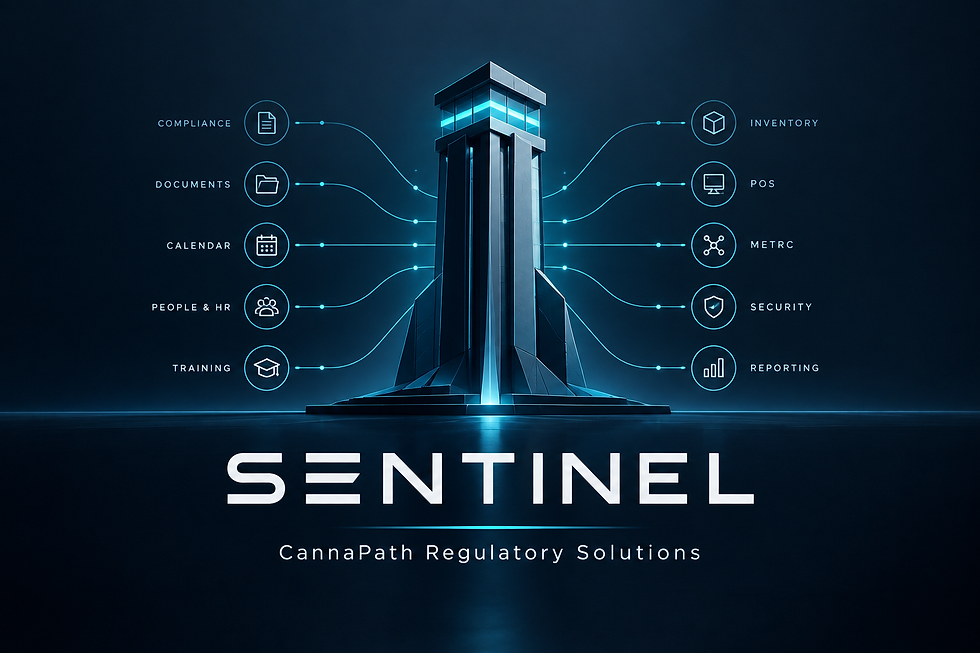
Scout is the first piece of CannaPath Sentinel, the cannabis compliance and business operating platform we are building for full release in March 2027. Sentinel brings compliance documents, people and training records, inventory, POS and Metrc data, security, and a single calendar for every regulatory, employee, and business deadline into one place. If you would like to know when it is ready, email thewatch@cannapath.org.
And if you get into something you would rather not sort out alone, we are here. Reach out.
-Drew
Last reviewed September 22, 2026. OCM licensing figures are preliminary data published September 14, 2026 and are subject to change. Minnesota and federal hemp law remain subject to further legislative, regulatory, and legal developments. This article is for general informational purposes and is not legal advice.
Primary sources: Minnesota Office of Cannabis Management, including Application and License Holder Data (Sept. 14, 2026) and Federal Hemp Changes (updated Sept. 2026); Minnesota Statutes chapter 342 and 2026 Minnesota Laws chapter 123; Minnesota Department of Revenue; U.S. Government Publishing Office, Public Law 119-37; U.S. Food and Drug Administration; Congress.gov.