The Current State of Minnesota Cannabis Microbusinesses and Mezzobusinesses

Updated: 2 days ago
What the licenses allow today, what the numbers tell us, and why 2027 may change the strategy
By Drew Duffy, MHA, FACHE, Founder & Managing Director, CannaPath Regulatory Solutions
Minnesota’s cannabis market has moved past the point where the central question is simply whether cannabis businesses can legally open.
The state now has licensed businesses operating, a functioning adult-use market, a medical program with more than 90,000 registered patients, a statewide seed-to-sale tracking system, established pre-licensure inspections, and a regulatory structure that is getting more specific about how cannabis businesses are expected to operate after they receive a license. At the same time, Minnesota has already enacted another substantial round of changes that take effect January 1, 2027.
For microbusinesses and mezzobusinesses, that combination makes this a particularly important moment.
These licenses were designed to give smaller businesses a way into a vertically integrated cannabis market. They can combine cultivation, manufacturing, and retail without an operator having to build an enterprise around several separate cannabis licenses. That basic concept is still intact. What has changed is the level of operational detail around it, and what is coming next may make the choice between a microbusiness and a mezzobusiness a lot more strategic than it first appears.
This is a snapshot of where those license types stand as of September 22, 2026, using application data the Minnesota Office of Cannabis Management (OCM) published through September 14, 2026, along with current Minnesota law and legislation already enacted for 2027. The application figures are OCM’s public numbers and will keep moving as processing continues.
Microbusinesses are not a niche part of Minnesota’s cannabis market
The first thing that stands out in OCM’s current data is how large the microbusiness applicant pool actually is.
As of September 14, OCM reported 1,854 total microbusiness applicants. Of those, 978 had reached preliminary approval and 273 licenses had been issued. Another 330 were qualified applicants, 45 had withdrawn, and 228 were denied. Microbusiness licenses have no statewide cap.
That makes the microbusiness license fundamentally different from the mezzobusiness license.
The mezzobusiness pool is much smaller, and the license itself is capped. OCM reported 273 total mezzobusiness applicants for 100 available licenses, with 49 preliminarily approved and 24 issued as of September 14. (Yes, 273 microbusiness licenses issued and 273 mezzobusiness applicants. That is a coincidence in OCM’s data, not a typo.) Of the mezzobusiness applicants, 229 applied as social equity applicants and 44 as general applicants, competing for 100 licenses split evenly between the two.
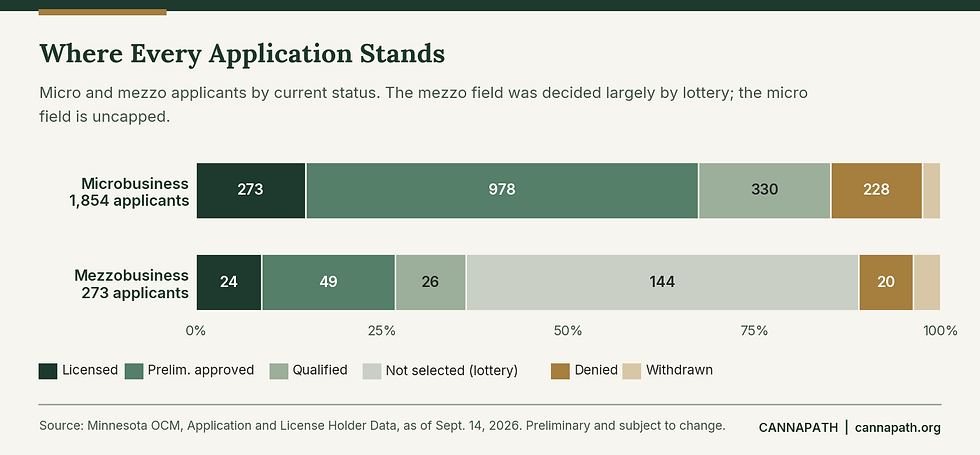

Put another way, microbusinesses and mezzobusinesses together account for 2,127 of the 3,541 cannabis business applications in OCM’s September 14 data. That is roughly 60 percent of all cannabis business applicants.
Among licenses issued, the two types account for 297 of 376, or roughly 79 percent.

Those numbers matter because they say something more useful than which license is “popular.” They show where a very large share of Minnesota’s cannabis business infrastructure is being built.
There is another distinction worth understanding. The state is not currently accepting new microbusiness or mezzobusiness applications. OCM says those license types are closed for now, and it has not determined whether more application opportunities will be offered. For mezzobusinesses, the 2026 legislation pushed the earliest date OCM can decide to make additional capped licenses available until July 1, 2027. So, the conversation in September 2026 is mostly about the businesses already moving through the process, the ones already licensed, and the ones planning how to operate and grow inside the framework they have.
One more clock applies to applicants who have not yet reached preliminary approval. Under the 2026 law, qualified applicant status now expires. Status granted before June 1, 2026, expires January 1, 2027, and status granted after that date expires six months after it was granted. Once that status lapses, OCM must deny the application, although the applicant can apply again in a future window. For the 330 microbusiness and 26 mezzobusiness applicants sitting at qualified status in OCM’s data, that is a real deadline.
The word “micro” can be misleading
There is a tendency to hear “microbusiness” and think “small retail store.”
That is not what Minnesota created.
Depending on its endorsements, a cannabis microbusiness can cultivate cannabis, manufacture cannabis products and certain hemp products, package products, sell directly to consumers, purchase cannabis and related products from other licensed businesses, transport its own products between its facilities, and operate a retail location. A qualifying microbusiness can also operate an on-site consumption establishment for edible cannabis products and lower-potency hemp edibles.
The cultivation limit is substantial for a business most people would still call “small.” A microbusiness may cultivate up to 5,000 square feet of plant canopy indoors or one-half acre of mature flowering plants outdoors. Minnesota law also directs OCM to set a manufacturing limit tied to the amount of flower that could be harvested from a 5,000-square-foot canopy.
That does not mean every microbusiness will cultivate, manufacture, and retail.
The license is deliberately flexible. One operator may concentrate on retail and purchased inventory. Another may cultivate and manufacture with a very limited retail operation. Another may be building a fully vertical operation from cultivation through final sale.
The license permits the structure. The endorsements determine which activities the business may perform.
That distinction gets more important under the changes already enacted for 2027.
The mezzobusiness is more than a larger microbusiness
Conceptually, a mezzobusiness looks like the next step up.
Current law allows a mezzobusiness to cultivate up to 15,000 square feet of indoor plant canopy or one acre of mature flowering plants outdoors, and OCM can raise the outdoor limit to as much as three acres if it determines the expansion is consistent with the statutory goals and market demand. Its manufacturing limit is tied to the flower that could be harvested from 15,000 square feet of canopy. A mezzobusiness may operate at three retail locations, subject to local retail registration requirements.
That is a significant difference in physical capacity.
But the more important difference may be structural.
Minnesota requires a mezzobusiness to hold multiple endorsements. Under current law, a mezzobusiness must obtain at least two qualifying endorsements within 18 months of receiving its license, or OCM may suspend, revoke, or decline to renew it. The 2026 legislation keeps that basic requirement while reworking the endorsement structure around it.
That requirement matters because the mezzobusiness license was never meant to work as a bigger retail license. It is built around real participation in multiple parts of the cannabis supply chain.
And that has a compliance consequence that is easy to overlook.
A business can be licensed and still not be operationally ready for everything its license structure makes possible.

Minnesota is getting much more specific about endorsements
The endorsement structure is where today’s system starts to look very different from the simple descriptions that circulated when Minnesota first created its cannabis licensing framework.
OCM’s current materials tie a long list of activities to microbusinesses and mezzobusinesses: cannabis cultivation, cannabis extraction and concentration, hemp extraction and concentration, creation of artificially derived cannabinoids, edible cannabinoid product handling, production of consumer products, retail operations, internal transportation, and the applicable medical cannabis endorsements. A microbusiness can also obtain the on-site consumption endorsement, which OCM identifies as available only to microbusinesses.
The important point is that the license alone no longer tells the whole story.
A business needs to know which activities it intends to perform, which endorsement authorizes each one, and what operational requirements come with that endorsement.
The 2026 legislation takes that a step further. Beginning January 1, 2027, a business that wants to perform certain activities has to apply for and obtain the matching endorsement instead of relying on the underlying license authority. A microbusiness that wants to cultivate will need a cannabis cultivation endorsement. A business that wants to do cannabis extraction will need the extraction endorsement. Manufacturing is being split more explicitly among extraction, edible product handling, and consumer product production. The same structural change applies to mezzobusinesses.

This may sound like administrative housekeeping.
It is more than that.
For a business owner, an endorsement is an operational boundary. It tells the regulator what you are authorized to do, and it ties that activity to the applicable rules, your plans, your physical premises, and the procedures your employees use.
That is exactly where a lot of cannabis compliance work moves from understanding the rule into running the business.
The application is only the beginning
The regulatory process also says something about what OCM expects from these businesses.
Once an applicant reaches preliminary approval, OCM requires detailed final plans of record before a license can be issued. For both microbusinesses and mezzobusinesses, that includes a Site, Security, and Operations Final Plan of Record with facility diagrams, an Inventory Control and Diversion Prevention SOP Final Plan, a Quality Assurance SOP Final Plan, and an Accounting and Tax Compliance SOP Final Plan. Businesses that transport product have additional vehicle disclosure requirements, including specified coverage for cargo, bodily injury, and property damage.
This is an important shift in how applicants should think about documentation.
Those documents don’t get submitted and forgotten. They become the written record of how the business says it will operate.
That matters because OCM’s process moves from final plans into a physical pre-licensure inspection. OCM says applicants must submit their finalized plans, complete site registration, and receive local government approval before the pre-license inspection can take place. It also says businesses should expect the process from site registration to licensure to take up to 90 days, with local government review happening inside that window.
Then comes the physical reality.
OCM’s August 2026 microbusiness/mezzobusiness pre-license inspection materials make it clear the inspection is not a conversation about whether a security policy exists. Inspectors are looking at whether the actual environment matches the regulatory requirements. The materials cover alarm systems, backup systems, video surveillance, camera coverage, lighting, commercial-grade locks, electronic locks and keypads, restricted and limited-access areas, employee age requirements, inventory practices, retail activity, and other operational controls. The surveillance requirements include continuous 24/7 operation, coverage of entry and exit areas, coverage of cultivation, manufacturing, storage, packaging, sales, and waste areas, and secure storage of recordings for at least 90 days.
There is a lesson here that reaches well beyond the inspection itself.
A policy on paper and an operation in practice are two different things.
A business can have an excellent security policy and still have a camera pointed in the wrong direction. It can have an inventory procedure and still have employees who handle transfers inconsistently. It can have a quality assurance manual and still lacks a reliable way to document that the required quality checks actually happened.
Those gaps are the difference between having a compliance program and operating one.
Metrc makes that distinction even harder to ignore
Minnesota’s statewide monitoring system is not a side task.
OCM requires cannabis businesses to use the statewide system administered through Metrc, which traces cannabis from cultivation through processing, testing, distribution, and sale. Businesses must create a Metrc account, attach serialized tags to every plant and product, and cover the costs of using the system.
For microbusinesses and mezzobusinesses this matters even more, because vertical integration can create a much more complicated internal flow of material.
A business that cultivates, manufactures, packages, and sells its own products is not necessarily creating less compliance work by cutting out outside vendors. In some circumstances it is creating more internal control points.
The plant has to be tracked. The harvest has to be accounted for. Material moving into manufacturing has to reconcile. Products must move through testing and packaging requirements. Finished inventory has to reconcile with sales. Waste has to be handled and documented appropriately, and transfers have to be recorded.
And when something does not reconcile, somebody has to determine why.

That is one reason inventory control and diversion prevention show up again and again in OCM’s licensing and inspection framework. The regulator isn’t simply interested in whether a business possesses cannabis. The system is designed around being able to explain where it came from, where it went, and what happened to it along the way.
The same principle applies to newer operational changes.
In July 2026, OCM issued guidance clarifying how licensed cannabis businesses can bring hemp-derived consumer products and certain hemp concentrates into their Metrc inventories through external transfers. OCM now reviews and approves those transfers, including supporting compliance information where applicable. Lower-potency hemp edibles are treated differently and are not tracked in Metrc the same way.
Minnesota also changed its rules around good-faith transactions and toll processing in 2026. Since late May, cannabis and hemp businesses can use legitimate processing-service arrangements without structuring them as a sale and buyback, but the resulting transfers still must be recorded correctly in Metrc and documented through the process OCM has established.
For vertically integrated micro and mezzo operators, these details matter because operational flexibility is growing and at the same time documentation expectations are getting more explicit.
The medical market is not disappearing. It is being rebuilt.
One of the most important developments for microbusinesses and mezzobusinesses is the restructuring of Minnesota’s medical cannabis system.
It is tempting to think of medical cannabis as an older piece of the market that will slowly matter less now that adult-use cannabis is established.
The current numbers do not support that assumption.
OCM reports more than 90,000 registered medical cannabis patients. In September it also reported that medical cannabis sales totaled approximately $100 million during the first year of state-licensed adult-use sales, compared with approximately $150 million in adult-use sales. OCM says medical enrollment has more than doubled, from just over 41,000, since patient fees were eliminated in 2023 and qualifying conditions were expanded in 2024.

So when Minnesota changes how the medical market is structured on January 1, 2027, it is changing the infrastructure behind an active market.
The state is eliminating the medical cannabis combination business as a license type and replacing it with the new macrobusiness. It is merging the separate medical and adult-use supply chains, so for most of the chain the line between the two moves to the point of retail sale. And it is organizing medical participation around three endorsements: medical cannabis cultivation, medical cannabis manufacturing, and medical cannabis retail. Microbusinesses and mezzobusinesses will be eligible to apply for them.
Medical endorsements themselves aren’t brand new. Current law already lets an authorized cannabis business seek one. What’s new is the capacity attached to them, which gives smaller vertically integrated businesses a far stronger reason to take part in the medical market.
What medical changes mean for microbusinesses
A microbusiness with a cannabis cultivation endorsement will be able to seek a medical cannabis cultivation endorsement beginning January 1, 2027.
There is an important capacity component attached. A qualifying microbusiness will be able to cultivate an additional 1,000 square feet of indoor canopy, or one-quarter acre of outdoor mature flowering plants, above its ordinary microbusiness cultivation limit.
For a business already operating at or near its cultivation limit, that is not a trivial change. It also comes with a supply obligation: a share of what you grow has to go to businesses that hold medical endorsements. OCM’s summary of the law describes that share as one-quarter, so confirm the exact calculation with OCM before you plan production around the added canopy.
The medical manufacturer endorsement creates another potential expansion. A microbusiness holding that endorsement can receive up to a 25 percent increase in its cannabis manufacturing capacity, based on the limit established by OCM rule. But endorsement carries obligations too. A business holding a medical cannabis manufacturer endorsement must manufacture the high-medical-need products OCM identifies, and medical cannabinoid products made under the endorsement can only be sold into the medical-endorsed portion of the supply chain as the law prescribes.
Retail changes are potentially even more visible.
A microbusiness with a retail operations endorsement can seek a medical cannabis retail endorsement. Under the new law, a qualifying microbusiness can operate one additional retail location beyond its normal limit when at least one retail location is in an area OCM identifies as a high-medical-need area. The business will also have to meet the medical retail requirements, including employing or contracting with a pharmacist or certified medical cannabis consultant, and the patient consultation requirements that come with it.
That changes the strategic ceiling of the microbusiness model.
It does not turn a microbusiness into a large operator overnight.
It does create a pathway for a small vertically integrated business to participate more meaningfully in Minnesota’s medical supply chain.
The mezzobusiness gets the same opportunity, at a different scale
The medical changes are just as significant for mezzobusinesses.
A mezzobusiness with a cultivation endorsement can apply for a medical cannabis cultivation endorsement and receive an additional 3,000 square feet of indoor canopy or one-half acre of outdoor mature flowering plants if it meets the applicable requirements. The same medical supply obligation comes with it.
A mezzobusiness can also seek a medical cannabis manufacturer endorsement. As with the microbusiness, the endorsement can increase manufacturing capacity by up to 25 percent above the applicable rule-based limit, while adding obligations around medical cannabinoid products and high-medical-need products.
The retail opportunity is larger, and so is the bar to reach it. A mezzobusiness with a medical cannabis retail endorsement may operate up to two additional retail locations beyond its ordinary three-location limit, but the statute requires at least two of its retail locations to be in areas OCM identifies as high medical need. A microbusiness needs only one. A mezzobusiness that clears that bar could potentially reach five retail locations under the new structure.


Again, this is not simply a larger number on a licensing chart.
Every additional location introduces another physical site, another set of local approvals and registrations, another security environment, another inventory environment, another group of employees, and another opportunity for the written compliance program and the actual operation to drift apart.
The law can authorize expansion.
It does not make expansion operationally simple.
The change that may matter most over time: reclassification
Minnesota has also created something that did not previously exist in this form: a statutory pathway for growth from one license category into the next.
A microbusiness that has held and operated a medical cannabis cultivation endorsement for at least two years and remains in good standing with OCM will be eligible to petition to reclassify as a mezzobusiness.
A mezzobusiness can similarly petition to reclassify as a macrobusiness after holding and operating a medical cannabis cultivation endorsement for at least two years, provided it has also held and operated either a medical cannabis manufacturing endorsement or a medical cannabis retail endorsement and meets the other statutory requirements.
Reclassification does not happen automatically.
OCM decides when reclassification opportunities are available. A petition must include financial statements showing the business can operate the larger license, a transition plan for the new regulatory requirements, information about its medical endorsements and how it serves patients, and a description of its planned growth. OCM can deny a petition for a variety of reasons, including an incomplete submission, unpaid fees or fines, substantial noncompliance, or failure to meet the statutory qualifications.
There is also an explicit social equity component. The law requires the number of reclassifications approved for qualified social equity petitioners to be at least equal to the number approved for other applicants. For microbusinesses seeking to become mezzobusinesses, every qualified social equity petitioner is to be reclassified, and a selection process applies to qualified non-social-equity petitioners only when they outnumber the social equity approvals.
The timing is worth doing the math on. Medical cannabis cultivation endorsements in their new form begin January 1, 2027, and eligibility takes two years of holding and operating one. That puts the earliest possible micro-to-mezzo petition in early 2029, and later for any business that gets its endorsement after the first day. Those two years are when the record gets built.

That makes the micro-to-mezzo pathway worth watching.
For a well-run microbusiness, “micro” may no longer have to mean “stay micro.”
The new framework lets some businesses treat the first license as a starting point rather than a permanent ceiling.
But growth creates a different kind of compliance problem
This is where the current state of the market gets interesting.
The regulatory system is becoming more flexible in some places while becoming more exacting in others.
Businesses have more ways to structure their operations. Microbusinesses and mezzobusinesses can integrate more activities. Medical endorsements create additional market opportunities. Reclassification creates a potential growth path. The 2026 legislation also relaxed some restrictions on legitimate business-to-business transactions and removed the previous prohibition on holding cannabis and hemp licenses at the same time.
At the same time, every additional activity creates another compliance relationship.

That last row is one of the reasons we think documentation deserves considerably more attention than it usually gets in cannabis compliance conversations.
A business does not become compliant because it has a binder.
The binder is useful only when it describes the way the business actually operates, and when the business can produce evidence that it followed what it said it would do.
The biggest issue may be compliance drift
Compliance drift doesn’t have to start with a business deciding to ignore a rule.
In fact, some of the most difficult compliance problems happen in businesses where nobody intended to violate anything.
A procedure is written when the company is preparing for inspection. Then the company opens.
Employees learn shortcuts. A manager modifies a process because the original procedure slows down production. A different employee takes over inventory. The POS system changes. The security configuration changes. A new product is added, a vendor changes, or the business begins using a different processing arrangement. Someone updates one document but not the three other documents that depend on it.
Six months later, the business may still have the plan OCM approved, but the day-to-day operation has moved somewhere else.
The business has drifted.
And a vertically integrated microbusiness or mezzobusiness has more places for that drift to happen, because more activities are happening inside the same organization.
OCM’s compliance structure increasingly reflects that reality. Businesses are required to maintain final plans of record, notify OCM about material changes, update the related documentation, and in some circumstances get approval before implementing changes. OCM specifically states that material changes to final plans must be submitted and reviewed, and that changes affecting cultivation or manufacturing plans may need to be submitted in advance.
That creates a practical question for every microbusiness and mezzobusiness:
Does your written compliance program still describe the business you are actually operating today? |
That’s a much better question than asking whether the business “has SOPs.”
Another deadline micro and mezzo operators should have on the calendar
For businesses that manufacture or sell hemp-derived products, the regulatory environment is also getting more complicated because of a federal change now scheduled to take effect on December 11, 2026, unless further federal action occurs. The original date was November 12; a September federal funding bill pushed it back.
OCM says the new federal definition of hemp will effectively exclude final hemp-derived cannabinoid products containing more than 0.4 milligrams of total THC per container. OCM also emphasizes that the federal change does not change Minnesota’s state definition of lower-potency hemp edibles or automatically make those products illegal under Minnesota law.
That leaves Minnesota operators in a complicated spot, because a product can remain lawful under the state framework while becoming federally noncompliant. OCM specifically warns of potential effects on banking, payment services, federal tax deductions, and interstate commerce.
For a microbusiness or mezzobusiness whose business model depends heavily on hemp-derived products, this is not an abstract federal issue.
It is a planning issue. It may affect product strategy, banking relationships, interstate activity, vendor relationships, and how the business thinks about its cannabis and hemp operations going into 2027.
So where does that leave Minnesota’s microbusinesses and mezzobusinesses?
In a very different position from where they were a year or two ago.
The market is operating. OCM reported more than $250 million in combined adult-use and medical cannabis sales during the first year of state-licensed retail sales, and more than 300 new cannabis businesses launched in that time. We have come a long way, there is still distance to cover, and the question now is increasingly how these businesses operate rather than whether the system will exist.
The microbusiness license remains the broadest path into vertically integrated cannabis operations at the smaller end of the market. It offers real flexibility: a 5,000-square-foot indoor cultivation ceiling or one-half acre outdoors, access to multiple operational endorsements, one retail location, and a unique opportunity for on-site consumption.
The mezzobusiness sits higher in the same vertically integrated model. It has more cultivation capacity, more retail locations, and a larger manufacturing allowance, and the license carries a stronger expectation that the business will actually perform multiple activities.
Neither license is “easy.” They are simply different ways of organizing a regulated business.
And the next phase of the Minnesota market looks likely to make the difference between the two even more meaningful.
Beginning January 1, 2027, medical cannabis cultivation, manufacturing, and retail endorsements will open additional pathways into the medical market. Microbusinesses and mezzobusinesses can potentially use them to expand cultivation and manufacturing capacity, operate additional retail locations in high-medical-need areas, serve registered medical patients, and build a record that could eventually support reclassification into a larger license category.
That is a meaningful opportunity. It is also a meaningful compliance responsibility.
The question we would ask a Minnesota micro or mezzobusiness today
We would not start by asking whether you have your license.
We would start by asking whether the business you are operating is the same business OCM approved.
Are the site and security controls still accurate? Are the cameras actually covering the areas they are supposed to cover? Are inventory records reconciling? Are employees following the procedures that exist on paper? Are your quality controls documented? Are material changes being reported when required? Are your Metrc practices consistent with what is actually happening on the floor? Are your manufacturing, retail, cultivation, and transportation processes aligned with the endorsements you actually hold?
And perhaps most important, can you prove it?
That last question is where compliance becomes operational rather than theoretical.
Minnesota’s regulatory system is increasingly built around evidence. OCM’s final-plan process, pre-license inspections, Metrc requirements, quality assurance requirements, inventory controls, security requirements, and material-change procedures all point toward the same basic expectation: the business needs to be able to show that the controls it says are in place actually exist and function.
For Minnesota’s microbusinesses and mezzobusinesses, that may be the most important part of where the industry stands right now.
WHAT THIS MEANS FOR YOU The license is the authorization. The operating system is the compliance program. And the evidence is what allows you to show that the two still match. |
CannaPath Regulatory Solutions works from that premise. We don’t believe compliance should be paperwork for paperwork’s sake, or a way to make an operator afraid of the next inspection. A useful compliance program should make the business easier to understand, easier to manage, and easier to prove.
A compliant document is a good start. The real goal is a compliant business.
One more thing, since drift came up. If you want a quick outside read on whether one piece of your program still matches how you actually operate, that is what Sentinel Scout does. Send us one module or standalone policy, plus up to three supporting documents that go with it, and we will send back a gap analysis within three business days. No contract. It is $99 through October 31 ($199 after), and the fee credits toward a larger engagement if you ever want one. You can find it at cannapath.org/sentinel.
And if you get into something you would rather not sort out alone, we are here. Reach out.
-Drew
Last reviewed September 22, 2026. Application statistics are OCM figures published September 14, 2026 and are subject to change. Minnesota cannabis law and OCM guidance continue to evolve; verify current requirements with OCM. This article is for general informational purposes and is not legal advice.
Sources: Minnesota Office of Cannabis Management, Application and License Holder Data (Sept. 14, 2026); Minnesota Statutes chapter 342; 2026 Minnesota Laws chapter 123 (SF 4401); OCM, 2026 Legislative Changes to Chapter 342 (May 2026); OCM Guidance Memo GM-2026-03; OCM microbusiness/mezzobusiness final plan of record and pre-license inspection materials; OCM Federal Hemp Changes (updated Sept. 2026); OCM first-year sales announcement (Sept. 2026).