Why Your Minnesota Cannabis Business May Be Rejected for 10DLC Registration

Minnesota may authorize your business to sell cannabis, but that does not mean a telecommunications carrier must deliver your text messages. Understanding the difference can save operators time, money, and considerable frustration.
By Drew Duffy, MHA, FACHE
Founder & Managing Director, CannaPath Regulatory Solutions
Regulatory review: October 19, 2026
Short answer: a Minnesota cannabis license does not make a business eligible for 10DLC text messaging. As of this writing, major messaging providers such as Twilio, and carriers such as T-Mobile, prohibit cannabis businesses from A2P texting regardless of state legality or message content, so even order-ready texts can be rejected. Rewording the campaign will not fix a category rejection. Confirm your provider's policy in writing before you build any part of your operation around SMS.
Imagine opening a cannabis retail business in Minnesota. You have obtained your license, completed the necessary inspections, established your point-of-sale system, and started building a customer base.
Now you want to send text messages. Perhaps you want customers to know when an order is ready. Maybe you want to send appointment reminders, provide customer-service updates, or notify customers about changes to your operating hours. You already have a business telephone number, and your software provider offers automated messaging. It sounds straightforward.
Then the messaging provider tells you that your business must register for something called A2P 10DLC. You complete the registration, submit your business information, and describe the messages you intend to send.
And your campaign gets rejected.
The confusing part is that you are operating a legitimate Minnesota business. Your cannabis license is valid. Your business is registered, and you have customers who have agreed to receive messages. So why is a telecommunications company refusing to approve your texts?
The answer is that Minnesota cannabis regulation and telecommunications carrier policies are two separate systems. Complying with one does not automatically satisfy the other.

Two separate approvals. Neither one stands in for the other.
What Is 10DLC? A2P Text Messaging Explained
10DLC stands for 10-Digit Long Code. It refers to the ordinary ten-digit telephone numbers businesses may use to send application-to-person text messages, commonly called A2P messaging. An application-to-person message is generally a message generated or sent through software rather than a conventional person-to-person conversation. Businesses use these systems for appointment reminders, account notifications, customer-service communications, and marketing campaigns.
In the United States, carriers require registration for A2P traffic sent through these ordinary ten-digit numbers. The framework generally involves identifying the business sending the messages and describing the intended messaging campaign. The business registration is commonly called the brand registration. The campaign registration describes the messages, intended recipients, consent process, and related details.
The Campaign Registry is part of the registration infrastructure used by participating messaging providers and carriers. A business may need to supply its legal name, tax identification information, website, messaging purpose, sample messages, and an explanation of how recipients agree to receive communications.

Registration documents who you are and what you plan to send. It does not override a prohibited category.
But there is an important limitation.
10DLC registration is not a universal permission slip to send whatever messages a business wants.
It is a registration framework operating within the policies of the telecommunications providers and carriers that carry the messages. A campaign can be properly documented and still involve a prohibited business category.
Why Cannabis Businesses Get Rejected for 10DLC
The problem for cannabis operators is that major messaging providers impose restrictions on cannabis-related businesses and content. These restrictions can apply even when the business operates legally under state law.
For example, as of this writing, Twilio explicitly identifies cannabis and CBD businesses among the categories prohibited from using its SMS and MMS services in the United States and Canada. Its published guidance states that the restriction applies regardless of whether the business is legal under federal or state law.
More importantly, the policy is not limited to messages advertising cannabis. Twilio states that cannabis and CBD product businesses are prohibited from using its messaging services regardless of message content, including nonpromotional uses such as two-factor authentication.
And it isn't only one provider. As of this writing, T-Mobile's Code of Conduct for business messaging lists cannabis among its prohibited content, and T-Mobile charges messaging providers non-compliance fines when prohibited traffic crosses its network.
That is a particularly important distinction for Minnesota operators. An owner may reasonably believe that avoiding product promotions will solve the problem. But if the messaging provider prohibits the business category itself, changing the wording of the message does not resolve the underlying restriction. The business remains a cannabis business. The provider's policy still applies.
This does not establish that every telecommunications provider applies exactly the same restrictions in every circumstance. Provider policies, carrier requirements, and permitted use cases must be evaluated individually. But it does establish why a licensed Minnesota cannabis business should not assume that ordinary commercial SMS services will be available.
Are Transactional Texts Exempt for Cannabis Businesses?
This is where the situation becomes particularly frustrating for operators. There is an understandable difference between advertising a cannabis sale and notifying a customer that an existing order is ready. From the business owner's perspective, one is marketing and the other is customer service.
But a messaging provider may apply restrictions based on the identity or activities of the sender, rather than solely on the promotional content of an individual message. That means an order confirmation, appointment reminder, or account notification may still be prohibited under a provider's policy. Businesses should therefore avoid assuming that describing a campaign as transactional will automatically make it eligible for approval. The actual business category, messaging purpose, recipient relationship, and provider policy all matter.
A business should obtain confirmation from its messaging provider before relying on automated SMS as an essential operating function. That is especially important when the messaging capability is built into a larger software platform. A POS system may advertise text notifications as a standard feature. That does not necessarily mean every customer using the platform is eligible to send every type of message. The underlying messaging provider and carrier restrictions still apply.
Minnesota's Rules for Cannabis Text Message Advertising
Even if a cannabis business identifies a messaging provider willing to consider its proposed communications, another compliance question remains. Does the proposed message comply with Minnesota law?
Minnesota Statutes, section 342.64, establishes restrictions on cannabis and hemp advertising. The statute addresses false or misleading claims, unverified health or therapeutic claims, advertising directed toward younger audiences, and other prohibited practices.
It also establishes requirements for direct, individualized advertising. Before sending direct advertising controlled by a cannabis or hemp business, the business must use an age-affirmation method to establish that the recipient is at least 21 years old. The statute permits methods such as user confirmation, birth-date disclosure, or similar registration procedures. Advertising directed toward location-based devices, cell phones included, is also off limits unless the device owner is 21 or older.
OCM's advertising guidance also explains that cannabis and hemp advertisements must contain specified warnings concerning impairment and health risks. The agency updated that guidance on August 7, 2026. The guidance applies to advertising across multiple formats, including online and social media communications. Businesses should review the full requirements when developing any direct marketing program.
That warning matters for texting in a practical way. The cannabis warning OCM specifies runs about 356 characters, more than twice the 160 characters of a single standard text message, before the business has said anything about its own promotion.

The required warning alone fills more than two standard text messages.
This creates separate compliance considerations. A business might satisfy Minnesota's advertising requirements but still be prohibited from using a particular messaging provider. Conversely, obtaining approval from a messaging provider would not excuse a business from Minnesota's advertising restrictions. And neither approval replaces applicable consent, privacy, or other federal communications requirements. These are different regulatory and contractual obligations that need to be evaluated together.

These apply to any direct cannabis or hemp advertising, whatever channel carries it.
Can You Reword a Rejected Cannabis 10DLC Campaign?
When a business receives a campaign rejection, the natural response is to determine what caused it. Sometimes the problem is correctable. A registration may contain inaccurate business information, an incomplete description of the consent process, or inconsistent sample messages. Those issues may be resolved by providing accurate information and resubmitting the campaign.
But a rejection based on a prohibited business category is different. A cannabis retailer should not attempt to disguise its business as an unrelated industry or submit misleading campaign descriptions to obtain approval. That approach may create additional problems rather than solving the original one.

Some rejections are paperwork. One is the business itself.
The same concern applies when businesses attempt to remove cannabis-related words from their messages while continuing to use the service for a prohibited business purpose. The relevant question is whether the provider permits the business and its intended use, not simply whether the text contains the word cannabis. A compliant solution begins with accurately identifying the business and understanding the restrictions that apply to it.
What to Check Before Buying SMS Software for a Cannabis Business
A Minnesota cannabis business considering automated text messaging should begin by examining the services it already uses. If the POS system, customer relationship management platform, or appointment software includes SMS functionality, determine which messaging provider actually delivers those messages. Then review that provider's current acceptable-use policy.
Do not rely exclusively on a salesperson's statement that the platform supports text messaging. Ask whether the provider permits the specific cannabis or hemp business category and the proposed messaging use case. Where the answer is unclear, request written clarification.

Ask these before the contract is signed, and get the answers in writing.
The business should also distinguish between promotional communications and operational notifications. Even when a provider permits a particular category of communication, the business needs appropriate consent procedures, records, and safeguards.
If SMS is unavailable, consider whether another communication method can accomplish the same purpose. Email, in-application notifications, customer portals, and appropriately managed telephone communications may provide alternatives, subject to their own applicable requirements and provider policies. The goal is a lawful and dependable communication process, not a technical workaround for a prohibited activity.
That matters particularly when customers or employees begin relying on the system. A business should not discover that its notification channel is unavailable only after it has built an essential operating process around that channel.
Can Ancillary Cannabis Businesses Use 10DLC?
There is another distinction worth discussing. Not every business serving Minnesota's cannabis industry sells cannabis. Compliance consultants, accountants, attorneys, software developers, security contractors, and other professional service providers may work extensively with cannabis operators without cultivating, manufacturing, distributing, or selling cannabis products themselves. Those businesses may be treated differently by telecommunications providers.
For example, CannaPath provides regulatory compliance consulting and operational support. It does not operate a cannabis retail business or sell cannabis products. That distinction may matter when a provider evaluates a proposed messaging campaign.
However, ancillary businesses should not assume that every provider will automatically approve them. Some providers may apply restrictions broadly, and eligibility can depend on the company's actual services and proposed messages. The appropriate approach is to describe the business accurately and obtain approval for the intended communications.
This becomes especially relevant as compliance technology develops. A platform that sends reminders to a compliance consultant's clients may present a different use case from a platform that sends cannabis product promotions on behalf of a dispensary. Those differences need to be understood before the system is deployed.
The Connection to Sentinel™
At CannaPath, we have been developing Sentinel around the idea that compliance responsibilities should be easier to manage across documents, employees, training, calendars, inventory, and other operating systems. Communications are part of that challenge.
A compliance platform may need to notify an employee about overdue training, alert a manager to a documentation issue, or remind an operator about an upcoming requirement. But the communication method must be appropriate for the business using it. That is why we believe compliance technology should be designed around the regulatory and operational environment rather than assuming every familiar software feature will work in every industry.
For some users, email or in-platform notifications may be the appropriate approach. For others, additional communication channels may be available after the necessary eligibility and compliance reviews. The important thing is to make those decisions deliberately. Technology should make compliance easier, not introduce another avoidable problem.
Cannabis 10DLC: Frequently Asked Questions
Can a cannabis business register for 10DLC?
Usually not with mainstream providers. As of this writing, Twilio prohibits cannabis and CBD businesses from using SMS and MMS in the United States and Canada regardless of message content or state legality, and T-Mobile's Code of Conduct lists cannabis as prohibited content. A Minnesota cannabis license does not change either policy.
Why was my cannabis 10DLC campaign rejected?
Most often because the provider or carrier prohibits the business category itself. Other rejection reasons, such as business details that don't match, an incomplete description of the consent process, or sample messages that don't fit the stated use, can be corrected and resubmitted. A category rejection cannot.
Can a dispensary send order-ready texts or appointment reminders?
Not automatically. Providers may restrict messaging based on who the sender is, not only what the message says. Twilio's restriction on cannabis businesses extends even to two-factor authentication, so describing a campaign as transactional does not make it eligible.
Will removing the word cannabis from my messages get the campaign approved?
That is the wrong question, and trying it can create bigger problems. What matters is whether the provider permits your business and its intended use. Disguising the business or misdescribing the campaign is not a compliance solution.
What does Minnesota require before a cannabis business advertises by text?
Under Minnesota Statutes, section 342.64, the business must use an age-affirmation method to confirm the recipient is 21 or older before any direct, individualized advertising, and it may not advertise to location-based devices such as cell phones unless the owner is 21 or older. Every advertisement also has to carry the impairment and health-risk warning OCM specifies, and the statute's content limits apply.
What can a cannabis business use instead of SMS?
Email, in-application notifications, customer portals, and appropriately managed telephone communications may cover the same need. Each carries its own requirements and provider policies, and Minnesota's advertising rules still apply to any channel used to promote sales.
Can a cannabis consultant or other ancillary business use 10DLC?
Possibly. Businesses that serve the cannabis industry without growing, making, or selling cannabis may be treated differently by providers. Approval is not automatic, though. Describe the business accurately and get approval for the specific messages you plan to send.
Where CannaPath Can Help
CannaPath does not provide telecommunications carrier registration services or promise that a prohibited messaging campaign can be approved. What we can help businesses do is examine the compliance implications of their proposed communications and determine whether their operating procedures, consent practices, customer-facing materials, and internal controls address the relevant requirements. For questions involving federal communications law or contractual disputes with a messaging provider, qualified legal or telecommunications counsel may be appropriate.
For most operators, the first step is much simpler. Before investing in automated text messaging, confirm that the provider permits your business category and intended use. Then evaluate the applicable Minnesota advertising requirements and establish appropriate internal procedures.
Minnesota cannabis legalization created a legitimate regulated market. It did not require every national telecommunications provider to accept cannabis-related messaging. That distinction can be frustrating, but understanding it early may prevent a business from spending money on a system it cannot use.
Your cannabis license establishes what Minnesota authorizes your business to do. It does not establish what a telecommunications carrier must allow you to send.
And knowing the difference is an important part of operating a cannabis business in the real world.
-Drew
CannaPath Regulatory Solutions
We don't just explain the rules. We help you operate under them.
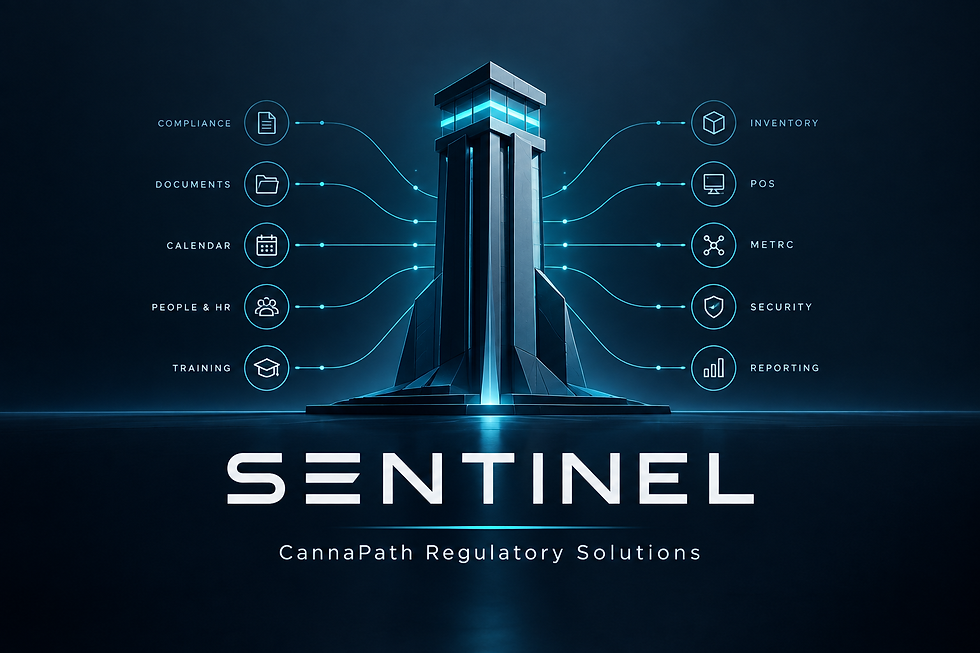
Sentinel is the compliance platform CannaPath is building to make compliance responsibilities easier to manage across documents, employees, training, calendars, inventory, and the other systems a cannabis business runs on.
Primary Sources
Minnesota Statutes, section 342.64: Advertisement. Subd. 1 (prohibited content and required warning), subd. 5 (age affirmation before direct, individualized advertising), subd. 6 (location-based devices).
OCM Guidance Memo GM-2025-07, Cannabis and hemp advertising guidance, updated August 7, 2026. Required warning language for cannabis and hemp advertisements.
Twilio, Forbidden message categories for SMS and MMS in the US and Canada, and Twilio messaging error documentation (codes 30459 and 30469), reviewed October 19, 2026.
Twilio, A2P 10DLC brand and campaign registration documentation, reviewed October 19, 2026.
Regulatory review: October 19, 2026.
This article provides general regulatory and operational information, not legal advice. Messaging provider and carrier policies change and are set by private companies; confirm current terms with your provider in writing. Minnesota rules change too; verify current requirements with OCM.