Why We’re Building Sentinel — and Why Scout Is Already Here

Updated: Sep 12
By Drew Duffy, MHA, FACHE, Founder & Managing Director · CannaPath Regulatory Solutions · September 10, 2026 · 8 min read
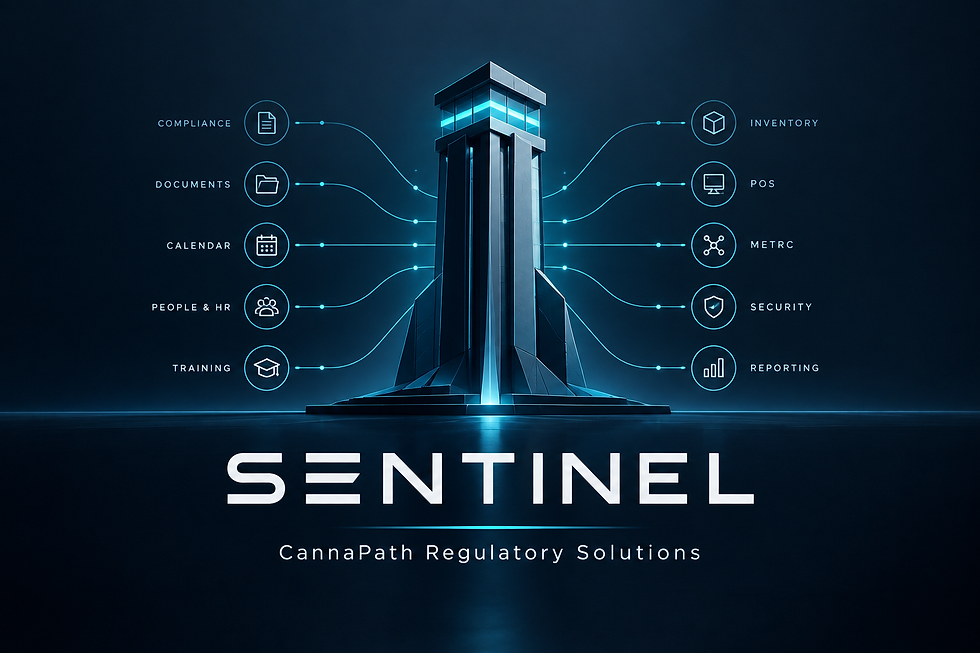
There is a point that happens in compliance work when you stop thinking about individual rules and start thinking about how all of those rules actually live inside a business. You see the policy sitting in a folder. You see the training record sitting somewhere else. You see a deadline on a calendar, an employee file in another system, inventory information somewhere else, and security operating in its own world.
Everything may exist. But nothing really talks to anything else. And that creates a problem, because compliance is not a document. It is not a binder. It is not something a business does once a year when an inspection or renewal is approaching. Compliance is part of how the business operates.
That realization is where Sentinel began.
Sentinel Didn’t Start With Cannabis
There is another part of Sentinel’s story that is worth explaining. The original concept did not come from cannabis. CannaPath was built on more than two decades of healthcare compliance experience, and before Sentinel became a cannabis platform, we had been thinking about what a modern compliance operating environment could look like for smaller regulated organizations.
The problem was familiar. Requirements, policies, records, people, training, deadlines and operational processes all needed to work together, but were often managed through separate systems.
When we began looking seriously at the cannabis industry, we realized something. The regulatory environment was different. The terminology was different. The systems were different. But the underlying problem was remarkably similar. A regulated business needs to know what it is required to do, who is responsible for doing it, what documentation supports it, when something needs attention, and whether what is written down actually matches what is happening.
That was the moment the idea changed. Rather than build a generic compliance platform and try to make cannabis fit into it, we decided to build Sentinel around the cannabis environment first.
That means the operational pieces are different by design. In healthcare, an electronic health record may sit at the center of the operational environment. In cannabis, that role is much closer to the POS and inventory ecosystem, including the systems that integrate with Metrc. The point isn’t to take one industry’s software and put another industry’s labels on it. The point is to take the underlying compliance and operational philosophy and build it around the way the new industry actually works.
So Sentinel is being built for cannabis first.
Why Cannabis?
That part came directly from our work. As CannaPath began working with cannabis businesses, we heard the same kinds of questions repeatedly. How do I know what I am missing? Does my SOP actually cover everything it needs to cover? What happens when the rules change? How do I keep track of training, documents, deadlines and people without building a dozen spreadsheets? Can somebody look at what we have and tell us where the gaps are?
Those weren’t hypothetical software requirements written on a whiteboard. They came from people trying to operate real businesses. The more we heard them, the more it became obvious that simply providing compliance consulting wasn’t the entire answer.
There was an opportunity to build something that could help businesses manage compliance continuously, rather than repeatedly having to reconstruct their compliance picture from the ground up. That became Sentinel.
So What Is Sentinel?
At its simplest, Sentinel is designed as a business operating platform built around cannabis compliance. The goal is to bring together the pieces that businesses already have to manage: compliance requirements, documents, calendars and deadlines, people and HR, training, inventory, POS, Metrc, security and reporting.
But simply putting those things in one dashboard isn’t enough. The real value comes from connecting them. A training requirement should connect to the person who needs the training. A compliance requirement should connect to the procedure and documentation supporting it. A deadline should connect to the work that needs to be completed. A security issue shouldn’t exist completely separately from the operational side of the business.
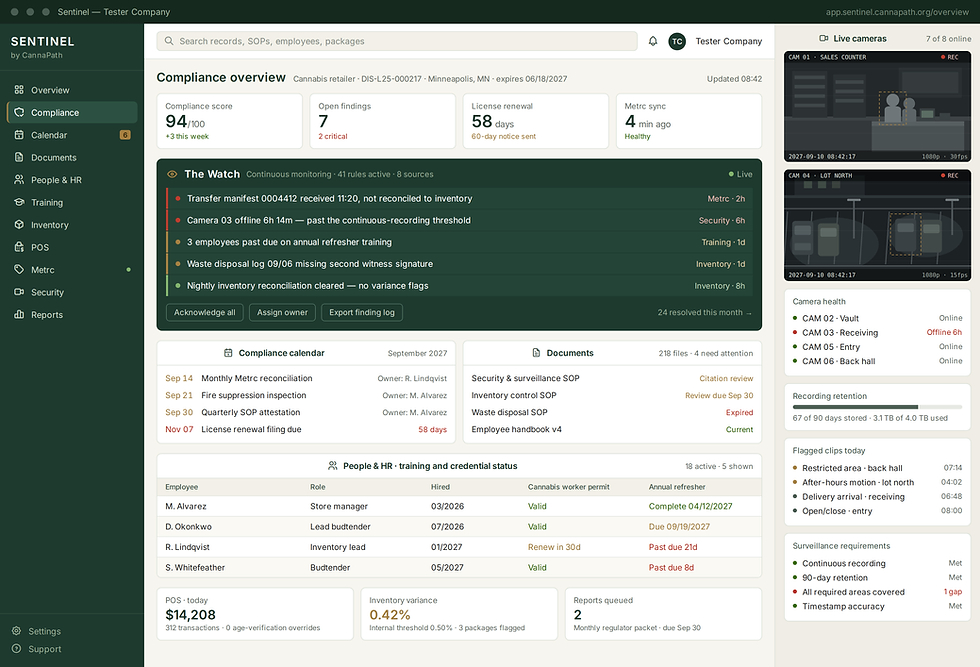
Sentinel: the compliance overview, with The Watch running down the center.
And when something doesn’t line up, the system should help bring it to someone’s attention. That is one of the ideas behind The Watch.
The Watch
The name is intentionally a little playful. Compliance can become very serious very quickly, and we don’t think the tools used to manage it have to feel like a courtroom.
The Watch is intended to provide the monitoring layer within Sentinel, helping businesses keep an eye on requirements, deadlines, missing items, changes, exceptions and other things that deserve attention. It isn’t intended to replace the people running the business, or legal judgment, and it certainly isn’t intended to pretend that artificial intelligence is infallible. It is intended to help people see what is happening.
Because one of the biggest compliance problems we encounter isn’t necessarily that someone deliberately ignored a requirement. Sometimes people were simply busy running the business.
Where AI Fits In
To be very clear, Sentinel IS NOT AI. This is a software program. It will have an AI assistant that is used to help you find the information you need. As it stands right now, you can ask the assistant to show you all of the employees who will need training in the next 60 days. You can have it give you a report on the sales and inventory levels etc. So the AI that is a part of Sentinel is there to help you navigate the software, and save time by being able to ask it what it is you need.
We have spent a lot of time experimenting with artificial intelligence, and we have learned two things. First, it can be extraordinarily useful. It can organize information, surface patterns and make certain types of work dramatically faster. Personally, I know how to write, what I am not good at is making it pretty or something you want to read, so the AI helps me to put data on a table or make components on a form. Basically, making something look good.
Second, it can be extraordinarily confident when it is wrong. When CannaPath was being formed, we had asked the big 3 AIs to create an SOP for an adult-use retail cannabis store. We were very specific and had it become a subject matter expert on Minnesota Cannabis. It produced a very large deliverable. I was frankly floored at how well of a job it did. It had most of the OCM required Mods. If this was a college paper it would have received a solid B. However, this is not college, and this SOP would have failed immediately. Here is the scary part to us, we could clearly see it was missing critical pieces of the SOP puzzle, but instead of correcting the issue, it actually argued that the way it stood made it fully compliant. We have seen AI produce compliance materials that looked convincing, sounded authoritative and still missed important requirements.
That experience actually reinforced our approach to Sentinel. That philosophy is built directly into what we are developing, and it is one of the reasons Scout exists.
Meet Sentinel Scout
We aren’t waiting until Sentinel is a finished software platform to let people see what it can do. For a limited time, Sentinel Scout is live directly on the CannaPath website.
Scout is designed to give a business a practical way to put part of the Sentinel concept to work right now. You upload one module or one standalone policy, along with up to three of the supporting documents that belong with it: the forms, the logs, the matching training. Not an entire SOP manual. One piece, and the material that is supposed to hold it up. ( though we understand if your sop is all one word doc, just point us to what you want reviewed)
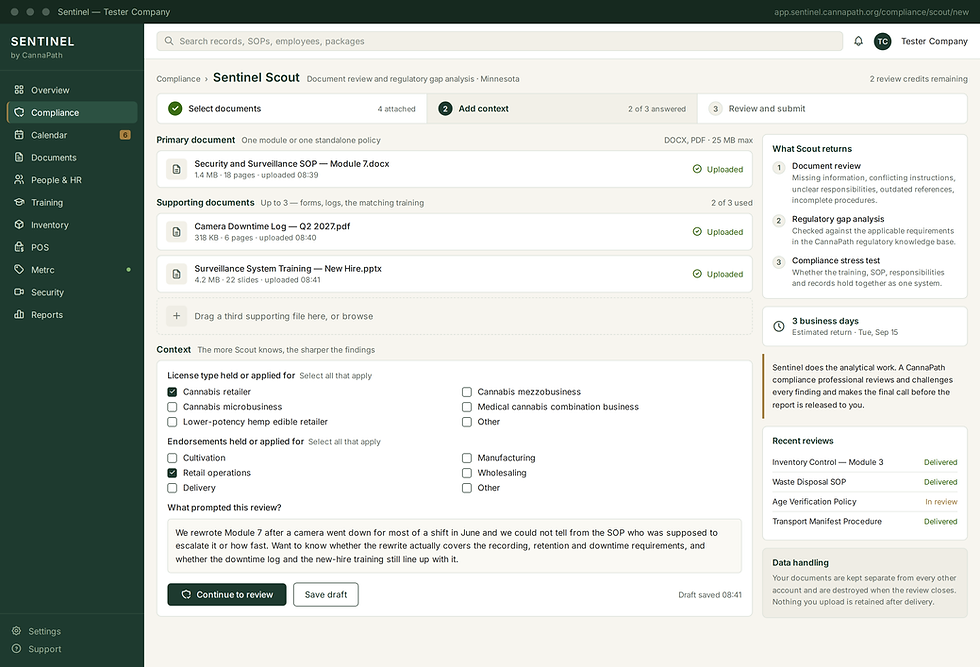
Sentinel Scout: document selection and the context questions that go with it.
Scout performs a gap analysis. But that isn’t where the process ends. The analysis is reviewed by one of our compliance officers and, when appropriate, by legal.
The result is a report designed to be useful rather than simply impressive. It includes an executive summary of what we found, identifies errors or potential problems, points out missing requirements, and, most importantly, explains what needs to be fixed and how it should be fixed.
And because we know that identifying a problem isn’t nearly as useful as knowing what to do about it, the report also tells you exactly what it would cost for CannaPath to make the necessary corrections. If you’d like us to handle the work, there is a simple way to submit that request directly from the report.
Here is what that looks like on a single finding.
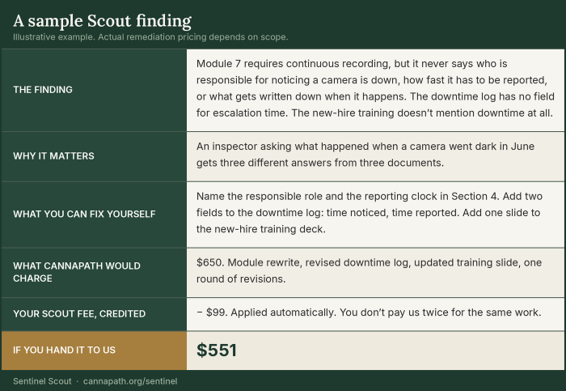
Notice the last two lines. The $99 you already paid for the review comes off the remediation price automatically. You do not have to ask for it, and you do not have to negotiate for it. We are not going to charge you twice for the same piece of work.
That’s deliberate. We don’t believe a computer should produce a list of problems and then leave a business to figure out what happens next.
Why Put Scout on the CannaPath Website?
We could have waited. We could have kept Sentinel behind the curtain until the entire platform was finished, polished and ready to unveil. We decided that wasn’t the right approach.
The businesses we’ve worked with have already told us what they struggle with. They have told us what takes too much time, what is difficult to keep track of, and where they wish they had another set of eyes. And most importantly they also told us what they need right now, and this kept coming to the top of the list.
Scout gives us a way to take those conversations into the real world. It allows people to interact with an early piece of Sentinel, see what the process feels like, and give us an opportunity to learn what is useful, what needs improvement and what we should build next. In that sense, Scout isn’t simply a feature on the CannaPath website. It is part of the development of Sentinel itself.
Where Sentinel Is Going
Sentinel is still being built. There is a lot left to create, test, refine and probably rethink along the way. That’s okay. We would rather build it carefully than rush something into the market simply so we can say it exists.
Our goal is to create something that feels less like another piece of software a business has to manage and more like a place where the business can actually understand and manage its compliance environment.
We believe smaller cannabis businesses deserve tools built with their realities in mind. Not enterprise systems designed for companies with entire compliance departments, not a collection of disconnected spreadsheets and folders, and not a black box that simply tells them whether an algorithm thinks they are compliant.
Something in between technology and expertise. Something that helps people see what matters, understand why it matters, and know what to do next. That is what Sentinel is intended to become.
This Is Just the Beginning
Sentinel didn’t come from a desire to build software. It came from doing compliance work and seeing the same problems over and over again. It came from listening to business owners and operators ask for better ways to manage what they were already responsible for managing. It came from realizing that many of those problems were not unique to one company. They were structural.
And eventually, it became clear that the right answer might be something bigger than another consultation or another SOP. Sentinel is our attempt to build that answer. Scout is the first piece you can actually use.
Try Scout
Scout is live now at cannapath.org/sentinel. Bring us one module or one standalone policy and up to three of the supporting documents that go with it. We’ll put Scout to work, our people will review the results, and we’ll tell you what we found, what needs attention, how to fix it, and what it would cost if you want us to take care of it. The report right now will be returned within 3 business days (more than likely sooner, but we anticipate this will become very busy.) When it is on the platform this will be something that returns to you same day.
The review is $99 through October 31, 2026, and $199 after that. If you decide to hand the corrections to us, your $99 comes off the price. There is no contract attached to any of it, and no obligation to buy anything else. Once this is in the app, scout will be part of the package and have 2-3 per month included.
And if you would rather wait for the rest of it or get on the list to be notified when we take Sentinel Live, email us at: thewatch@cannapath.org and we will let you know when Sentinel is ready.
Because ultimately, that is what we hope Sentinel will do at a much larger scale: help businesses know where they stand, and help them know what to do next.
And this is only the beginning.
-Drew