Cannabis + Hemp in the Same Business: What Minnesota's 2027 Changes Actually Allow

Minnesota has opened the door for cannabis and hemp businesses to operate much closer together. The hard part is understanding where the lines still exist.
Drew Duffy, MHA, FACHE, Founder & Managing Director, CannaPath Regulatory Solutions
Last reviewed: September 30, 2026
One of the most common questions we are hearing from Minnesota cannabis and hemp operators right now sounds deceptively simple. Can I operate a cannabis business and a hemp business out of the same operation?
The answer is yes. But that answer is only the beginning.
There is a very big difference between being allowed to hold both types of licenses, being allowed to operate them from the same premises, being allowed to use shared infrastructure, and being allowed to treat the two operations as though they are one regulatory program. Minnesota has made the first three much more possible. It has not eliminated the need to understand the fourth.
Some of this is already law and has been since August 1. The rest arrives January 1, 2027, and it changes what a combined operation can actually be. If you are planning a facility right now, you are planning against two different clocks at once.
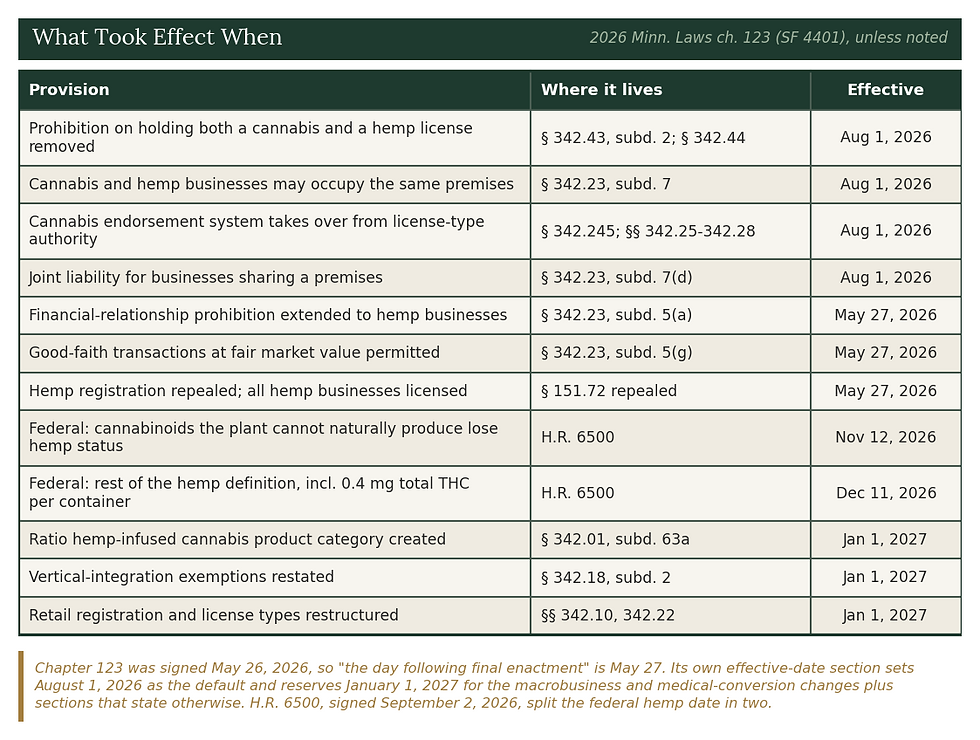
Minnesota did not simply say that cannabis and hemp can share a building. It created a framework in which they can operate in closer proximity while still being subject to controlled, regulated supply chains. For a business owner, that means the real question is no longer whether cannabis and hemp can coexist.
What does a compliant combined operation actually look like? |
This Is Not Another Article About Whether Hemp Is Legal
Before going any further, we are deliberately not going to rehash the entire Minnesota hemp market or the federal hemp-definition issue here. We have already covered those subjects in detail.
Our article "Minnesota Lower-Potency Hemp in 2026: The Rules Changed, the Market Changed, and the Federal Clock Is Now Ticking" explains how Minnesota's hemp market moved into its permanent licensing structure and how the state and federal frameworks are diverging. Our article "The 0.4 Milligram Problem: What the New Federal Hemp Definition Could Mean for Minnesota Products" goes deep into the federal definition change itself. And our earlier "What Actually Changes on August 1?" article walked through the broader 2026 Minnesota cannabis-law changes.
One update since those pieces ran, because it changes the deadline you are planning against. In September, Congress split the federal hemp date in two. The 0.4 milligram cap and most of the new definition moved to December 11, 2026. The exclusion for cannabinoids the plant cannot naturally produce was not delayed and still arrives November 12, 2026.
Those articles explain the why. This article is about the how.
Because knowing that two businesses can occupy the same premises is one thing. Figuring out how employees, inventory, manufacturing, records, purchasing, testing, security, and responsibility are actually going to work together is another.
If You Read Somewhere That You Still Cannot Hold Both, Here Is Why
This one deserves a direct answer, because we have seen good analysis land on both sides of it.
Earlier in the 2026 session, a version of the omnibus bill moved through the process that went the other direction. It took the prohibition on holding both a cannabis license and a hemp license and wrote it into statute as an explicit new paragraph. Anyone reading that version was reading it correctly. The bill said what they said it said.
The version that actually became law did the opposite. It struck a single word. The statute had read that a hemp license holder "may not hold a cannabis business license." The enacted law deleted the word not. The mirror provision on the hemp eligibility side was changed to match.
So the published chapter, the legislative summaries, and OCM's own post-session guidance all land in the same place: a person, cooperative, or business may hold both, effective August 1, 2026.
We are pointing this out because if you read an analysis mid-session and filed it away, the conclusion you filed may be the opposite of current law. That is worth five minutes of your time before you make a structural decision.
One more thing to watch. Some of OCM's own published pages have not fully caught up. At least one licensing page still carries the old restriction. Official pages lag; the chaptered law does not.
The Part Nobody Is Telling You: The Licensing Calendar
Here is the practical problem with everything you are about to read.
Lower-potency hemp edible licensing has been open on a rolling basis since April 1, 2026. Cannabis business licensing works differently. It runs in windows, and between those windows there is nowhere to apply.
That asymmetry matters enormously for a hemp operator reading this article and deciding the combined model is the answer. The state law pathway is open. The application door may not be. Verify where cannabis licensing stands with OCM before you build a plan whose first step is getting a cannabis license.
And the clock behind that question is not a state clock. It is federal, and it is now two clocks rather than one.

The federal date split, and why it matters to your product list
Congress delayed most of the new federal hemp definition by roughly a month, but not all of it.
What did not move is the exclusion for cannabinoids that are not capable of being naturally produced by a Cannabis sativa L. plant. Products containing those cannabinoids lose federal hemp status on November 12, 2026, exactly as originally scheduled.
What did move is nearly everything else, now arriving December 11, 2026: the shift from a delta-9 standard to a total THC standard, the 0.4 milligram per container cap on total THC and similarly acting cannabinoids, restrictions on viable seeds, and restrictions on certain intermediate hemp-derived cannabinoid products.
For a Minnesota operator the practical question is which of your SKUs sit on which side of that line, and the answer is not uniform across your shelf. A hemp edible built on artificially derived delta-9 THC is in a different position from one carrying a cannabinoid the plant cannot make on its own. Where the line falls for any particular compound is exactly the question to get answered for your own product list rather than assumed, because the phrase doing the work is "capable of being naturally produced," and it has not been applied compound by compound yet.
None of this makes the combined model a bad idea. It means the sequencing has to be real. A plan that assumes you can obtain a cannabis license on your own schedule is not a plan, and a plan built around one federal date when there are two is not one either.
There is one more piece of that timing worth knowing, and it reaches into 2027. Minnesota caps how many cannabis licenses it will issue in the capped categories, and the 2026 law pushed the date those caps run through from July 1, 2026 to July 1, 2027. The numbers themselves did not change: 25 cultivator, 12 manufacturer, 75 retailer, and 50 mezzobusiness licenses, each split between social equity applicants and all applicants. Only after July 1, 2027 does OCM get to decide how many of those licenses to make available going forward.
For a hemp operator trying to get onto the cannabis side, that is the real shape of the next nine months. The ceiling is fixed until the middle of 2027, and the federal deadlines arrive well before it lifts. If the combined model is where you are headed, the planning window and the licensing window are not the same window.
There Are Two Very Different Ways to Build This
When an owner says they want cannabis and hemp in the same business, there are two basic structures to consider. The first is a single legal business holding both types of licenses. The second is two separate legal businesses operating from the same premises.
Minnesota's framework can accommodate both, but they are not operationally identical, and the differences run deeper than most people expect.

The single-entity structure is the simpler one from an ownership perspective, because there is one legal entity. But one company having two licenses does not mean the licenses cease to matter. The business still needs to know which activity is being performed under which authorization.
The two-company structure is where the statutory ownership test comes in, and where most of the planning work lives.
The Ownership Test Is Not "Same Person Runs Both"
Minnesota permits two businesses to share a premises when the ownership requirements are met. The businesses must have the same majority owners in common, and the common majority owners must each individually own more than ten percent of each business.
That sounds simple until you start looking at real ownership structures. Family ownership, multiple investors, holding companies, management companies, minority investors, and related entities all complicate the answer. A business should not determine that two companies qualify merely because the same person runs both businesses. The statutory ownership test needs to be examined against the actual ownership structure.

There is a wrinkle here that is worth understanding before you design anything.
Minnesota's true party of interest rules limit how many licenses one individual can have an interest in, and they carry a safe harbor for anyone holding ten percent or less of a business entity. The shared-premises test runs the other way. It requires each common majority owner to hold more than ten percent in each business.
Qualifying for shared premises therefore pushes those owners out of the ten percent safe harbor by design. That is not a contradiction, and it does not make the model unworkable. It does mean the ownership structure has to be built with both provisions in view at the same time, rather than solving for one and discovering the other later. For complicated structures, this is one of the areas where legal review before signing the lease can save a business considerable trouble.
Same Building Does Not Mean One Regulatory Identity
This is probably the most important concept in the entire article.
Minnesota has made it possible for cannabis and hemp businesses to occupy the same premises. That does not turn them into one regulatory category. A cannabis license is still a cannabis license, an LPHE license is still an LPHE license, and an endorsement is still an endorsement. The product category still matters. The source of the cannabinoid still matters. Testing, inventory ownership, and the records that demonstrate what happened all still matter.
The easiest way to think about the new model is not that cannabis and hemp are now combined.
Minnesota has made it possible for the physical operation to become more integrated while the regulatory identities remain identifiable. |
That distinction should drive the way the business is designed.
The Shared-Premises Provision Comes With a Very Important Warning
Minnesota law does something that should get the attention of anyone considering this model. Businesses occupying the same premises under the new cannabis and hemp provision are jointly liable for violations of Chapter 342 and Minnesota Rules, chapter 9810.
That changes the conversation considerably. Imagine a cannabis company and a hemp company sharing a building, and the owners assume that their cannabis side is compliant and whatever happens on the hemp side is the hemp company's responsibility. That is not a safe assumption under this provision. Likewise, the hemp company should not assume that a problem on the cannabis side is somebody else's problem simply because the hemp company did not create the product involved.
When two regulated businesses deliberately put their operations under the same roof, they are accepting a more interconnected regulatory environment. That means the shared facility should be designed so that problems are easier to prevent and easier to identify.
The Best Combined Operations Are Built Around Boundaries, Not Walls
A compliant combined facility does not necessarily need to look like two completely separate buildings built inside one building. Minnesota's law is clearly intended to allow more operational flexibility than that.
The better question is whether the business has established clear boundaries around regulated activities. Those boundaries can be physical where necessary. They can also be procedural, technological, documentary, and organizational.
A receiving employee should know where a cannabis shipment goes and where a hemp shipment goes. A production employee should know what product is being manufactured, which authorization permits that production, what ingredients are being used, and what records are created. An inventory employee should be able to determine who owns a product and what regulatory category it belongs to without asking the owner.
The goal is not to make the facility feel divided. The goal is to make the compliance responsibilities obvious. That is a much better design principle.
The Endorsement System Is Already the Spine
Before the manufacturing question makes sense, one thing has to be clear, and it is the piece operators most often assume is still coming.
Minnesota's cannabis licensing is now built around endorsements, and it has been since August 1. Cultivation, cannabis extraction and concentration, hemp extraction and concentration, creation of artificially derived cannabinoids, edible cannabinoid product handling, production of consumer products, retail operations, cannabis flower packaging, and internal transport between your own facilities are each a specific endorsement, applied for and held separately from the base license.
That is the structural change that matters most to a combined operation, because the endorsement is what tells you which activity you are actually permitted to perform. When someone asks which authority covers a given production run, the answer is an endorsement, not a license type.
Which makes the endorsement set the thing to audit, and to audit now rather than in January. A business that assumes its license covers an activity, and finds out at inspection that the activity needed an endorsement it never applied for, has a problem no amount of good recordkeeping fixes.
The medical cannabis endorsements are the exception. Those arrive January 1, 2027, along with the macrobusiness. The rest of the endorsement framework is live.
Shared Manufacturing Is Narrower Than Most People Think
Minnesota's manufacturing framework is one reason this model looks commercially attractive, and it is also the place where we see the most optimistic assumptions.
Here is what the statute actually does. Cannabis manufacturing must take place in an enclosed, locked facility used exclusively for a defined set of cannabinoid activities, and on equipment used exclusively for that same set. That list includes manufacturing cannabis products, creating hemp concentrate, creating artificially derived cannabinoids, creating lower-potency hemp edibles, and creating hemp-derived consumer products.
Read that list again. Lower-potency hemp edibles are on it. That is the real permission, and it is a meaningful one. A cannabis business holding the right endorsements can manufacture both cannabis products and qualifying hemp products on the same infrastructure, rather than building two independent production facilities.
Now here is the limit that changes the design.
A standalone lower-potency hemp edible manufacturer license does not work that way. A hemp edible manufacturer holding the edible handler endorsement may manufacture only lower-potency hemp edibles, and must not add cannabis flower, cannabis concentrate, or any cannabinoid derived from them to a product. The cannabis manufacturing provisions do not govern that license at all; a separate section does.

So the shared-manufacturing story is real, but it runs through the cannabis license, not through the hemp one. For an operator whose main reason to combine is production economics, that pushes hard toward the single-entity structure with the right endorsements, rather than two companies where the hemp side holds the manufacturing license.
This should also not be interpreted as one room, one production schedule, and nobody caring what happens in between. The opposite is true. Shared infrastructure increases the importance of production control. If the same manufacturing environment can be used for multiple regulated categories, the business needs an exceptionally clear way to establish what was made, from which inputs, under which authority, for which product category, and what happened to that batch afterward.
The physical equipment may be shared. The compliance trail cannot be vague.
This Is Where Product Classification Becomes Critical
One of the biggest mistakes we see in multi-product operations is starting with the formula instead of the regulatory classification. An owner develops a product and then asks what license they need for it. That is backwards.
For a combined cannabis and hemp operation, the business should determine the intended regulatory category first and build the formulation and production process around it. The question is not simply whether the product contains hemp. It may contain cannabis-derived cannabinoids, hemp-derived cannabinoids, or both. It may fall into a specific Minnesota cannabis product category, or it may be a lower-potency hemp edible, or a hemp-derived consumer product.

That is why "hemp product" is not enough information for a manufacturing team. The business needs to know what the product legally is before it can determine how the product should be made, tested, labeled, tracked, stored, and sold.
And beginning January 1, 2027, there is one more box on that map.
What January 1 Actually Adds
The 2026 law did not finish arriving on August 1. A second set of changes lands on January 1, 2027.
It is worth being precise about what is in that second set, because it is narrower than most summaries suggest. The act's own effective-date section makes August 1, 2026 the default, and holds back January 1, 2027 for the creation of the cannabis macrobusiness, the conversion of medical cannabis combination businesses, and the individual sections that say so themselves. Most of the operational framework in this article is already law.
Two of the January items change what a combined cannabis and hemp operation can build, and a third changes what it may have to absorb a year from now.
A product category that only a combined operation can make
Minnesota is creating the ratio hemp-infused cannabis product. It combines cannabis extracts with hemp-derived cannabinoids that are not artificially derived and that OCM has approved as nonintoxicating, in concentrations that may differ from what occurs naturally in the plant.
This is the first Minnesota product category that is genuinely a cannabis and hemp hybrid rather than one or the other. And the classification point matters more than the formulation point: a ratio hemp-infused cannabis product is a cannabis product. It is not a lower-potency hemp edible and it is not a hemp-derived consumer product. It moves under cannabis authority, through cannabis channels, with cannabis obligations.
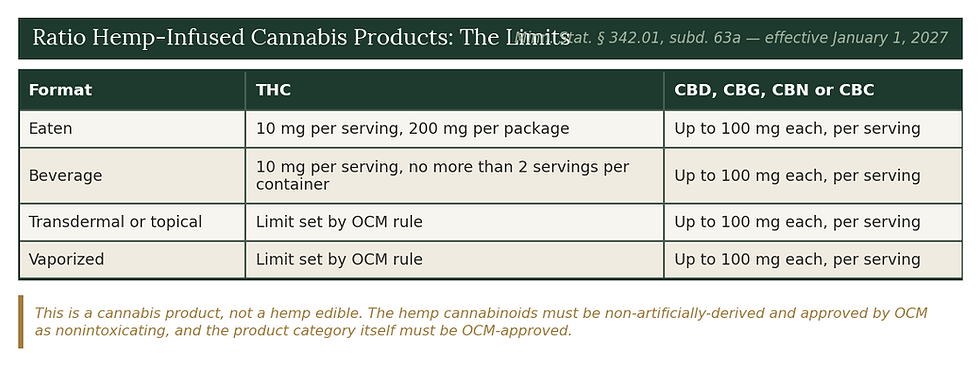
The product category itself has to be approved by OCM, and the limits differ by format. For an operator already sourcing hemp-derived cannabinoids and already manufacturing cannabis products, this is the most concrete commercial reason to build the combined operation now rather than later.
The third market opens, and it lands in the same building
The medical cannabis endorsements arrive January 1, 2027, and they are available to cannabis businesses that already hold the underlying activity endorsement.
A cannabis microbusiness with a cultivation endorsement can apply for a medical cannabis cultivation endorsement, and one that qualifies gets additional canopy on top of its normal limits: up to 1,000 square feet indoors, or up to a quarter acre outdoors. There are parallel medical manufacturer and medical retail endorsements built the same way.
Read that next to everything else in this article and the implication is not subtle. A business that has spent 2026 working out how to keep cannabis and hemp identifiable under one roof may, in 2027, add a third regulated category to the same facility, the same equipment, and the same staff.
Every boundary question in this piece gets harder when there are three answers instead of two. Which authority permits this activity. Which inventory does this belong to. Which rules did this employee follow. Which record proves it.
That is an argument for designing the combined operation now as though a third category is coming, rather than building for two and retrofitting. The businesses that will have the easiest time adding medical in 2027 are the ones whose cannabis and hemp boundaries are already clean.
Vertical integration and license limits get restated
The vertical-integration provisions are restated to make clear that microbusiness, mezzobusiness, and macrobusiness licenses, and the three hemp edible licenses, may be issued to the same person or entity. Retail registration and the license type list are restructured at the same time, and the medical cannabis combination business becomes the cannabis macrobusiness.
For most combined operators, the practical read is that the structures described in this article are being written more firmly into the statute rather than changed. But if your plan depends on a specific stacking of licenses, January 1 is the date to check it against.
Receiving, Inventory, and the Statewide System
A shared cannabis and hemp facility may look perfectly organized once everything is sitting on the shelves. The problems often begin at the loading dock.
Imagine an employee receives a shipment containing cannabinoid ingredients. The employee knows it came from an approved supplier. That is not enough. The employee also needs to know what was received, which business owns it, which license authorizes its use, what documentation accompanies it, where it must be stored, whether it requires testing, and what system records the transaction. A receiving system designed for one product category can quietly create problems when a second regulated supply chain is added. The solution is not necessarily two loading docks. The solution is a receiving process that understands the difference between the materials it is receiving.
Inventory is the other place where owners sometimes misunderstand the new law. Shared premises does not mean one giant inventory pool. A combined operation should be able to answer a very basic question at any point.
What is this, and who owns it? |
That sounds almost embarrassingly simple. It becomes much harder when a business has cannabis flower, cannabis extracts, hemp concentrate, hemp-derived consumer products, lower-potency hemp edibles, packaging components, ingredients, work-in-process material, and finished goods moving through the same facility. An employee should not have to identify a product by remembering who ordered it three weeks ago. Labeling, storage locations, batch identification, lot numbers, work orders, and system controls become the mechanism that keeps two regulated supply chains from becoming one undocumented pile of product.
The statewide monitoring system makes the distinction even sharper. The shared-premises provision specifically requires sales or transport of regulated products to and from licensed cannabis businesses to be recorded in that system. The same provision allows a cannabis business sharing a premises to transport regulated products between the businesses on that premises.
Both halves of that matter. The ability to physically move regulated product from one business to another on the same premises does not mean the transfer disappears because nobody drove a truck across town. The transaction still exists. The product still has an owner. The record still has to exist, and the business still needs to be able to explain what happened.
The fact that the businesses share a hallway does not make a transfer cease to be a transfer.
Money Between Related Companies Got Harder and Easier at the Same Time
Most coverage of the 2026 changes treats the financial-relationship amendment as a loosening. It is both, and the order matters.
The prohibition itself was widened. It used to bar a cannabis business or hemp business from offering, giving, accepting, receiving, or borrowing money or anything of value from any other cannabis business. The amended version reaches any other cannabis business or hemp business. For two co-located related companies, that is the rule that now sits directly across the relationship you are trying to build.
The relief valve is the new exception, which permits any transaction entered into in good faith for the sale of goods or services at fair market value.
Read together, the message is not that money can now move freely between related cannabis and hemp businesses. It is that money can move when the transaction is real, documented, and priced defensibly, and the rule got broader everywhere else.

So suppose the cannabis side owns manufacturing equipment and the hemp side uses it. Or one company provides warehousing to the other. Or one side provides a legitimate administrative service. The fact that the same owners control both companies does not mean the relationship should be undocumented. A real service should have a real agreement. A real product transfer should have real documentation. A real charge should have a defensible value. And the accounting should match the operational reality.
This becomes particularly important when the two companies share employees, equipment, space, or other resources. The closer the relationship, the more useful clear documentation becomes.
Employees, SOPs, and Training
A combined cannabis and hemp business can easily end up with employees who work across multiple parts of the operation. That is not inherently a problem. The problem is when an employee has to decide for themselves which regulatory rules apply to a task.
Imagine the same employee works in manufacturing Monday through Thursday and helps with retail on Friday. That employee may encounter completely different responsibilities depending on what they are doing and which products they are handling. Training should therefore be tied to the actual job functions the employee performs. The business should also know which entity employs the person when two separate companies are involved. That sounds like a human resources question. It is also a compliance question. When something goes wrong, the business needs to know who was responsible for the activity, what training that person received, which procedure they were following, and which entity's operation they were performing work for.
Good combined operations do not make employees experts in corporate structure. They make the structure simple enough that employees know what they are supposed to do.
Your SOPs have to reflect that. This is where a lot of businesses will get themselves into trouble. They will take the cannabis SOPs, take the hemp SOPs, put them in the same folder, and assume they now have an integrated compliance program. That is not integration. That is two documents sitting next to each other.
A combined operation needs procedures that address the points where the two regulatory environments actually intersect: receiving, inventory, manufacturing, transfers between related businesses, shared equipment, employee access, testing and product release, security and facility access, and change management. The SOP should make it clear what happens when a product or activity crosses from one regulatory pathway into another. That is the important piece.
Security and Testing Follow the Same Logic
The physical-security plan becomes particularly important when cannabis and hemp share a facility. The business should not assume that because the premises is secure for cannabis, every regulatory question surrounding hemp automatically disappears. The security design should reflect the actual facility and the actual regulated activities occurring there. Who can enter manufacturing, who can access which inventory, who can move product between areas, who receives shipments, what areas are restricted, and what happens when an employee changes roles or leaves.
Again, the answer is not necessarily separate buildings. It is controlled access. A well-designed facility should make it difficult for the wrong person to access the wrong regulated material, and easy for management to determine who had access when something happened.
Testing works the same way. The business needs to know which products require testing, what standard applies, when a batch can be released, what happens if a result fails, and where the result is retained. The test result needs to connect to the correct product and batch. It sounds obvious, but when a facility is manufacturing multiple product categories using overlapping equipment and employees, the chance of a documentation mismatch increases. The answer is not necessarily more testing. The answer is better batch control.
A business should be able to look at a finished product and work backward through its records to the inputs used, the production run, the testing, the disposition decision, and the finished inventory. That is traceability.
Retail Is Where the Customer Sees the Integration
The back of the building may be complicated. The customer should not have to understand any of it.
From a customer's perspective, a combined store may simply look like a well-designed retail operation with multiple product categories. That is perfectly reasonable. The compliance work should happen behind the scenes.
The store needs to know which products it is legally permitted to sell, which license or endorsement supports the sale, which age requirements apply, what product information must be available, and how the transaction is recorded. A cannabis retail operation with the retail endorsement can sell cannabis flower, cannabis products, lower-potency hemp edibles, and hemp-derived consumer products to customers who are at least 21. The state separately licenses hemp edible retailers. The operational point is that the business should know which authority it is relying on for each product rather than treating every cannabinoid product as interchangeable.
The customer does not need to see the regulatory architecture. Management does.
A Combined Business Should Have One Source of Truth
This may be the most practical recommendation in the entire article.
A business operating cannabis and hemp under the same roof should not have one version of the truth in the cannabis system, another in the hemp spreadsheet, another in the accounting software, and a fourth version in someone's email. The systems need to reconcile. Not necessarily become one system. Reconcile.
If 100 units arrive, the business should know where those units went. If 60 units are manufactured into finished product, the business should know what happened to the remaining material. If 20 finished units are sent to retail, the business should know why. If five are destroyed, that disposition should be documented. If a product is transferred between related operations, that transfer should be traceable.
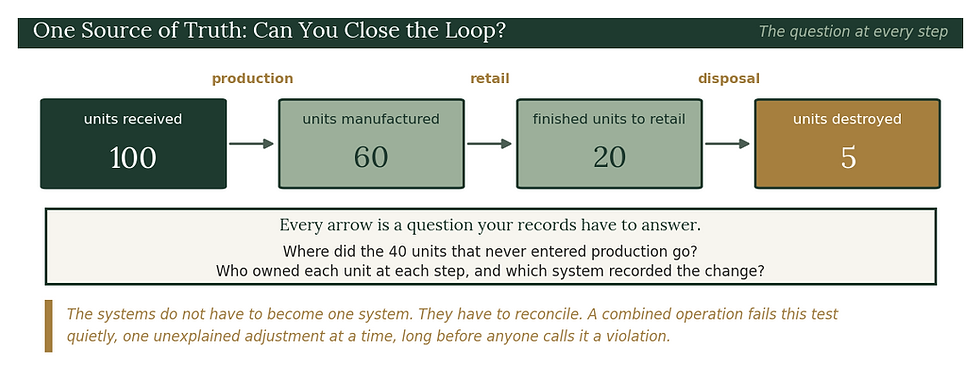
The system does not need to be enormous. It needs to tell the same story from beginning to end.
What a Real Combined Operation Might Look Like
Consider a hypothetical Minnesota microbusiness called North Star Botanicals. North Star is one legal entity. It holds its cannabis microbusiness license and the endorsements necessary for its cannabis activities, including the endorsements that let it manufacture qualifying hemp products.
The company operates from one facility with retail at the front, manufacturing at the back, a secure storage area, a receiving area, and a small administrative office. North Star decides it wants to manufacture both cannabis products and qualifying hemp products, and it does not build two factories.
Instead, it maps each product category, identifies the endorsements that authorize each activity, establishes production procedures that identify the product being manufactured, and creates inventory controls that distinguish cannabis inputs, hemp inputs, work-in-process material, and finished goods. The manufacturing floor is shared where permitted. The records are not. Every production run identifies what is being made and under which regulatory authority. Testing is connected to the correct batch. The finished product goes into the correct inventory location. Employees are trained on the differences that matter rather than being handed two enormous manuals and told to read the hemp section.
That is what integration looks like. The business is not pretending cannabis and hemp are the same. It is building a system in which the differences are controlled.
Now change the hypothetical. Suppose North Star Cannabis LLC and North Star Hemp LLC are separate businesses sharing the facility and meeting the common-ownership requirements. Now there are additional questions. Which company owns the manufacturing equipment, and which employs the production staff? If one company performs a service for the other, how is that relationship documented? If material moves between the companies, who owns it before and after the transfer, what system records the transaction, who is responsible for the batch, and who retains the records? What happens if an employee belonging to one company identifies a compliance issue involving the other?
And one more, which is the one people miss: if the hemp manufacturing sits under a hemp edible manufacturer license in the second company, that company cannot add cannabis-derived cannabinoids to anything. The two-company structure that looked like a tidy separation may have quietly moved your hemp production outside the shared-manufacturing permission you were counting on.
Those questions are not reasons the model cannot work. They are the reason the model needs to be designed. Minnesota has expressly made the shared-premises model possible, and it has expressly attached joint liability to businesses operating under that arrangement. That is a pretty strong argument for getting the structure right before opening the doors.
Do You Need Separate Rooms?
This is one of those questions where an honest answer is better than an easy one.
There is no universal rule saying every cannabis and hemp activity must occupy a completely separate room simply because the products are regulated differently. At the same time, there are activities where Minnesota law imposes specific separation requirements. Manufacturing carries the exclusive-use facility and equipment rule described above. Edible cannabis products cannot be manufactured at the same premises where food is manufactured, except for limited production for development, sampling, or testing, and that limitation does not apply to lower-potency hemp edibles. Cultivation, storage, security, and contamination control can all affect facility design as well.
So the correct approach is not that everything must be separated, and it is not that nothing has to be separated. The correct question is what this particular activity requires, and what level of physical separation makes the operation demonstrably controllable.
Sometimes the answer will be a locked room. Sometimes it may be a defined storage area. Sometimes it may be shared infrastructure with controlled scheduling and documentation. The facility should be designed around the actual regulated activity rather than around a blanket assumption.
The More the Businesses Share, the More the Agreements Matter
For two separate entities, this is an area where businesses often underestimate the value of written agreements. If the companies share space, document it. If one company provides manufacturing services to the other, document it. If equipment is shared, document the arrangement. If employees are working across entities, make sure the employment and operational responsibilities are appropriately structured. If one company pays expenses on behalf of the other, have an accounting method that reflects what actually happened.
None of this needs to become a stack of meaningless paperwork. Quite the opposite. The purpose is to make the relationship understandable. If an OCM inspector asks why a piece of equipment is being used by two related companies, the business should have a clear answer. If an auditor asks why one company paid another company for a service, there should be a clear answer. If there is a product-transfer question, the records should tell the story.
Good documentation makes the operation easier to explain.
Where Businesses Get Into Trouble
Most problems in a combined operation are unlikely to begin with an owner deciding to violate the rules. They are much more likely to begin with something ordinary.

A product is received and set on the wrong shelf. An employee uses the wrong work order. A label is printed from the wrong template. An inventory adjustment is made in the wrong system. A related company borrows equipment without documenting the arrangement. A batch is moved before the required release step. A new product is launched before somebody confirms which category it belongs to. A facility changes but the approved documentation does not. An employee changes roles and keeps access they no longer need.
Individually, these can look like small operational mistakes. In a regulated environment, repeated small mistakes become a system problem. That is why the combined model should be designed around preventing ordinary mistakes, not merely responding to major violations.
The Biggest Mistake Would Be Treating Cannabis and Hemp as the Same Thing
Minnesota's changes clearly make cannabis and hemp more compatible. That does not mean they are identical. They can share a building. They can be operated by the same owner. They can, under the applicable structure, share certain infrastructure. A business can hold both types of licenses. A customer can encounter both categories in the same retail environment.
But none of those facts means a business can stop asking which rules apply to the product or activity in front of it. The best combined businesses will take advantage of the new flexibility because they understand the differences, not because they ignore them.
This May Be Especially Valuable for Microbusinesses and Growing Mezzos
For a microbusiness, the economics of shared infrastructure can be meaningful. Building two fully independent operations is expensive: two facilities, two administrative setups, two sets of equipment, two security footprints, and two separate workflows. Minnesota's framework gives qualifying businesses more room to build a combined model, and that may let a smaller business get more use out of its facility, equipment, management team, and existing infrastructure.
But there is a tradeoff. The more activities you combine, the more your compliance systems have to carry. A business that makes one product in one regulatory category has a relatively simple story. A business that manufactures cannabis products, makes hemp-derived products, retails both, purchases materials from multiple sources, operates under multiple licenses and endorsements, and shares infrastructure has a much longer story to tell. That does not make the model bad. It makes planning important.
The same concept becomes more significant as the business expands. A mezzobusiness already has a broader operational footprint. Add multiple retail locations, manufacturing, cultivation, medical endorsements, and hemp activity, and the business has something that may still look small by corporate standards but is operationally sophisticated.
At that point the company needs something better than a binder of SOPs. It needs an operating system. The procedures, people, inventory, training, records, security, testing, licensing, and corrective actions need to connect. That is where compliance stops being something that sits beside operations. It becomes part of operations.
So What Should a Business Do Before It Combines the Two?
Start with the business model rather than the facility. Figure out exactly what the company intends to make, sell, buy, store, and transfer. Then determine which licensing and endorsement structure supports those activities, and confirm that the licenses you need are actually obtainable on your timeline. Once that is established, map the physical flow of the product through the facility. After that, map the information flow. Finally, make sure the two agree.
That last step is where many businesses discover their real gaps. The physical process says one thing. The SOP says another. The inventory system says something else. The employee training says something else. And the regulator sees only the result.
A good combined operation closes those gaps before they become problems.
The Most Important Question Isn't "Can We?"
Minnesota has largely answered that question. Under the current framework, businesses can hold both cannabis and hemp licenses, qualifying businesses can occupy the same premises under specified ownership conditions, and the endorsement system that governs what you may actually do is already running. On January 1 the ratio hemp-infused product category gives that combined operation one more thing to work with.
The more useful question is whether you can build it so that an employee, an auditor, an inspector, or an owner can understand exactly what is happening.
That is the real test of the model. A shared building is easy. A shared manufacturing room is manageable. A shared ownership structure is manageable. The difficult part is building a business in which the boundaries remain clear while the operation remains efficient.
At any moment, somebody should be able to walk into the operation, point to a product, ingredient, batch, record, or activity, and answer four questions. What is this, who is responsible for it, what authority allows us to handle it, and where is the evidence?
That does not have to mean a complicated bureaucracy. It means the business was designed intentionally.
Minnesota has created a much more flexible environment for cannabis and hemp businesses to work together. Now the businesses have to decide what they are going to do with that flexibility. For some, that may mean one company holding both licenses. For others, it may mean two related companies sharing a facility. For some, it may simply mean a cannabis retail operation adding qualifying hemp products. For a growing microbusiness or mezzobusiness, it could become the foundation of a much broader vertically integrated operation.
The opportunity is real. So is the compliance responsibility. And the businesses that get this right will be the ones that understand that shared space does not mean shared confusion. It means shared infrastructure supported by clear controls.
If You Are Working Through This Right Now
If you are already operating and weighing a combined model, the useful first move is not a facility drawing. It is an honest look at where your current documentation and your current operation disagree, because those gaps are the ones that travel with you into a more complicated structure.
That is what Sentinel Scout does, and we had made it available on our site for a limited time. This will be part of our new operating system which will launch in March of 2027. If you would like to know when this will drop and get updates on this, email thewatch@cannapath.org and we will add you to the list so you know when Sentinel goes live. And as always, if you do sign up for something in CannaPath, we will not sell anything of your, and we will not spam you. No one from CannaPath will ever reach out to you unsolicited, you don't have time for that and neither do we. If you find yourself wondering where you stand, just reach out, we will help. The fastest way to start a conversation is email us at: clientservices@cannapath.org .
-Drew
This article is intended for general informational purposes and is not legal advice. Minnesota cannabis and hemp laws, rules, OCM guidance, and federal requirements continue to develop. The provisions discussed here are based on Minnesota law and OCM guidance in effect as of September 30, 2026, and several of the changes described take effect January 1, 2027. Businesses should review their specific ownership structure, licenses, endorsements, facility design, products, and transactions with qualified legal and regulatory professionals.
Primary sources: 2026 Minn. Laws ch. 123 (SF 4401); Minn. Stat. ch. 342, including §§ 342.01, subd. 63a; 342.07, subd. 3; 342.18, subd. 2; 342.23, subds. 5 and 7; 342.26; 342.43, subd. 2; 342.44; 342.45; Minn. R. ch. 9810; H.R. 6500, the Continuing Appropriations and Extensions Act, 2027 (signed September 2, 2026); Minnesota Office of Cannabis Management; Minnesota Office of the Revisor of Statutes.