Minnesota Cannabis Microbusinesses and Mezzobusinesses: What to Expect in 2027

Updated: 1 day ago
What Minnesota’s smallest cannabis businesses need to know about the rules, opportunities, endorsements, expansion pathways, and compliance expectations coming January 1, 2027
Drew Duffy, MHA, FACHE, Founder & Managing Director, CannaPath Regulatory Solutions
Last reviewed: September 29, 2026
If you operate a Minnesota cannabis microbusiness or mezzobusiness. or you are planning to, 2027 deserves your attention now. A significant package of cannabis-law changes takes effect January 1, 2027. Some of those changes are technical. Others are structural. And several could materially change what a small cannabis business can grow, manufacture, sell, and eventually become.
For microbusinesses and mezzobusinesses, the important story is not simply that the rules are changing. The bigger story is that Minnesota is beginning to build a more connected pathway for smaller cannabis businesses to participate in multiple parts of the supply chain, participate in the medical market, and potentially grow into larger license categories.
That creates opportunities. It also creates another reality that is easy to overlook. The more a business does, the more systems it has to control. A business that begins as a small cultivator and later adds manufacturing, retail, medical cannabis activities, additional locations, or expanded production is no longer managing one compliance environment. It is managing several overlapping ones.
For Minnesota’s micro and mezzo businesses, 2027 may therefore be less about getting licensed and more about building an operation that can stay compliant as it grows. This article looks at what is changing, what is already established in law, what businesses should be preparing for, and where additional OCM guidance will still matter.
First: What Is Actually Changing in 2027?
The Minnesota Legislature made substantial changes to Chapter 342 during the 2026 session. The legislation retains the microbusiness and mezzobusiness license categories and creates a new macrobusiness license above them. It eliminates the medical cannabis combination business license beginning January 1, 2027, and creates medical cannabis endorsements that microbusinesses and mezzobusinesses can hold. It builds formal pathways for qualifying microbusinesses to petition for reclassification as mezzobusinesses, and for qualifying mezzobusinesses to petition for reclassification as microbusinesses.
It also changes how certain cultivation and manufacturing activities are authorized, expands the products and transactions certain small businesses may conduct, allows qualifying cannabis and hemp businesses to operate under the same ownership and, in specified circumstances, in the same space, establishes new provisions for transporting samples to testing facilities, changes requirements affecting retail registration and local governments, and rewrites portions of Minnesota’s medical cannabis supply chain.
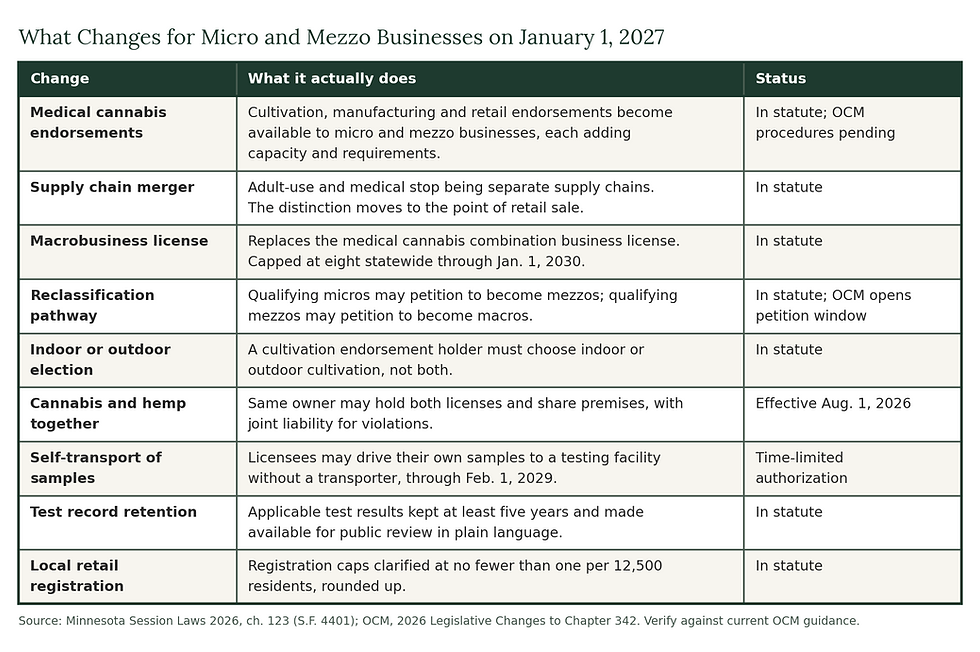
The changes are substantial enough that it would be a mistake for a current license holder to treat 2027 as simply a continuation of 2026. At the same time, not every operational detail is settled today. OCM still has guidance, forms, procedures, and implementation details to communicate, and that distinction matters.
There is a difference between the law saying something will be allowed beginning January 1 and OCM publishing exactly how you apply for it, what documentation you need, and how the process will work. Businesses should pay attention to both. The statute establishes the legal framework. OCM’s rules, forms, guidance, and implementation procedures will determine how many of these changes actually work at the operational level.
The Microbusiness Gets More Flexible
Minnesota’s microbusiness license remains the state’s smallest cannabis business license category, but the 2027 changes give it more flexibility than the word micro might suggest. A microbusiness can perform a combination of activities depending upon the endorsements it holds, and those activities can include cultivation, manufacturing, extraction, retail, internal transportation, and certain hemp-related activities.
The basic cultivation limits remain important. A microbusiness may cultivate up to 5,000 square feet of indoor plant canopy or one-half acre of mature flowering plants outdoors, subject to the applicable requirements and endorsements. A microbusiness with a retail endorsement may operate one retail location.
One thing worth flagging about that word “or.” The 2026 legislation makes the choice explicit. A cultivator, macrobusiness, mezzobusiness, or microbusiness holding a cannabis cultivation endorsement has to choose whether it cultivates indoors or outdoors. Some operators had hoped the Legislature would turn that “or” into an “and” while keeping everyone under the same canopy ceiling. It did not.
Beginning in 2027, though, the microbusiness can go beyond those baseline cultivation limits through a medical cannabis cultivation endorsement. A microbusiness with a cannabis cultivation endorsement can apply for one, and if the applicable requirements are met it allows an additional 1,000 square feet of indoor canopy, or an additional one-quarter acre of outdoor mature flowering plants, on top of the standard microbusiness limits.
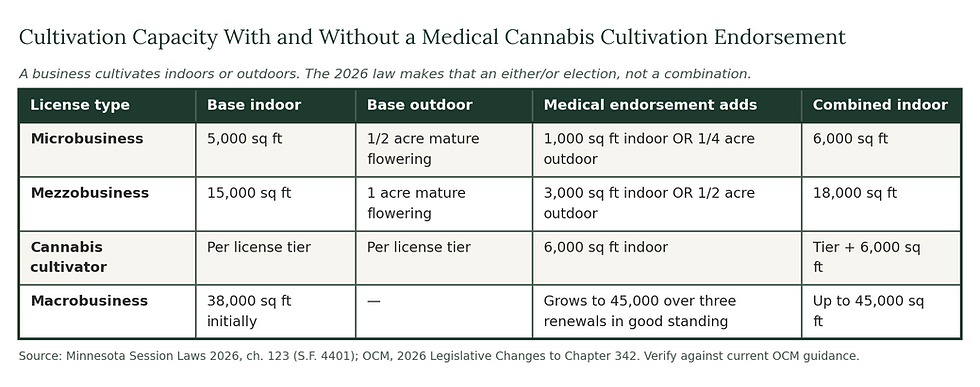

That distinction is significant. A business that understands only its original microbusiness cultivation limit could miss one of the most important expansion opportunities created by the 2027 law. But this is also where the compliance burden increases. Medical cannabis cultivation is not simply an extra square-foot allowance. The business is entering a regulated medical supply chain with additional requirements.
There is another requirement attached to the medical cultivation pathway. OCM describes it this way: a cultivator holding the endorsement must ensure that one-quarter of its canopy supplies businesses with medical cannabis endorsements. How that gets measured, and how OCM expects a business to document it, is one of the operational details still being worked out.
For a small cultivator, that means production planning and sales planning can no longer be completely separate conversations. The business needs to know what it is growing, how much it can grow, what portion is subject to the medical-market requirement, who it can legally sell that portion to, and what documentation demonstrates the transaction occurred properly. That is compliance becoming part of operations rather than something that happens after the operational decisions are made.
Medical Manufacturing Is Also Coming Into the Small-Business Picture
The 2027 law also creates a medical cannabis manufacturer endorsement that qualifying microbusinesses and mezzobusinesses can obtain. It allows a business to exceed its standard rule-based manufacturing limit by up to 25 percent, provided the statutory and regulatory requirements are met.
But the endorsement comes with responsibilities. A business holding it must comply with the applicable manufacturing requirements and must manufacture the high-medical-need products OCM identifies. Medical cannabinoid products produced under this endorsement have their own requirements, including specific labeling and limits on who may purchase them.
This creates an interesting opportunity for small manufacturers. A business that once thought of itself as simply making adult-use products may now have a route into the medical supply chain. But again, the question should not be whether you can make more product. It should be whether your systems can support making more product under another set of requirements. Those are very different questions.
And Retail Gets an Interesting New Option
The 2027 law also creates a medical cannabis retail endorsement for qualifying microbusinesses and mezzobusinesses that already have retail operations. For a microbusiness, it can allow one additional retail location beyond the normal limit if at least one retail location sits in an area OCM identifies as a high-medical-need area. For a mezzobusiness, the corresponding provision can allow up to two additional retail locations when the same high-medical-need conditions are met. A standalone cannabis retailer gets three.
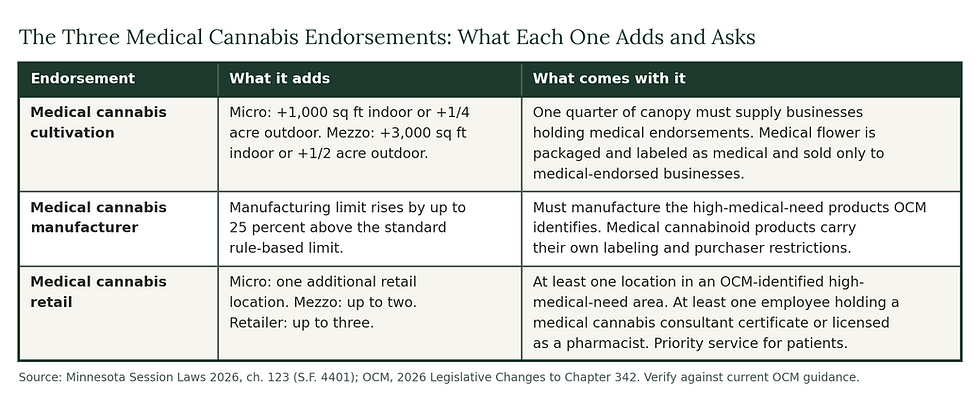
One requirement is worth knowing before you plan around a medical retail endorsement. OCM issues it only to a license holder with at least one employee who holds a medical cannabis consultant certificate or is a licensed pharmacist. That is a hiring or training decision, and it has a lead time attached to it.
The retail expansion is potentially very significant. But there is an important catch that small businesses should understand now. A state license does not automatically mean you can open a retail location wherever you want. Retail activity also involves local government registration.
Local Retail Registration Is Still a Big Deal
Minnesota requires businesses conducting cannabis retail activity to obtain a local retail registration in addition to the applicable state license and endorsement. That includes microbusinesses and mezzobusinesses operating retail locations. Local governments can establish their own registration processes, and local retail registration is distinct from zoning certification.
Zoning approval is not the same thing as retail registration.
OCM specifically warns applicants to understand the local registration process before making significant investments in a proposed location, because a local government may limit the number of registrations it issues. The 2026 changes sharpen this. A city or county may cap registrations at no fewer than one for every 12,500 residents, rounded up at each increment, and the older provision that let a city off the hook once the county hit its own ratio is gone.
For a business planning a 2027 expansion, the practical lesson is straightforward. Do not treat the state license as the last regulatory hurdle. The location itself can remain a separate compliance project. And if a business is considering multiple locations, the complexity multiplies.
Mezzobusinesses Are Getting More Room to Grow
The mezzobusiness category is where the 2027 changes become particularly interesting. A mezzobusiness can operate up to three retail locations and can cultivate up to 15,000 square feet of indoor plant canopy or one acre of mature flowering plants outdoors, depending upon the applicable endorsements and requirements.
Beginning in 2027, a mezzobusiness with the appropriate cannabis cultivation endorsement can also pursue a medical cannabis cultivation endorsement. That can provide an additional 3,000 square feet of indoor canopy, or one-half acre of outdoor mature flowering plants, again on top of the ordinary mezzobusiness limits. For a business already approaching the practical limits of its existing operation, that could represent meaningful additional production capacity.
But it also raises a bigger strategic question. At what point does a growing small business need enterprise-level controls? There is no magic number. It might happen at two employees. It might happen at ten. It might happen when a business adds its second retail location, or when manufacturing is added to cultivation, or when the business begins participating in both adult-use and medical markets. The important point is that complexity does not necessarily arrive at the same time as headcount.
The Micro-to-Mezzo Pathway Is One of the Biggest 2027 Changes
This may ultimately become one of the most important parts of the 2027 framework for Minnesota’s small cannabis businesses. The law creates a formal pathway for a qualifying microbusiness to petition OCM for reclassification as a mezzobusiness. But it is not simply a matter of having grown enough.
A microbusiness has to have held and operated a medical cannabis cultivation endorsement for a minimum of two years, and it has to be in good standing with OCM. A mezzobusiness petitioning to become a macrobusiness has to clear more than that. It needs the same two years of medical cultivation endorsement, plus a medical cannabis manufacturing endorsement or a medical cannabis retail endorsement held and operated, plus good standing, plus a twelve-month gap since its last reclassification.

OCM controls the timing. It determines whether licenses are available for reclassification, and it must announce the date when it will begin accepting petitions. Macrobusiness reclassifications are further limited by the statewide cap on that license type.
There are also specific statutory protections and selection requirements involving social-equity applicants. Qualified social-equity microbusiness petitioners are to be reclassified to mezzobusiness licenses. Where the number of qualified non-social-equity petitioners exceeds the number of social-equity petitioners, OCM selects among them using the same methods it uses for license selection. Reclassification does not strip a social equity license of that status.
And importantly, submitting a petition does not mean the business loses its existing license while it waits. The law allows a business that submits a reclassification petition to continue operating while OCM makes its determination. If the petition is denied, the business retains its existing license. That is a much more deliberate growth pathway than Minnesota’s original license structure suggested.
What Does “Good Standing” Mean in Practical Terms?
This is an area where businesses should start thinking now rather than waiting for a reclassification opportunity to arrive. The statute makes good standing an eligibility requirement for the micro-to-mezzo pathway. That means compliance history could become more than a matter of avoiding penalties. It could become part of the business’s growth qualification.
The law does not define good standing in a tidy sentence, but it does something almost as useful. It lists what will get a petition denied. Unpaid fines or fees. Substantial noncompliance with Chapter 342. An incomplete petition. A materially false statement. Failing the general ownership qualifications. Missing the petition deadline. And failing to answer an OCM request for more information within fourteen calendar days.
Fourteen calendar days is not a long window to assemble records you have not been keeping.
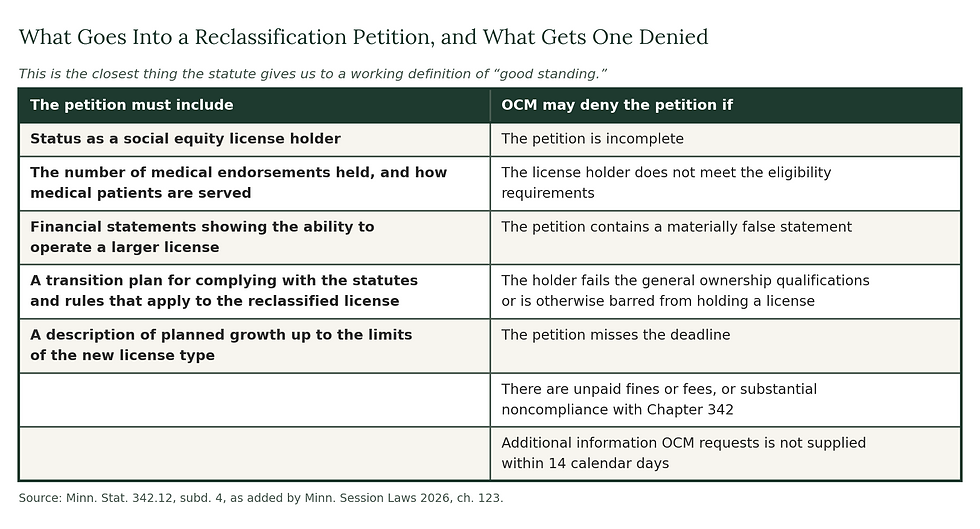
The petition itself also tells you what OCM expects a growing business to have on hand. It asks for social equity status, the number of medical endorsements held and a description of how medical patients are served, financial statements showing the ability to operate a larger license, a transition plan describing how the business will comply with the statutes and rules applicable to the reclassified license, and a description of planned growth up to the limits of the new license type.
A business that wants to move from micro to mezzo should therefore be thinking about its compliance record as an asset. That means being able to demonstrate that required records were maintained, inventory reconciliations were performed, required training occurred, testing documentation was retained, required reports were submitted, employee records were maintained, security requirements were followed, retail registration remained current, tax obligations were addressed, corrective actions were completed, policies reflected actual operations, and changes to the business were documented and approved where required.
This is where the phrase “if it isn’t documented, it didn’t happen” becomes more than a compliance cliché. If a business eventually needs to demonstrate that it has operated in good standing for two years, its historical documentation may matter.
2027 Makes the SOP Question More Important, Not Less
This is one of the areas where the 2027 changes intersect directly with the way Minnesota microbusinesses and mezzobusinesses are already being asked to prepare their operations. OCM’s Final Plans of Record process for microbusiness and mezzobusiness applicants includes five major components: accounting and tax compliance; inventory control, storage, and diversion prevention; quality assurance; site, security, and operations; and vehicle disclosure.
Those documents should not be thought of as five PDFs that exist primarily to get through licensing. They describe the operating system of the business. And 2027 makes that distinction increasingly important. A business that adds cultivation, manufacturing, retail, medical activity, transportation, additional locations, or expanded production needs to make sure that its written procedures continue to match what employees actually do.
A beautiful SOP that nobody follows is not a strong compliance system. Neither is an excellent operation that exists entirely in somebody’s head. The real goal is the connection between the two.
The Business May Be Getting Bigger Without “Becoming a Big Business”
This is one of the most interesting things about the micro and mezzo structure. Minnesota’s system gives relatively small businesses the ability to combine activities that, in another regulatory structure, might belong to several different businesses. A microbusiness can combine cultivation, manufacturing, retail, extraction, consumer products, transportation-related functions, and other authorized activities depending on its endorsements. A mezzobusiness can do even more.
That can be an advantage. It can also create compliance fragmentation inside a single company. Consider a hypothetical small business that starts with cultivation, manufacturing and retail, then adds medical cultivation, medical manufacturing and a second retail location, then begins transporting its own products, then adds a hemp license. The company may still describe itself as a small business. Operationally, it is now managing several regulatory environments at once.
That means the compliance question changes from whether you have an SOP to whether the entire operation works together.
Cannabis and Hemp Become More Flexible
The 2026 legislation also creates greater flexibility for businesses operating in both cannabis and hemp. The changes remove the prior prohibition on holding both a hemp and a cannabis license, and they allow cannabis and hemp businesses to occupy the same premises. OCM describes this as creating flexibility across market segments while also clarifying the endorsement structure.
The ownership condition is specific. The businesses have to have the same majority owners in common, and each of those majority owners has to individually own more than ten percent of each business. All sales or transport of regulated products to and from licensed cannabis businesses still has to be recorded in the statewide monitoring system, and a cannabis business sharing premises may move regulated products between the businesses on that shared site.
Then comes the part that deserves a highlight. Businesses that occupy the same premises are jointly liable for any violations of Chapter 342 or Minnesota Rules, chapter 9810. If you share a building with a hemp business you also own, its mistake is your mistake.
For a small business, the flexibility could still be significant. It may create opportunities to diversify revenue without building an entirely separate physical operation. But shared space does not mean shared compliance. If cannabis and hemp operations occupy the same facility, expect to need extremely clear controls around inventory, receiving, storage, labeling, product identification, records, employee responsibilities, point-of-sale activity, waste, testing, transportation, and documentation. The physical building may be shared. The compliance obligations are not automatically interchangeable.
Testing Gets an Important Operational Change
One of the less flashy changes could nevertheless be useful to smaller businesses. The law creates a pathway for a cannabis microbusiness, mezzobusiness, cultivator, or manufacturer to transport samples of its own cultivated or manufactured products to a cannabis testing facility without contracting a licensed cannabis transporter. The requirements include maintaining an appropriate shipping manifest, using a vehicle that meets specified storage and security requirements, and providing OCM with information about the vehicles used.
Two things to note. First, this authorization runs through February 1, 2029. It is a window, not a permanent feature, and a business that builds its testing logistics around it should know the window has an end date. Second, this is not simply a matter of driving your samples to the lab. There are controls attached to that activity.
Testing logistics can become a real operational issue for smaller businesses, so the change is worth watching. A business considering this pathway should build the transportation process into its written procedures rather than improvising the first time a sample needs to move.
Test Records Still Matter for Years
The 2027 law also establishes a clear record-retention expectation around testing. Microbusinesses, mezzobusinesses, cultivators, manufacturers and certain other businesses must maintain applicable test results for at least five years after testing. The law also provides that maintained test results must be made available for public review, in plain language.
That second half is easy to skim past. Test results a business keeps are not purely internal records anymore. They are subject to public review, and the statute expects them to be readable by the person asking.
That means testing records should not live solely in an email inbox. Businesses should have a defined system that runs from test ordered, to sample identified, to result received, to batch disposition, to record retained. Five years is long enough that a business should assume the person who originally managed the record may no longer be the person responsible for the business. Good compliance systems account for that.
The Tax Side Has Not Disappeared
One thing that should not get lost amid all the license changes is taxation. Minnesota’s cannabis gross receipts tax remains 15 percent on taxable cannabis products, on top of the state’s 6.875 percent general sales tax and any applicable local sales taxes.
The medical side is treated differently, and that difference matters for any micro or mezzo considering a medical retail endorsement. The 2026 legislation retains the cannabis excise tax exemption on medical products for enrolled patients. Same building, same inventory system, different tax treatment at the point of sale. Your point-of-sale configuration and your reporting both have to know which transaction is which.
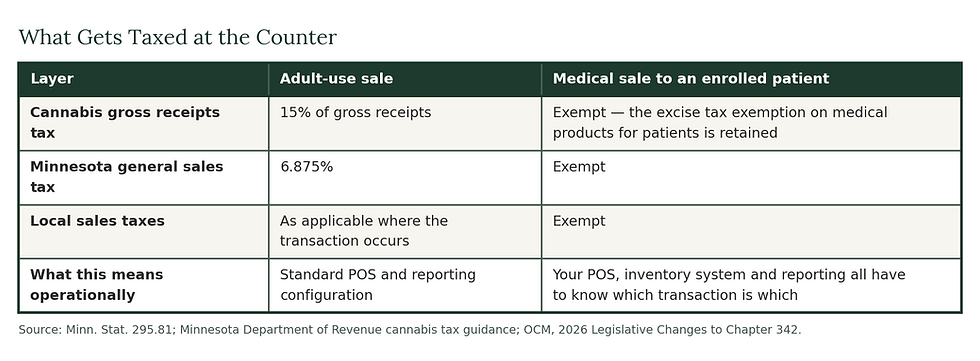
For a small business, tax compliance should be integrated with the same operational controls used for inventory and sales. This is particularly important when the business operates multiple channels. The more products, locations, sales types, and potentially hemp and cannabis transactions a company handles, the more important it becomes to have a reliable reconciliation process between what was produced, what was received, what was transferred, what was sold, what was returned or destroyed, what remains, and what was reported and taxed. That is not merely an accounting exercise. It is part of the business’s overall compliance picture.
The Medical Market Could Become a Major Compliance Opportunity
For many micro and mezzo businesses, the medical provisions may be the most intriguing part of the 2027 changes. The state is creating medical cannabis cultivation, manufacturing, and retail endorsements that smaller license holders can use. That means the medical market is no longer simply something happening in a separate corner of Minnesota’s cannabis industry. It is being folded into the broader cannabis supply chain.
The supply chain merger is the mechanism. Beginning January 1, 2027, the point of distinction between adult-use and medical cannabis moves to the point of retail sale for most of the supply chain, which removes the requirement to run separate cultivation, manufacturing and inventory-tracking operations. The medical registry, patient protections and consultation requirements stay in place.
But medical activity still comes with additional requirements. A business that decides to participate should not treat the medical endorsement as another checkbox on a license. It should ask what products it will make, who can buy them, how medical inventory will be identified, how labels will differ, what employee training is required, how patient-facing requirements will be handled, how medical and adult-use inventory will be reconciled, and how it will demonstrate compliance months later. Those questions should be answered before the first medical transaction, not after it.
The End of the Medical Cannabis Combination Business Matters Too
Beginning January 1, 2027, Minnesota’s medical cannabis combination business license goes away and the macrobusiness license takes its place. For microbusinesses and mezzobusinesses, this matters because it changes the shape of the overall state cannabis market.
The macrobusiness numbers are worth knowing even if you never intend to become one. A macrobusiness may cultivate 38,000 square feet of indoor canopy initially, growing to 45,000 over three license renewals for a business in good standing. It can use up to 90,000 pounds dry-weight equivalent for manufacturing and operate up to eight retail locations, three of which must sit in high-medical-need areas. It is required to manufacture high-medical-need products, ensure one-quarter of its canopy supplies medical-endorsed businesses, carry high-medical-need products at all times, and establish priority service to patients. Statewide, the cap is eight macrobusiness licenses through January 1, 2030.
That 38,000 figure is a reduction from the 90,000 square feet available to medical cannabis combination businesses today. The state did not simply rename the top tier. It reshaped it.
The new structure creates a more defined progression from microbusiness to mezzobusiness to macrobusiness. That does not mean every microbusiness is expected to become a mezzo, or every mezzo a macro. It does mean Minnesota has now created a statutory growth pathway between these categories. For entrepreneurs entering the industry, that may change how they think about the license they choose today.
The Question to Ask Before Adding an Endorsement
One of the biggest mistakes a growing cannabis business can make is looking at an endorsement only as a revenue opportunity. A better question is what new compliance system comes with it.
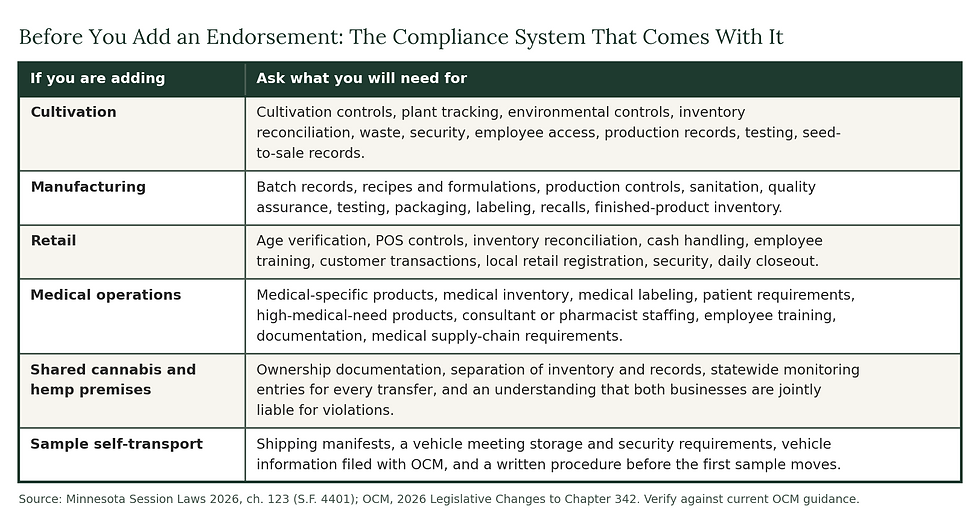
The license or endorsement is the permission. The operating system is what makes the permission usable.
What Should a Micro or Mezzo Be Doing Before January 1?
The smartest preparation is not necessarily rewriting every SOP immediately. Start by mapping the business. Write down every major activity the business currently performs. Not what the license says. What the business actually does: cultivation, manufacturing, retail, receiving, transportation, testing, inventory, waste, purchasing, sales, employee management, security, training, accounting. Then compare those activities with the endorsements and registrations the business actually holds. That exercise alone can uncover gaps.
Next, identify what you want to add in 2027. Additional cultivation capacity? Medical cultivation, medical manufacturing, or medical retail? Another retail location? Hemp operations? Internal transportation or sample transportation? Additional products? A pathway toward mezzobusiness reclassification? Do not wait until the application or endorsement process opens to answer these questions. The two-year medical cultivation clock in particular means the reclassification decision is being made now, whether you are thinking about it or not.
Then build the compliance infrastructure before the expansion. If the business plans to expand, the SOP framework should expand before the operation does. That does not mean creating a 300-page binder nobody reads. It means creating procedures that answer the questions employees actually encounter. Who does it? When? How? What record is created? Where is that record kept? Who reviews it? What happens when something goes wrong?
That last question is particularly important. A mature compliance program does not assume nothing will ever go wrong. It defines what happens when something does.
Think About Compliance as a System, Not a Binder
This may be the most important takeaway for Minnesota’s small cannabis businesses heading into 2027. A compliance program is not a collection of documents. It is a system.
The accounting system should agree with the inventory system. The inventory system should agree with the POS. The POS should agree with the required reporting. The employee training records should match the procedures employees are expected to follow. The security plan should reflect the facility that actually exists. The testing records should correspond to the products actually produced and sold. And when something changes, the affected documents and training should change with it.
This is where compliance drift begins. The business opens. The SOP says one thing. Six months later, employees have developed a faster way to do it. A new POS feature gets turned on. A storage room changes. A new employee takes over inventory. A product line is added. A second location opens. Nobody updates the procedure.
Nothing necessarily looks dramatically wrong. But the business is slowly operating under a different system than the one it originally documented. That gap can become increasingly important as a business grows.
2027 Could Be the Year Small Businesses Need to Think Bigger About Compliance
There is an understandable tendency to associate sophisticated compliance systems with large companies. Minnesota’s 2027 cannabis framework challenges that assumption. A microbusiness can have multiple endorsements. A mezzobusiness can have multiple retail locations. A business can combine cannabis and hemp operations. Medical endorsements add another layer of requirements. Businesses can grow into larger license categories. And the state is increasingly expecting businesses to demonstrate that their operations are controlled, documented, and traceable.
None of that means a small cannabis business needs to operate like a Fortune 500 company. It means the business needs controls appropriate to what it actually does. That distinction matters. Enterprise-level compliance does not require enterprise-level bureaucracy. It requires knowing where the risks are, putting controls around them, and being able to demonstrate that those controls actually work.
A 2027 Readiness Checklist for Minnesota Micro and Mezzo Businesses
Before the new year, every microbusiness and mezzobusiness should be able to answer a few basic questions.
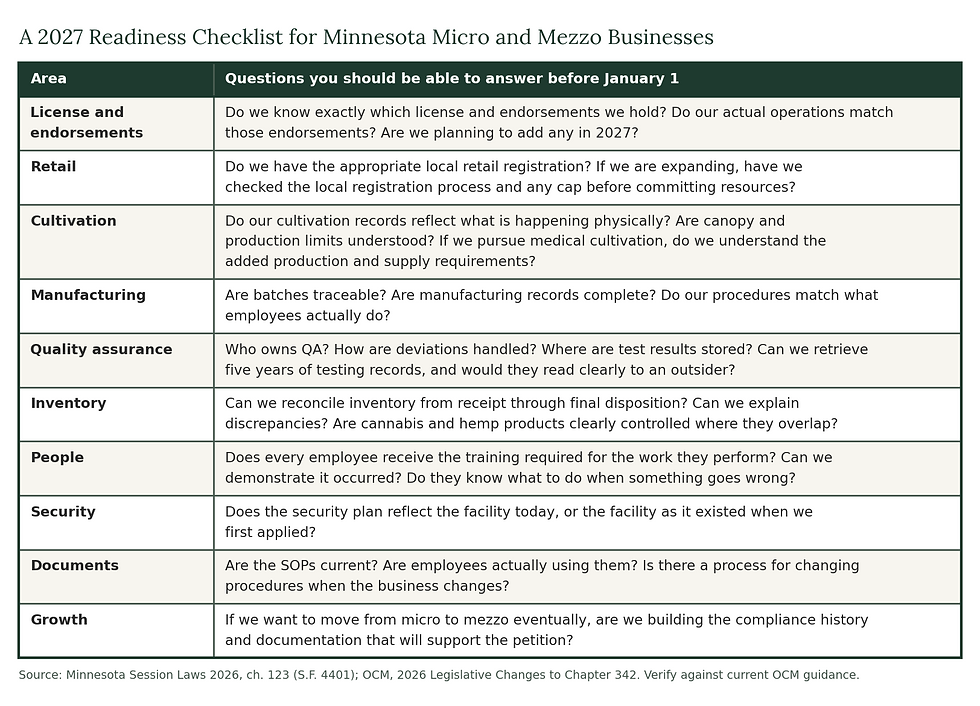
If any row in that table produces a pause rather than an answer, that is the row to start with.
The Biggest 2027 Mistake May Be Waiting Until 2027
Some of the most consequential provisions do not become effective until January 1. That does not mean businesses should wait until January 1 to think about them. A business that wants to add medical cultivation, increase production, expand retail, pursue another endorsement, or eventually move from micro to mezzo should be looking at the operational consequences now.
Some of those processes will depend on OCM guidance that has not yet been published. That means businesses should not invent requirements OCM has not yet established. But they can absolutely prepare the underlying systems. They can clean up inventory, review their SOPs, document training, reconcile records, identify gaps, review their physical security, map their workflows, determine which endorsements they may want, and begin conversations with local governments about retail registration and location requirements. They can make sure their business is operating the way their documentation says it operates. None of that requires waiting for a January 1 deadline.
The Opportunity and the Responsibility
Minnesota’s 2027 cannabis changes give small businesses something they have not always had: more room to grow without immediately leaving the small-business end of the licensing structure. A microbusiness can expand its cultivation capacity through medical cultivation, enter medical manufacturing, and expand retail under the medical retail structure. A mezzobusiness has larger cultivation and retail capacity and can access similar medical endorsements. And qualifying businesses can eventually pursue reclassification into the next license category.
That is a meaningful opportunity. But every additional activity creates another set of operational questions. The businesses that benefit most from the new flexibility will not simply be the ones that obtain additional endorsements. They will be the ones that understand what those endorsements require before they turn them into operations.
The goal should not be to build the biggest possible cannabis business. The goal should be to build a business that knows exactly what it is doing, can prove that it did it correctly, and can adapt when the rules or the business change. Because in 2027, Minnesota’s microbusinesses and mezzobusinesses may have more room to grow. They will also have more reasons to make sure their compliance infrastructure grows with them.
What We Will Be Watching as 2027 Approaches
There are still important details to watch as OCM continues implementing the 2026 legislative changes. Among them: OCM procedures and documentation requirements for the medical cannabis endorsements; the identification of high-medical-need areas and high-medical-need products; manufacturing limits established through rule; the procedures for micro-to-mezzo reclassification and when reclassification opportunities actually become available; implementation details around medical cannabis manufacturing; operational requirements for transporting samples to testing facilities; updated OCM forms and guidance; local implementation of retail registration requirements; and additional guidance for businesses operating across cannabis and hemp.
This is an area where businesses should be cautious about relying on information that was accurate six months ago. Minnesota’s cannabis framework is still developing. The law establishes the foundation. OCM’s guidance fills in the operational details. And businesses need to keep up with both.
The Bottom Line
For Minnesota’s microbusinesses and mezzobusinesses, 2027 is shaping up to be a year of expansion, integration, and increasing operational complexity. The state’s smallest cannabis businesses are not being pushed into a one-size-fits-all model. Instead, the 2027 framework gives qualifying businesses additional ways to cultivate, manufacture, participate in the medical market, operate retail locations, work across cannabis and hemp, and potentially progress into larger license categories.
That flexibility is valuable. But flexibility works only when the underlying operation can support it. The businesses preparing for 2027 should therefore be asking one question now.
If our business changes on January 1, will our compliance system know that it changed?
If the answer is no, that is not a crisis. It is a starting point, and it is a better place to start from than most operators think.
That question, whether your compliance system actually knows what your business does today, is the one we built Sentinel Scout to answer. Scout looks at what you have in place against what your license and endorsements actually require, and shows you where the gaps are. If it tells you everything lines up, that is worth knowing too, particularly before you add an endorsement on top of it. You can find Scout at: cannapath.org/sentinel
Minnesota’s market has come a long way from where it started. We still have some distance to cover, but we are getting there, and the operators who came in early are the reason. If you get into something you would rather not sort out alone, we are here. Reach out at: clientservices@cannapath.org.
-Drew
Next in this series: Minnesota's New Micro-to-Mezzo Pathway: What Does Two Years of Good Standing Really Mean? The two-year clock is not the one most owners assume it is. It does not start when you receive your microbusiness license. It starts when you begin holding and operating the medical cannabis cultivation endorsement, which means a business licensed in 2027 may be further from eligibility than it thinks. We also take apart what good standing means, because the statute never defines it and it does not appear to demand a spotless record. What it does name is unpaid fines and substantial noncompliance. There is a real difference between a problem you found and corrected and a pattern you let settle in, and that difference is probably what OCM will be reading.
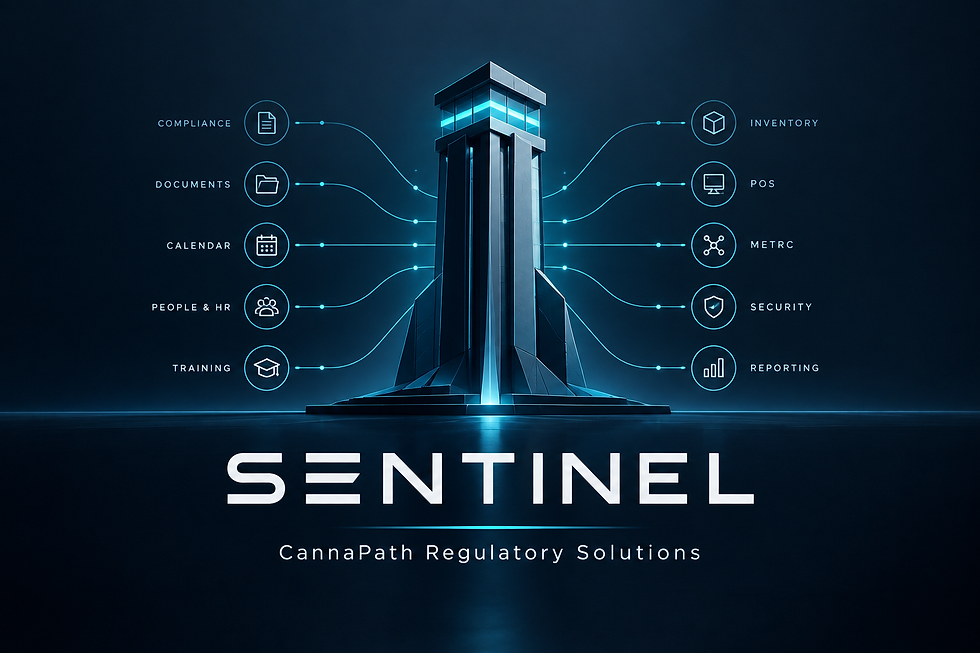
Sentinel is coming!!
Our development team is putting the finishing touches on Sentinel, and we’ve made some huge progress.
We’ve just completed the Site Security section, which means Sentinel users will soon be able to have up to four live security camera feeds right on their dashboard (provided your security system supports remote viewing).
We’re also adding another POS vendor to the system. Like the other three vendors already integrated, it will work directly with Metrc, helping close some of the gaps between systems.
And yes, you will have choices. We made that a requirement from the beginning because we want to give businesses options and help keep costs down.
If you want to be the first in line when Sentinel drops add yourself to our email list. Please do not worry, we do not sell your information, nor do we flood you with marketing emails. We don’t have time for that, and neither do you. thewatch@cannapath.org
This article is intended for general informational purposes and is not legal advice. Minnesota cannabis laws, rules, and OCM guidance continue to develop. Businesses should consult the current statutes, OCM guidance, and qualified legal and professional advisers regarding their specific circumstances.
Sources: Minnesota Office of Cannabis Management, 2026 Legislative Changes to Chapter 342; Minnesota Session Laws 2026, Chapter 123 (S.F. 4401); Minnesota Statutes chapter 342; Minnesota Statutes 295.81 and Minnesota Department of Revenue cannabis tax guidance. The principal 2027 statutory changes discussed above were enacted in 2026 legislation and take effect January 1, 2027 where noted. Figures should be verified against current OCM guidance before you rely on them, as rules continue to change.