Minnesota's New Micro-to-Mezzo Pathway: What Does Two Years of Good Standing Really Mean?

For Minnesota cannabis microbusinesses, the new path to a mezzobusiness license may be one of the most important changes coming in 2027. But there is a phrase in the law that deserves much more attention: “in good standing with the office.”
Drew Duffy, MHA, FACHE, Founder & Managing Director, CannaPath Regulatory Solutions
Last reviewed: September 29, 2026
There is a lot to like about Minnesota's new micro-to-mezzo pathway. Beginning January 1, 2027, Minnesota law creates a formal process through which a qualifying cannabis microbusiness can petition the Office of Cannabis Management to reclassify its license as a mezzobusiness.
On paper, the eligibility requirement looks fairly simple. A microbusiness must have held and operated a medical cannabis cultivation endorsement for at least two years, and must be in good standing with OCM. Two years. Good standing. That sounds straightforward. It is not quite that simple.
The two-year requirement is actually narrower than some businesses may assume, because the law ties the clock specifically to holding and operating the medical cannabis cultivation endorsement. And while the statute requires a business to be in good standing, it does not provide a neat one-page definition that says exactly what every past mistake, violation, correction, inspection finding, or late filing means for eligibility.
That leaves businesses with an important question. What does good standing actually mean when your future license category may depend on it?
As of September 2026, the safest answer is this. Do not treat good standing as simply “we have not been shut down.” Treat it as an ongoing condition of the business that you should be able to demonstrate through your records, renewals, approvals, corrections, financial obligations, and day-to-day operations. And that is something a microbusiness can start preparing for long before its two-year clock runs out.
The Two-Year Clock Is Not the Clock You May Think It Is
This is the first point I would want every Minnesota microbusiness owner to understand. The law does not say that a microbusiness simply has to hold its microbusiness license for two years. It says the microbusiness must have held and operated a medical cannabis cultivation endorsement for a minimum of two years. That is a very different requirement.
A business could have been operating as a microbusiness for years and still not have started its two-year reclassification clock. The clock is tied to the medical cannabis cultivation endorsement. So the date to watch is not when you received your microbusiness license. It is when you began holding and operating the medical cannabis cultivation endorsement.
That distinction could become particularly important for businesses that are licensed in 2026 and begin adding medical capabilities during 2027.
A simple example
Imagine a hypothetical Minnesota microbusiness receives its cannabis microbusiness license in April 2027. The owners operate for several months and then receive their medical cannabis cultivation endorsement in September 2027. The two-year requirement would not be satisfied merely because the business has been a licensed microbusiness for two years. The relevant two-year period would be tied to the medical cultivation endorsement.
That means September 2029 would be the earliest point at which the business could satisfy the two-year portion of the statutory eligibility requirement, assuming it has actually held and operated the endorsement for that period.
Even then, something else matters. OCM must determine whether reclassification licenses are available and announce when it will begin accepting petitions. So reaching two years does not create an automatic conversion. It creates potential eligibility to petition. That distinction is easy to miss.
A Question the Statute Does Not Answer Yet
Here is a wrinkle worth knowing about before you build a timeline around any of this.
A medical cannabis cultivation endorsement is not brand new. A version of it exists under current law, available to a cannabis license holder authorized to cultivate. What the 2026 legislation does is rewrite that framework, repealing the existing endorsement provision and replacing it with new subdivisions that carry the added canopy and the obligation to supply medical-endorsed businesses.
The reclassification statute says a microbusiness must have held and operated a medical cannabis cultivation endorsement for a minimum of two years. It does not say whether time accrued under the current version of the endorsement counts toward that two years, or whether the clock effectively restarts when the new framework takes effect.
For a business already holding the endorsement, that is not a small question. It is the difference between being eligible to petition in early 2029 and being eligible some time later. The statute is silent, and I would not guess at it. This belongs on the list of things OCM's reclassification procedures will need to resolve, and it is worth asking about directly rather than assuming the answer you would prefer.
“Two Years” Does Not Mean “Automatic Upgrade”
Minnesota's new pathway is a petition process. The law gives OCM authority to determine whether licenses are available for microbusinesses seeking reclassification to mezzobusinesses. When OCM determines that licenses are available, it must announce when it will begin accepting petitions.
So there are really several gates, and the two-year clock is only the second one.
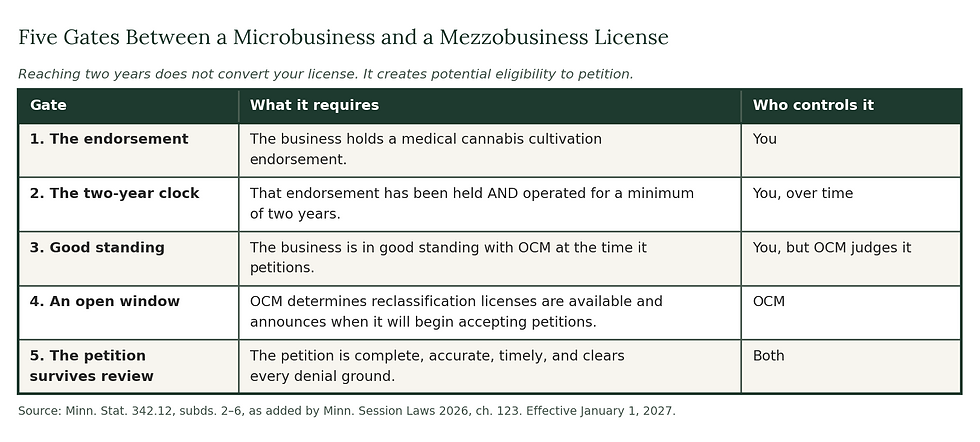
That last gate is important, because the petition requires much more than proof that the business has been around for two years.
The Reclassification Petition Looks More Like a Growth Application
The legislation tells OCM what information a reclassification petition must include, where applicable. Among other things, the petition must address the business's social equity status, the number of medical endorsements it holds and how it provides services to medical patients, financial statements showing the ability to operate a larger license, a transition plan describing how the business will comply with the statutes and rules applicable to the new license, and the business's planned growth up to the limits of the new license type.
That is revealing. The state is not simply asking whether you have been compliant long enough. It is also asking whether you are ready to operate at the next level. Those are two different questions, and a business might be eligible based on its history while still having work to do demonstrating it is prepared for the responsibilities that come with a larger license.
And that brings us right back to good standing.
So What Is “Good Standing”?
This is where we need to be careful. The reclassification statute uses the phrase “in good standing with the office,” but it does not provide a simple definition saying no violations whatsoever for two years. That is not what the statute says.
The same provision does, however, list the circumstances under which OCM may deny a petition. That gives us something much more useful than a vague definition. It gives us a window into what OCM will be looking at.
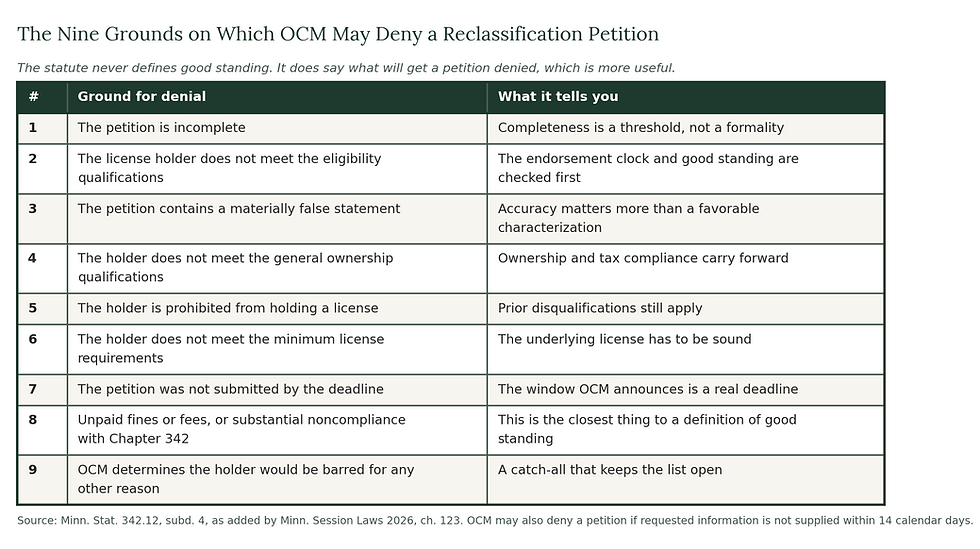
Read that list carefully and an important distinction emerges. A compliance history is not necessarily the same thing as a perfect compliance history.
A Mistake Is Not Necessarily the Same as Losing Good Standing
This is probably the place where business owners could become unnecessarily worried. Cannabis businesses operate in a regulated environment. Mistakes happen. A required record gets missed. An employee makes an error. A procedure is not followed exactly. A compliance issue is discovered during an inspection. A business gets an administrative order requiring a correction.
The existence of a problem does not automatically mean a business can never qualify for reclassification. Minnesota law gives OCM authority to issue administrative orders when it determines a licensed cannabis business has violated Chapter 342 or the rules adopted under it. Those orders can require the business to correct the violation, to cease the noncompliant activity, or both, and monetary penalties may also be imposed. In other words, the regulatory system itself recognizes that compliance problems can be identified and corrected.
The reclassification statute then specifically identifies unpaid fines or fees and substantial noncompliance as grounds on which OCM may deny the petition. That wording matters. The law does not say that any violation at any time means you can never become a mezzobusiness. It says OCM may deny a petition where there are unpaid fines or fees, or where the license holder has engaged in substantial noncompliance. Those are not necessarily the same thing as making an isolated mistake and correcting it.
That said, businesses should not read that distinction as permission to be casual about violations. Quite the opposite. If your future growth depends partly on OCM determining that you are in good standing, the safest strategy is to make compliance problems small, visible, documented, and corrected rather than allowing them to become recurring or systemic.
The Difference Between a Problem and a Pattern
This is where good compliance systems become particularly valuable. Consider two hypothetical businesses that encounter the same category of problem and handle it very differently.
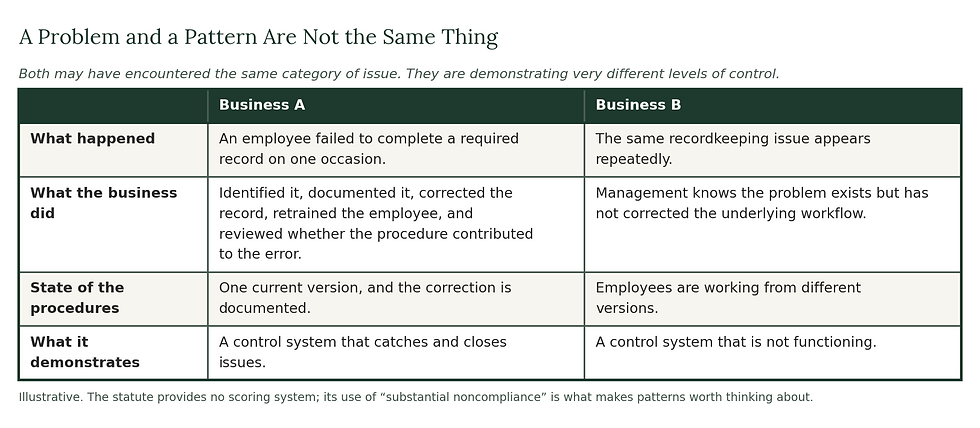
Those two businesses may have technically encountered the same issue. Operationally, they are demonstrating very different levels of control.
The law does not provide a mathematical scoring system for those situations, and businesses should not assume OCM will use one. But the statute's use of the phrase “substantial noncompliance” makes it reasonable to think about compliance in terms of patterns and overall control rather than only isolated events. That is an interpretation, not a formal OCM definition, and until the office publishes more detailed reclassification procedures that distinction should stay clear.
Good Standing Is Also About Staying Current
One of the easiest things for a growing business to overlook is that compliance is not static. OCM tells license holders that they must work with the office when making business changes and must follow established processes to remain compliant. Some changes require prior approval, including changes involving ownership, endorsements, locations, and material changes to final plans of record.
Adding a new endorsement is a good example of how much is attached to what sounds like a simple upgrade. A licensed business has to submit a new site registration and upload amended final plans of record covering the new endorsement, then notify OCM that the updates have been submitted. Every request for a new endorsement is subject to OCM review, approval, and inspection, plus local approval of the new site registration.
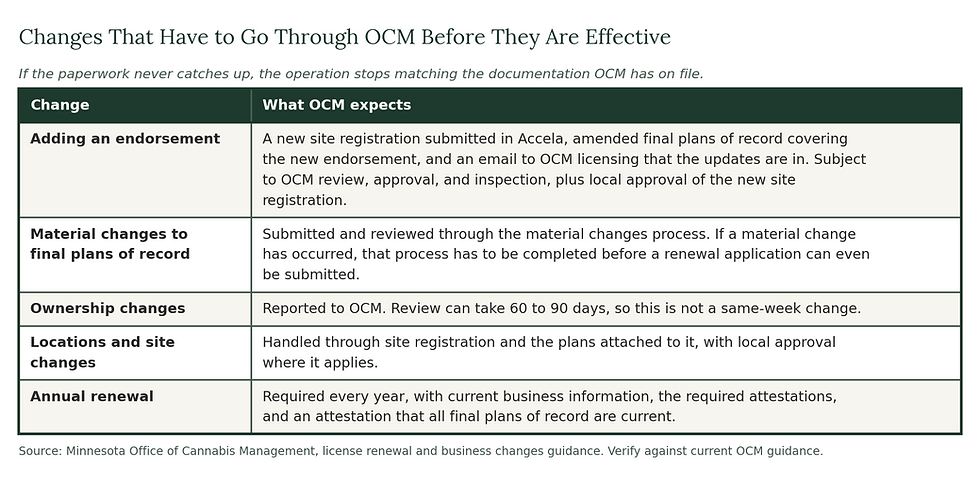
This matters for a future mezzobusiness. Imagine a microbusiness that begins with a carefully documented operation, then over the next two years adds a room, changes its security layout, adds an endorsement, changes part of its cultivation workflow, changes ownership, moves equipment, changes a manufacturing process, and modifies how employees perform a critical task. If the paperwork never catches up, the business may eventually be operating in a way that no longer matches the documentation OCM has on file. That is exactly the kind of drift that creates problems later.
Your Final Plans of Record Matter More Than Many Businesses Realize
OCM's renewal guidance provides an excellent example of why this matters. License holders must attest that all final plans of record are current, and renewal applications cannot be submitted until those plans are up to date. If material changes have occurred, the business has to complete the material changes process before it can submit the renewal at all.
That means the documents created during licensing are not supposed to become historical artifacts. They are supposed to remain representative of the operation.
For a business thinking about eventually moving from micro to mezzo, that matters for another reason. The reclassification petition will require a transition plan describing how the business will comply with all statutes and rules applicable to the reclassified license, along with a description of planned growth up to the limits of the new license type. A business with two years of organized documentation will be in a very different position from a business that has to reconstruct what it has been doing.
Renewal Is Part of the Record Too
Minnesota cannabis business licenses must be renewed annually. Businesses must maintain current business information and complete the required attestations and documentation each year. This sounds administrative. It is. But administrative compliance is still compliance.
There is also a harder edge to it than most operators realize. If a renewal has not been approved by the expiration date, even if it is still under review, the license holder must cease all operations as of that date.
Even if it is under review. That is not a grace period, and it is not a warning — it is a stop.
For a future reclassification applicant, the point is not simply don't forget your renewal. The broader lesson is to keep the license itself, the business information attached to it, the plans attached to it, and the operation represented by those documents aligned over time. That is what creates a clean compliance history.
Financial Compliance Is Part of the Picture Too
The statute specifically identifies unpaid fines or fees as a potential reason for OCM to deny a reclassification petition. That is important, because a business could otherwise think of accounting and compliance as two completely separate functions. They are not.
A growing cannabis operation should be able to demonstrate that required fees have been paid, required filings have been addressed, tax processes are functioning, and obligations to regulators are not sitting unresolved. OCM's licensing and renewal processes already require financial and business information, and the reclassification process will require financial statements demonstrating the ability to operate a larger license. A future mezzobusiness application is therefore not just a regulatory exercise. It is partly a business-readiness exercise.
Documentation May Become Your Best Evidence of Good Standing
Here is where I think Minnesota microbusinesses should start thinking differently. Do not build documentation only because somebody may inspect you. Build it because someday you may need to demonstrate how well you have operated.
Imagine that two years from now your business is ready to petition for reclassification, and you can put your hands on all of it.
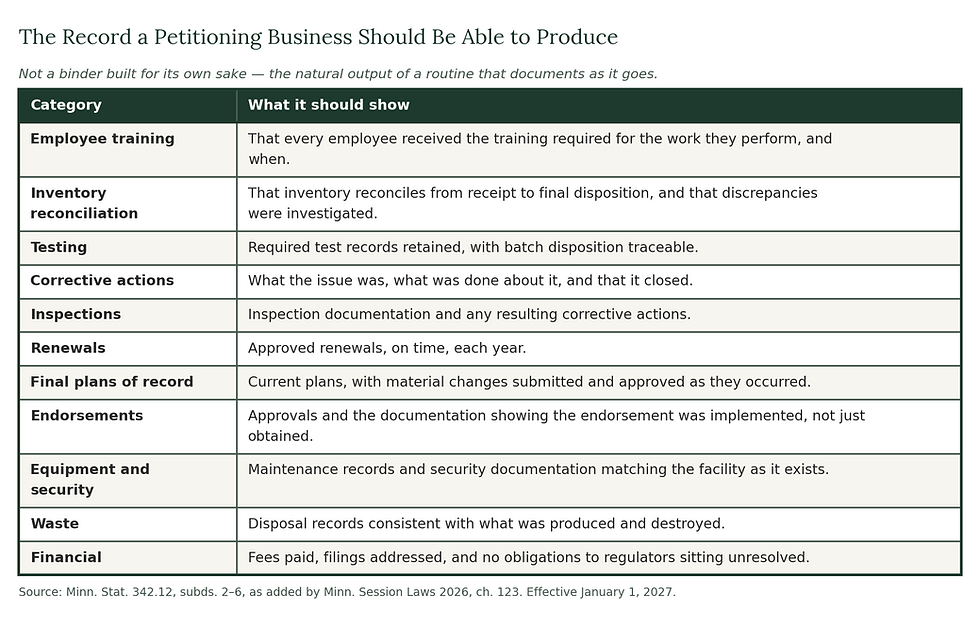
You are not necessarily guaranteed approval. But you have something valuable: a history that can be demonstrated. Compare that with “we've always done it right, we just don't really have all that paperwork anymore.” That may be perfectly true. It is also much harder to demonstrate.
What Should a Microbusiness Keep an Eye On?
I would not recommend creating a giant good-standing binder simply for the sake of having one. Instead, build a routine that produces the evidence naturally. When an issue is identified, document what happened. When it is corrected, document the correction. When an employee is retrained, record it. When a procedure changes, update the procedure.
When a material change requires OCM approval, preserve the submission and the approval. When an endorsement is added, retain the approval and the implementation documentation. When a renewal occurs, retain the final record. When testing occurs, retain the required records. When inventory does not reconcile, document the investigation and the disposition. When an inspection happens, retain the inspection documentation and any corrective actions.
None of those practices guarantees that OCM will find a business to be in good standing. But together they create something important: an auditable history of how the business manages compliance.
Do You Have to Be Perfect for Two Years?
This deserves its own section, because I suspect it will be one of the first questions business owners ask.
Based on the statute currently in effect for the 2027 reclassification pathway, there is no provision saying that a single corrected compliance mistake automatically resets the two-year period or permanently disqualifies a microbusiness. The explicit two-year requirement is that the microbusiness has held and operated its medical cannabis cultivation endorsement for a minimum of two years. The separate eligibility requirement is that it be in good standing with OCM. The petition-denial section then identifies unpaid fines or fees and substantial noncompliance among the circumstances that may support denial.
So there are three things we should not be telling businesses. We should not tell them that every violation resets their clock. We should not tell them that any inspection finding automatically eliminates their eligibility. And we should not tell them that good standing means having a completely spotless regulatory history. The law does not say those things.
What we can say is that a business seeking future reclassification should treat every compliance issue as potentially relevant to its record, and should resolve issues promptly and completely. That is a much more defensible position.
The Clock Might Be the Easy Part
There is an irony here. The hardest part of the micro-to-mezzo pathway may not actually be surviving two years. It may be being able to show that you are ready for what comes after those two years.
Remember what the reclassification petition requires. Financial information demonstrating the ability to operate a larger license. A transition plan. A description of how the business will comply with the requirements of the larger license. A description of planned growth up to the limits of the new license type. That is much closer to an operational readiness review than a simple license upgrade.
You've demonstrated that you can operate a microbusiness. Show us how you intend to operate a mezzo.
That is the question being asked, in effect. And it means a business should probably start building that answer before it reaches the two-year mark.
Don't Wait Until Year Two to Figure Out What “Mezzo” Means
A microbusiness that wants to eventually become a mezzobusiness should know what that larger operation is going to look like. How many retail locations? What happens to cultivation? What manufacturing capacity do you anticipate? How many employees? What happens to security? How does inventory move? How many people can access regulated areas?
Then the harder ones. Who reviews reconciliations? Who owns QA? Who is responsible when something goes wrong? How are corrective actions tracked? How does management know whether employees are actually following the procedures?
Those questions may seem premature when the company is still small. They are not. The 2027 pathway gives Minnesota microbusinesses something many small businesses struggle to create on their own: a defined regulatory growth path. Once that path exists, it makes sense to build toward it.
The Medical Cultivation Endorsement Is More Than a Ticket
There is another point worth emphasizing. The law does not say to operate any microbusiness for two years and then apply to become a mezzo. It specifically requires the business to have held and operated a medical cannabis cultivation endorsement for at least two years. That means the medical operation itself matters.
A business should not view the endorsement as something that exists only to start a clock. The business is expected to actually operate under it. If a business obtains the endorsement but barely uses it, it should not assume that simply having the endorsement sitting on the license satisfies everything the statute means by held and operated. The statutory language is explicit enough that businesses should expect OCM's eventual procedures to matter here.
As of this writing, OCM has publicly described the two-year medical cultivation pathway, but the detailed procedures for the eventual reclassification petition still need to be established by the office. The law itself directs OCM to establish those procedures and announce when petitions will be accepted. So plan ahead, but do not pretend that unanswered procedural questions have already been answered.
A Good Standing Strategy for a Minnesota Microbusiness
So what should a microbusiness actually do? Not build a compliance museum. Build a functioning compliance system.
Start by knowing what you are licensed and endorsed to do today, then make sure your actual operation matches those permissions. Keep your final plans current. Complete required renewals on time. Follow OCM's change-approval processes when they apply. Keep financial obligations current. Train employees and document that training. Reconcile inventory. Maintain required testing records. Document deviations and corrective actions.
And perhaps most importantly, do not allow small compliance problems to become normal operating practice. A mistake is something you identify and correct. A workaround that becomes “the way we've always done it” is something else entirely. That is where compliance drift lives.
What “Good Standing” Should Mean to Your Business
Until OCM publishes more specific reclassification guidance, I would encourage Minnesota microbusinesses to think about good standing in practical terms. Not as a test you either pass or fail, but as the overall condition of the relationship between your business and its regulator.
Are your licenses current? Are your endorsements accurate? Are your plans current? Are required fees paid? Are regulatory obligations being met? Are problems being corrected? Are material changes being reported? Are your records available?
Then the ones that get to the heart of it. Does your actual operation match what you told OCM you were going to do? Can you explain your inventory? Can you explain your testing? Can you explain your employees' responsibilities? Can you demonstrate that you addressed problems when they occurred?
Again, these are not an official OCM definition of good standing. They are the practical questions a well-controlled business should be asking itself while the state works out the detailed mechanics of the new reclassification process.
There Is Another Protection Worth Knowing About
The new law contains an important provision for businesses that actually make the leap. A microbusiness that submits a reclassification petition may continue operating while OCM makes its determination. And if OCM denies the petition, the business retains its existing license.
That matters. A business is not being told to apply and hope it does not lose what it has. The statutory structure allows the existing microbusiness operation to continue while the petition is reviewed, and a denied petition does not automatically strip away the existing license. That makes the process considerably more practical for a business that has planned carefully.
Compliance History Can Become a Business Asset
For years, compliance conversations have often sounded like this: do this so you don't get in trouble. That is only half the story.
Minnesota's new micro-to-mezzo pathway creates a situation where the quality of your compliance history may become part of your growth strategy. That changes the conversation. Your training records, your corrective-action records, your updated final plans, your inventory reconciliations, your testing records, your documented approvals — none of that is just paperwork. Together they tell the story of how your business operates. And someday you may need that story.
Start the Two-Year Clock With the End in Mind
A microbusiness that wants to become a mezzo should not look at January 1, 2027 as the finish line. It should look at it as the beginning of a longer growth cycle.
The law creates the pathway. Your business has to build the evidence. The two-year requirement gives you a defined period in which to demonstrate that you can operate under the medical cultivation endorsement. The good-standing requirement gives OCM a basis to evaluate the business's regulatory relationship. The petition requirements then ask whether the business is financially and operationally prepared to grow.
That is a lot more than a license upgrade. It is a progression from “we are licensed” to “we are operating” to “we can demonstrate that we operate under control” to “we are ready to operate at the next level.” That is a much healthier way to think about the micro-to-mezzo pathway.
What We Still Need to Learn From OCM
There are still important questions that businesses should not pretend have been answered. OCM must establish the procedures for processing reclassification petitions. The office must determine when reclassification opportunities are available and announce when petitions will be accepted. And, as covered earlier, the statute does not say whether time held under the current version of the medical cultivation endorsement counts toward the two-year requirement.
The law tells us what information belongs in the petition and identifies the circumstances in which OCM may deny it, but the practical mechanics of submission, review, supporting documentation, and implementation will matter greatly. Watch OCM's guidance closely as 2027 approaches. The statute gives us the framework. The procedures will tell us how the framework works in practice.
A Microbusiness Should Not Have to Reconstruct Two Years of Compliance
This may ultimately be the most important takeaway. If your business thinks there is even a possibility that it will seek reclassification in the future, start acting like the records from today may matter two years from now.
Not because Minnesota has announced a giant good-standing binder requirement. It has not. Not because every minor mistake will destroy your eligibility. The law does not say that. Do it because a clean, organized compliance history makes a future growth application much easier to explain.
Two years goes by quickly, especially when the business itself is changing. Employees come and go. Processes change. Software changes. Facilities change. Products change. Endorsements change. Owners and managers change. And memories are not a compliance system. Documentation is.
The Micro-to-Mezzo Pathway Is a Growth Opportunity. Treat It Like One.
Minnesota's new pathway gives qualifying microbusinesses a route to seek a larger license category without abandoning the business they built. But the state is not simply rewarding longevity. The legal framework connects reclassification to medical cultivation experience, good standing, available licenses, financial readiness, transition planning, and a documented growth strategy.
That means the businesses thinking about reclassification should begin preparing long before they submit a petition. Not by trying to guess what OCM will require. Not by creating paperwork nobody uses. And not by assuming that good standing means perfection. Instead, build an operation that is controlled enough that, when OCM eventually asks you to demonstrate how you have been operating and how you intend to grow, you can answer the question with evidence.
Because the most important part of the micro-to-mezzo pathway may not be the moment you receive the larger license. It may be the two years before you apply. That is when you are building the record that tells OCM what kind of business you are.
If you are trying to work out where your own operation actually stands against what your license and endorsements require, that is the question we built Sentinel Scout to answer. It looks at what you have in place, shows you the gaps, and gives you something concrete to work from rather than a feeling that you are probably fine. You can find Scout atc cannapath.org/sentinel.
Minnesota's market has come a long way from where it started. We still have some distance to cover, but we are getting there. If you get into something you would rather not sort out alone, we are here. Reach out at clientservices@cannapath.org.
-Drew
NEXT IN THIS SERIES (NOT SERIES) — Next, we’re taking a closer look at what it actually means to operate cannabis and hemp under the same roof. We’ll look at how these businesses can work together, what that setup can look like in practice, and where the lines, responsibilities, and potential challenges still matter. And like I said above if you need us we are here for you. We offer a complimentary consultation. It says its about a half hour, it lies, I have yet to have one only go a half hour, but its still free. Here is how we do things at CannaPath. I have no problem explaining to a client how to do something, and myself personally I don't feel the need to charge for everything under the sun. If I need to actually do something for you (create a policy, or SOP, or training) than of course there is a fee with that, but if I can explain something in a way that makes it so you can do it yourself, than I am happy. I have said it before and I will say it again, they way I look at it, if i am doing my job right, you wont need me anymore, you may want to keep CannaPath around for policy changes, regulatory updates etc., but you are confident enough in your abilities that you wont actually need me. Maybe it is all those years working in healthcare, but I would rather SHOW someone how to do it.
This article is intended for general informational purposes and is not legal advice. Minnesota cannabis law and OCM implementation guidance continue to develop. The reclassification provisions discussed here were enacted in 2026 legislation and, where specifically noted, take effect January 1, 2027. Businesses should consult current Minnesota statutes, OCM guidance, and qualified legal and professional advisers regarding their individual circumstances.
Sources: Minnesota Office of Cannabis Management (license renewal guidance, making business changes guidance); Minnesota Session Laws 2026, Chapter 123 (S.F. 4401); Minnesota Statutes chapter 342, including 342.12 and 342.19. Figures and requirements should be verified against current OCM guidance before you rely on them, as the reclassification procedures have not yet been published.