Hiring a Minnesota Cannabis Compliance Consultant? What your agreement should actually tell you.

By Drew Duffy, MHA, FACHE, Founder of CannaPath Regulatory Solutions
Last reviewed August 31, 2026 · 13 min read
THE SHORT VERSION
A consulting agreement should tell you five things in plain language: what your consultant will do, what they will not do, what you are paying and when, who owns the work that gets produced, and how either side ends the relationship.
If you cannot answer those five questions after reading the contract, the contract is not finished yet.
And the consultant worth hiring is the one working toward the day you do not need them.
You are going to talk to a consultant. Good.
If you are getting ready to open a cannabis business in Minnesota, you are probably going to talk to a consultant. Maybe several. That is a good thing.
The regulatory environment here is a lot to hold at once. Licensing requirements, operational requirements, employee training, recordkeeping, security, inventory controls, testing, advertising restrictions, local approvals, and a rule set that keeps moving underneath you. Nobody expects a new owner to know all of it on day one. That is a large part of why consultants exist.
But before you sign a contract with any consultant, and I mean any consultant, including us, understand what you are actually buying.
I have read enough consulting agreements over the years to know they are not all built the same. Some are simple. Some run twenty pages with exhibits attached. A contract for a two-hour conversation should not look like a contract for someone who is going to spend six months building your compliance program from nothing. There is no single correct agreement, and anyone who tells you otherwise is selling you their template.
Your consultant should be walking beside you
This is the most important thing I can tell you, so I am putting it near the top.
A good compliance consultant is not leading you down the path while you follow blindly. They are not dragging you along because you are struggling to keep up. And they are not so far out in front that you have lost sight of them entirely.
They are walking beside you.
Sometimes they will know something you do not. That is why you hired them. Sometimes they will spot a problem you did not see or tell you the thing you have planned will not work or ask you to stop and fix a regulatory issue before you spend another dollar. And sometimes they will learn something from you, because you know your building, your staff, your customers, and how you intend to operate. The compliance program must work inside all of that, or it is just paper.
Which is why I get a little nervous when someone describes a consultant as the person who is going to take care of everything. There are engagements where full project management is exactly the right call. But doing something for you and teaching you how to do it are two different products, and only one of them leaves you with a business that still runs after the consultant is gone.
What exactly am I paying this person to do?
That is the first question you should be able to answer after reading your agreement. Not generally. Specifically.
Not “help with compliance.” Not “assist with licensing.” Not “provide regulatory support.” Those phrases survive in contracts because they are comfortable for everybody and they commit nobody.
Compliance consulting covers a wide range of work, and the pieces take very different amounts of time and skill. Here is what usually falls under the heading, and the question your contract should answer for each one.

If you are paying eight thousand dollars for an SOP suite, the contract should say what a suite is. Five documents or thirty. Whether forms and logs come with it. Whether employee acknowledgments are included. Whether you get one round of revisions or unlimited revisions. Whether a compliance calendar is part of the package or a separate line item.
The more specific the deliverable, the fewer arguments there are in month four.
What is not included matters just as much
A good contract does not only tell you what your consultant will do. It tells you what they will not do. Compliance consulting sits next to a lot of other work that opening a cannabis business requires, and that boundary is worth drawing on paper before anyone is disappointed.
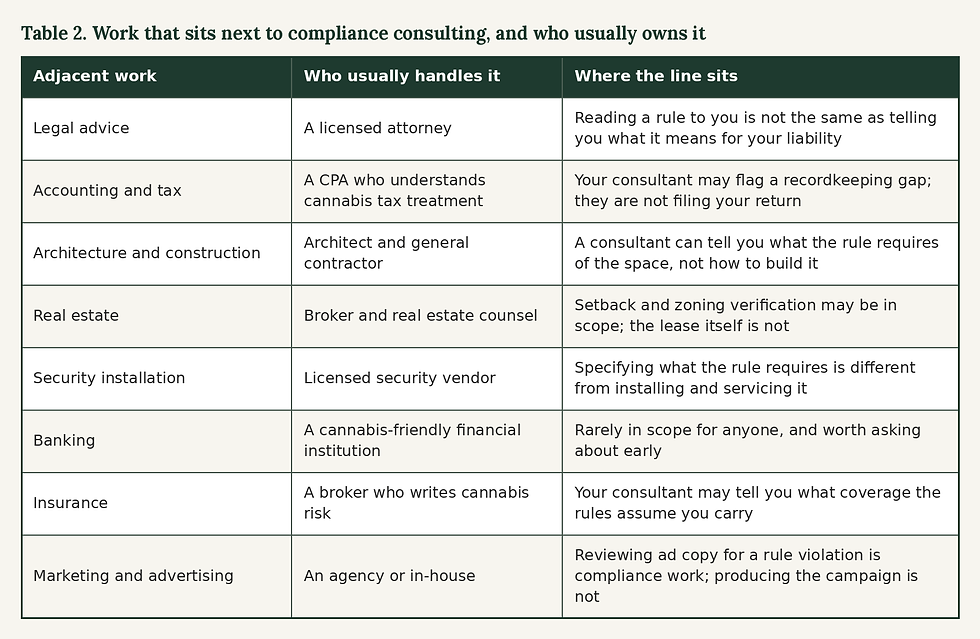
Those are all real pieces of opening a cannabis business. They are just not all compliance consulting, and the distinction protects everybody in the room.
I have always thought a consultant should be comfortable saying, that is outside what I do, but I can tell you who to call. That is not a weakness. That is the job.
Language that commits somebody
There is a real difference between paying for time and paying for a result. Both are legitimate. If you are buying hours of expertise, the contract should say so plainly. If you are buying a thing, the contract should describe the thing.
Here is what that looks like in practice. The examples on the right are illustrations of drafting, not anyone's specific terms.
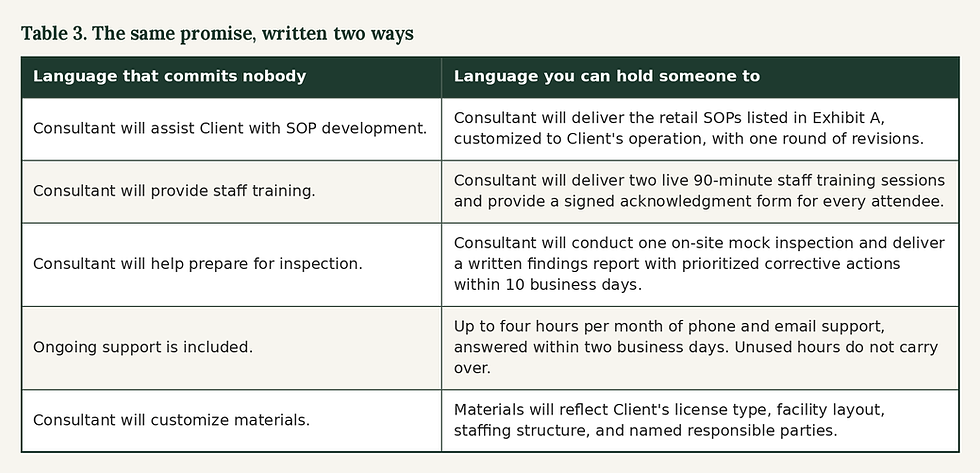
If the deliverable matters to you, put it in writing. And if your consultant tells you the materials will be customized specifically for your operation, that promise belongs in the agreement too, not just in the sales conversation.
When is this supposed to happen?
A consulting agreement should give you some sense of timing. That does not mean every project gets a guaranteed completion date. Regulators do not move on our preferred schedule. Licensing decisions take what they take. Construction runs long. Local approvals stall. And sometimes the client is the reason a project is sitting still, which is worth saying out loud because it happens more than people admit.
But “we will get to it” is not a timeline. A phased roadmap is.
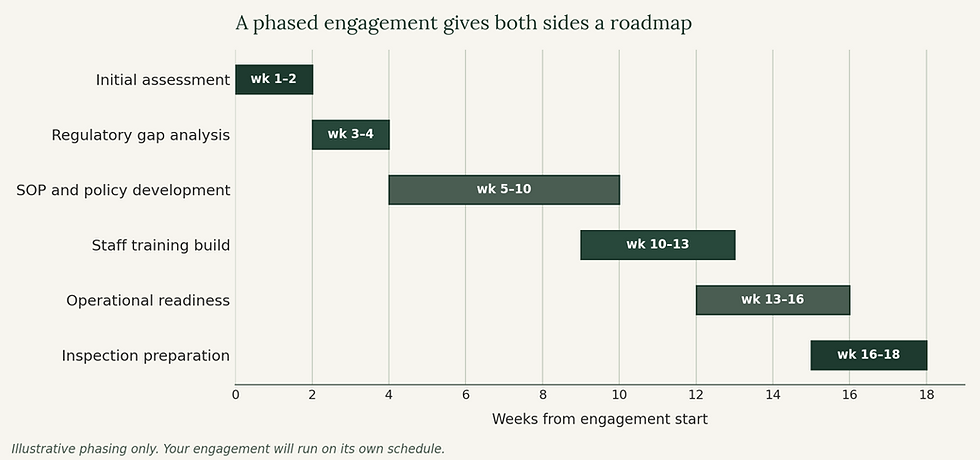
Yours may look nothing like that, and that is fine. The point is that both sides can see where they are. When something slips, and something always slips, you adjust the roadmap together instead of arguing about whether it slipped.
And what happens when the project changes?
This is one of those boring provisions that becomes the important one about four months in.
Say you hire someone to build your retail compliance program. Three months later you decide to add a second location. Or delivery. Or you pick up cultivation. That is a substantially different project than the one you signed for.
The agreement should say how additional work gets handled. Sometimes it is an hourly rate. Sometimes a separate project fee. Sometimes a written change order that both parties sign. There is no single right answer, and the mechanism matters far less than the fact that one exists. Neither party should be surprised by the bill.
The clauses everybody scrolls past
Now the part of the contract most people skip, because the language is heavy and it is not why you got into this business. Please do not skip it. And if you do not understand a provision, ask the consultant to explain it. If someone cannot explain their own agreement in plain English, that tells you something worth knowing before you sign it.
Four provisions do most of the work here, and they do genuinely different jobs.
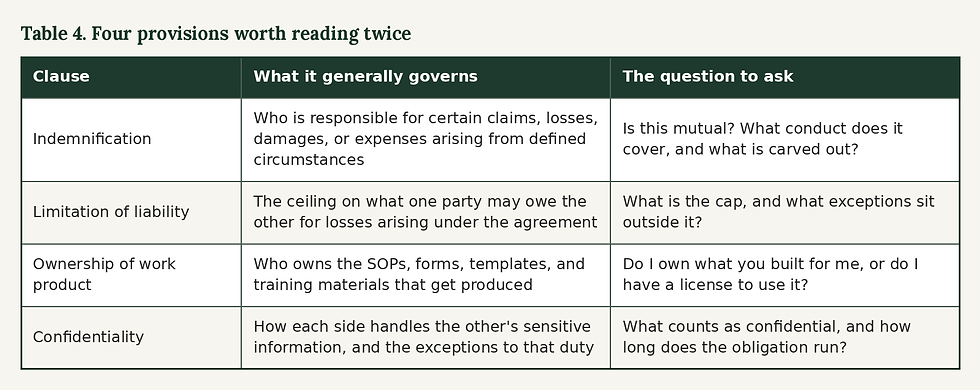
On indemnification, the exact language matters enormously, and no two clauses mean the same thing. A contract might contain mutual obligations. It might apply only to certain conduct. It might carry exclusions. Do not read the word indemnification and assume your consultant is promising to take responsibility for everything, because that is generally not what it says. Do not assume the opposite either. Read the actual provision.
Limitation of liability does a different job. It generally establishes how far one party's financial exposure runs. You may see a cap tied to the amount paid under the agreement, with exceptions for things like intentional misconduct, fraud, a confidentiality breach, or intellectual property claims, depending on the contract and the applicable law. Ask for it in plain English. Can you walk me through your limitation of liability provision? If they will not, that is your answer.
Ownership gets overlooked until the day it matters. A consultant may have spent years building the frameworks and templates that sit underneath your documents and may reasonably want to keep them. You may reasonably expect to own the customized version you paid to have built. Both of those positions can be true at the same time, and a decent agreement says which one you got. What you do not want is to discover in year two that the SOPs running your store belong to somebody else.
Confidentiality runs in both directions. You are going to hand over business plans, financial information, staffing details, security information, and vendor relationships. You should know how that gets handled. Your consultant also needs to be able to actually work with your information. A good provision does both jobs and names the exceptions.
Where I stop and your attorney starts
I am a compliance consultant, not an attorney, and this article is education rather than legal advice. If a provision is complicated or something about it makes you uneasy, have your attorney read it. That is what attorneys are for, and it is money well spent on a contract you are going to live inside for a year.
What nobody can promise you
This one is specific to cannabis, and it is where I would pay the closest attention of anything on this page.
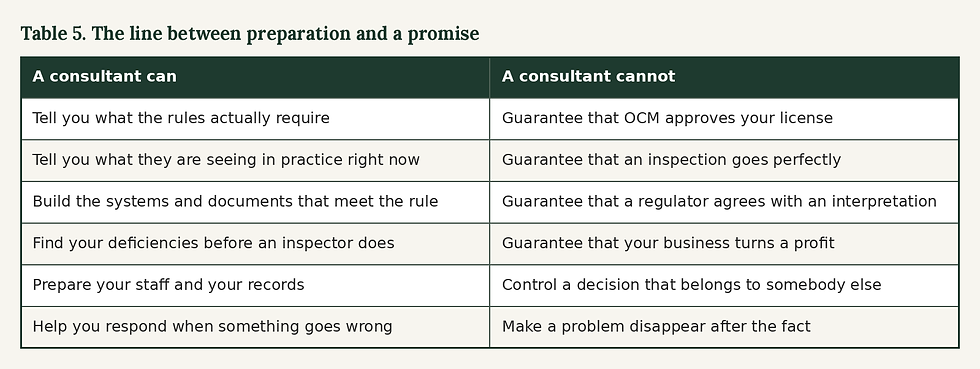
There is an enormous distance between we are going to prepare you for your inspection, and I guarantee you will pass your inspection. One of those is a service. The other is a sales line, and in this industry, it is a red flag. Your agreement should make clear which one you bought.
Look at how the number works, not just the number
Everybody looks at the price. Fewer people look at the mechanics underneath it, and the mechanics are where the surprises live.
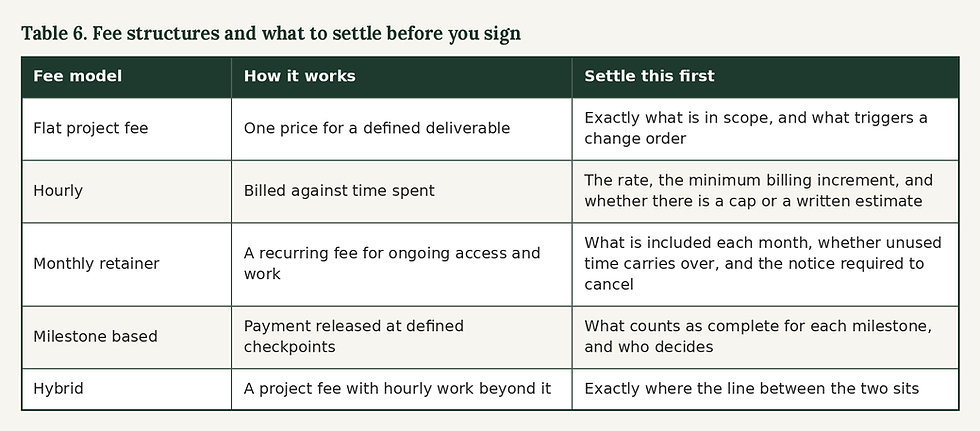
Then the questions that sit around the number. Is there an initial deposit? When are invoices due? What happens if a payment is late? Are travel expenses included, and at what rate? Are third-party costs passed through to you? Are additional services billed separately, and at what rate?
If your consultant is going to be at your facility regularly, settle travel now rather than later. Nobody enjoys a surprise mileage invoice in month six.
How either of you can walk away
Both parties get to decide that a professional relationship is not working anymore. That usually does not mean anybody did anything terrible. Businesses change direction. Projects are finished. Expertise stops matching the need. Communication styles grind against each other. Expectations drift apart. That is ordinary, and a contract that pretends otherwise is not doing its job.

That last row is the one people miss. If your SOPs came to you under a license rather than outright ownership, find out what happens to that license the day the contract ends. It is a much better conversation to have now.
You have responsibilities too
I wish more people said this part out loud. Consulting is a two-way relationship, and the contract usually says so somewhere in the middle.
If your consultant needs information to finish a project, you have to give it to them. If they need access to your facility, you have to make that possible. If they are writing an SOP based on your operation, you have to tell them how your operation actually runs, including the parts that are not pretty. If they identify a problem, you must be willing to deal with it rather than filing it away for later.
Nobody builds a working compliance program in a vacuum. And nobody can operate your business for you.
What happens when your consultant says no?
This might be the single best question you can ask before hiring anybody. What happens when you disagree with me?
Because at some point you will. You will want to do something your consultant thinks carries unnecessary regulatory risk. They will recommend something that costs more than you planned to spend. You will think a particular requirement is pointless. They will disagree with you.
Good. The most valuable sentence a consultant can say is some version of this: I understand what you are trying to accomplish, I am not comfortable with that approach from a compliance standpoint, and here is another way we could get there.
You do not need somebody who agrees with everything you say. You need somebody who will tell you the truth respectfully and then help you find a route that works.
A long contract is not automatically a good contract
Some of the least clear agreements I have read were also the longest. Some of the clearest ran three pages.
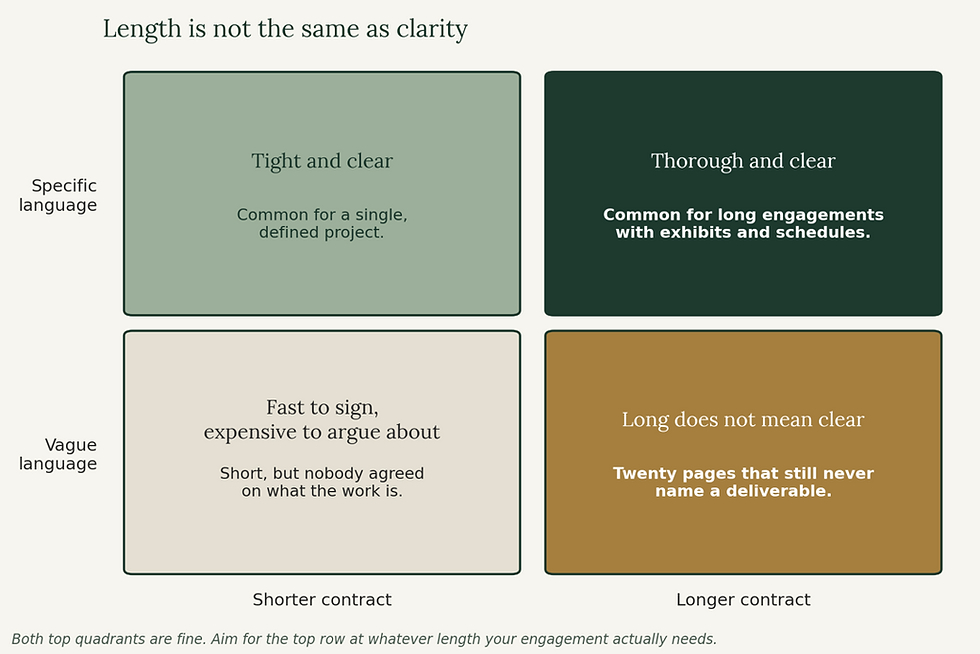
Aim for the top row at whatever length your engagement actually requires. Two pages is fine. Twenty pages with exhibits, schedules, and special provisions is fine. Vague at either length is not, and page count is a terrible proxy for care.
Questions to ask before signing anything
I would rather you ask too many questions than sign something you do not understand. Do not be embarrassed about any of these. Asking about fees does not make you difficult and asking how termination works does not mean you are planning to terminate.
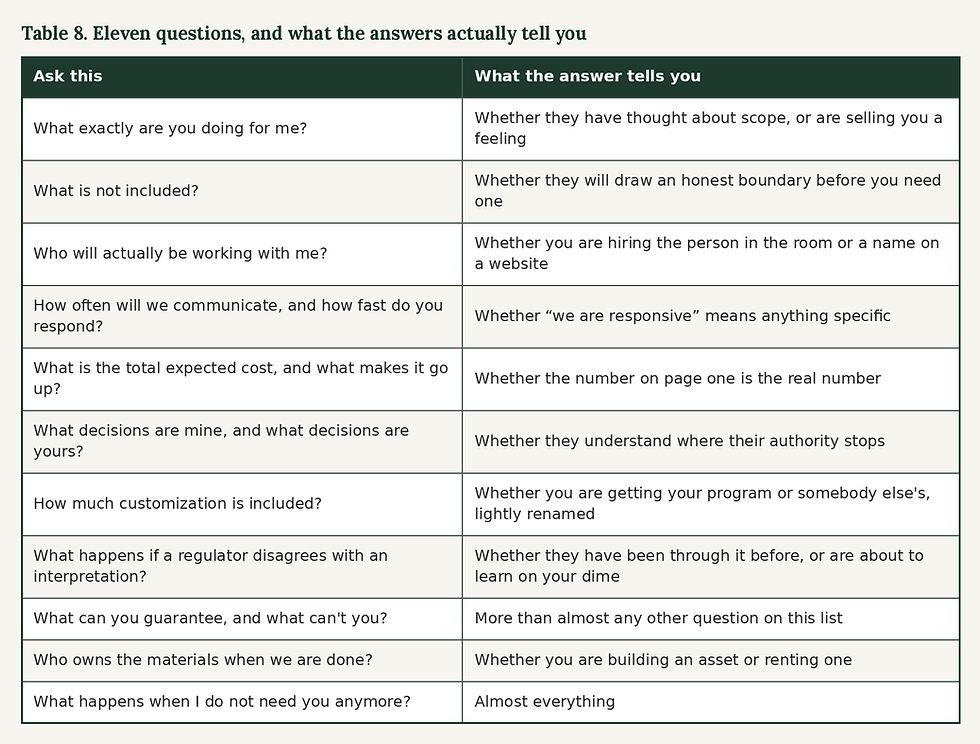
That last one is my favorite. The answer tells you a great deal about the consultant sitting across from you.
The goal is not to make you dependent
One of our core beliefs at CannaPath is short enough to fit on a business card. If I am doing my job right, eventually you will not need me.
That does not mean I do not want your business. Of course I do. If you want to keep us involved because you like having somebody watching the regulatory landscape, converting rule changes into updated policy, running periodic audits, standing beside you at an inspection, or just being another set of eyes, that is a good use of money and we are glad to be there. There is real value in ongoing compliance support and I am not going to pretend otherwise.
But there is a difference between choosing to keep your consultant and being unable to function without them.
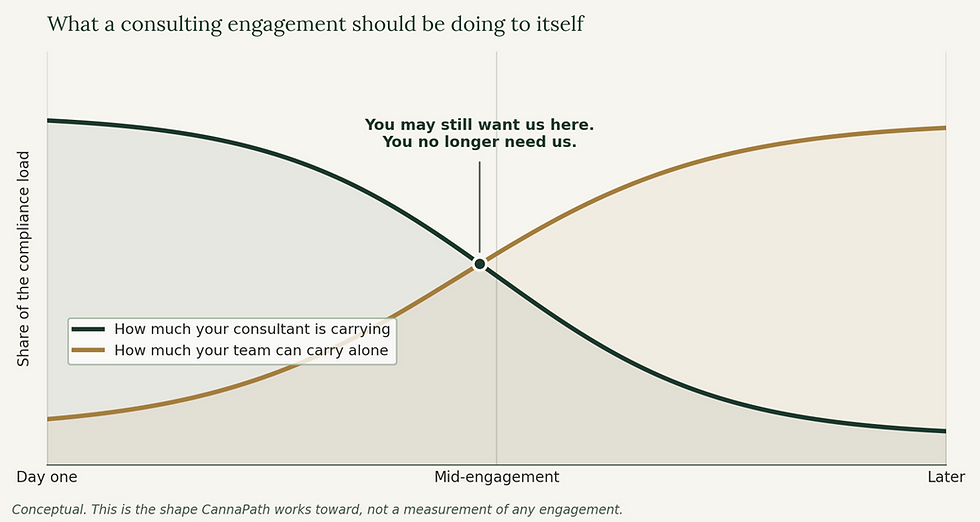
I want owners to understand why their SOPs say what they say. I want managers to know what they are responsible for. I want the person behind the counter to understand the reason behind the procedure and not just the procedure. And I want an owner to be able to look at their own compliance program and say, I understand this.
That is what success looks like from where I sit.
You do not have to hire us
I will say something that probably sounds strange coming from a consulting company.
You do not have to hire CannaPath.
I want your business. I would be glad to have it and I will compete for it, openly. But Minnesota has a couple of other cannabis compliance firms doing genuinely good work, and I am not going to run them down to win a client. We all have different strengths. Some of us are stronger in a particular license type, some in training, some in the operational building. If you talk to all of us and pick somebody else because they fit your business better, you are in good hands, and honestly this state is lucky to have that kind of bench in a market this young.
What I would push back on is hiring somebody who does not know Minnesota. Our rules are not a light adaptation of another state's, and a consultant working from a national template will find the gaps at the worst possible moment, usually about four days before an inspection. Hire someone who knows this state.
So do the homework. Ask the questions. Read the contract. Understand what you are buying. And pick the person you trust to walk beside you.
One last thought before you sign
Opening and operating a cannabis business in Minnesota is a long walk. We have come a long way from where this market started, and there is still distance to cover, but it is getting better and the people in it are getting better at it.
Your compliance consultant should not be the person dragging you down that road. Or disappearing around the next corner. Or standing out front telling you where you are going without ever explaining how to get there.
They should be beside you. Helping you understand the road. Pointing out the hazards. Finding a better route when something changes. And eventually helping you get to the point where you can walk it confidently on your own.
If we are doing our job right, you will not need us.
You may still want us. But you will not need us.
And honestly, that is exactly where I want you to be.
Before you go
We keep several readiness workbooks in our resources section of the site. They are based on license type, and actually cover what you need to know to be ready for inspection. Best part is they are actually free, No email, no form, no drip campaign. Download it, use it, and we will not chase you.
One other note as we continue through 2026: take a look at OCM’s data page. We are currently seeing a large number of businesses approaching critical milestones toward opening, which means more operators are reaching the point where they realize they need compliance help. We are already seeing this happen. Last month, we posted four online Budtending class options for store employees, and all four filled within the same week they were announced. We expect October to be extremely busy with contract clients as well, based on what is already signed.
The point is simple: if you think you are going to need a compliance partner, start the conversation early rather than waiting until you urgently need one. You do not need to sign a contract that day. In fact, a good compliance firm should be willing to have that initial conversation and help you understand what you will need before you are actually on the clock.
For example, if you know you are going to need help around the beginning of October, there is no reason you cannot have that conversation and get things lined up now. Your contract can still begin in October, with your first payment due at that time. Getting ahead of the process does not mean you have to start paying early.
I simply don't want to see a business reach the point where it desperately needs help, only to discover that the firms it would trust are already booked. If you know you are going to need help, start the conversation before you need it.
And if you get into something you would rather not sort out alone, or just need a second set of eyes, we are here. Reach out at hello@cannapath.org.
-Drew
A note from CannaPath
This article is intended for general educational purposes and is not legal advice. Consulting agreements vary based on the services being provided, the parties involved, and the circumstances of the engagement. If you have questions about the legal meaning or enforceability of a particular provision in a contract, we recommend consulting a qualified attorney. Rules and guidance change, so verify anything time-sensitive against current Minnesota Office of Cannabis Management materials.


