Why Reading the Rules Isn’t Always Enough

Drew Duffy, MHA, FACHE, Founder & Managing Director, CannaPath Regulatory Solutions
Last reviewed September 19, 2026
One of the things we hear fairly often from cannabis businesses is some version of this:
“I’ve read the rules. I think I understand what I’m supposed to do. But I’m still not completely sure.” |
There is a good reason for that.
Cannabis compliance is not always a matter of finding the right sentence in the right rule and checking a box. Sometimes the real question is whether that rule is still consistent with the law it was written to implement.
A recent question from one of our clients was a good example.
The client was trying to verify a requirement related to cannabis transportation. The issue seemed straightforward enough. Minnesota’s cannabis rules contain language addressing randomized delivery routes and times, as well as the number of employees required in a transportation vehicle. Anyone reading the applicable rule today could reasonably conclude that those requirements still apply. There was just one problem, the statute had changed.
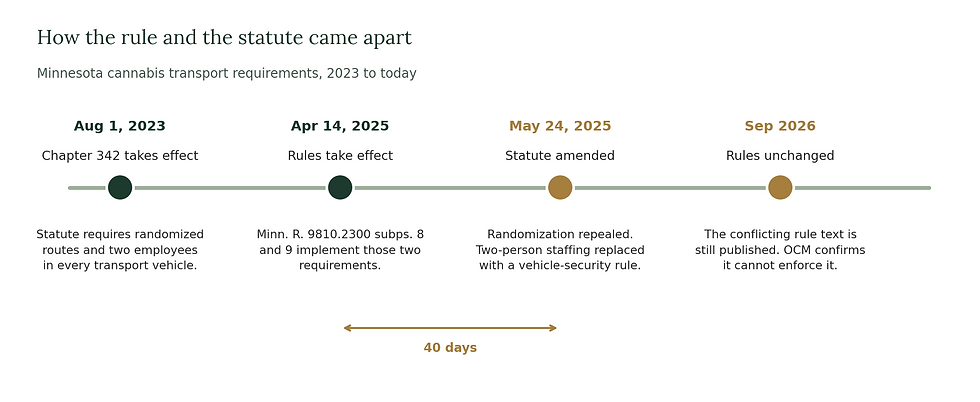
When Chapter 342 first took effect, it did require both. One subdivision said a transporter had to randomize all delivery times and routes. Another said every transport vehicle had to be staffed with a minimum of two employees. The rules were written to implement exactly that. Then, in the 2025 session, the Legislature repealed the randomization subdivision outright and rewrote the staffing one. The statute now says plainly that a cannabis transporter must not be required to randomize delivery times and routes or staff cannabis transport vehicles with multiple employees.
The rules took effect on April 14, 2025. The statute they were written to implement was amended forty days later.
The rule, meanwhile, still contains language requiring transporters to make reasonable efforts to randomize routes and delivery times, and it still contains a two-person vehicle requirement.
That creates exactly the kind of situation that can make a well-intentioned business owner stop and ask, “So which one am I actually supposed to follow?”
And that is a very reasonable question.
This is where compliance gets more complicated than reading the rulebook
There is an important distinction here.
It is not accurate to say that a business can simply ignore a rule because it believes a statute is more recent. Nor is it accurate to assume that the most restrictive requirement you can find must automatically be the one that controls.
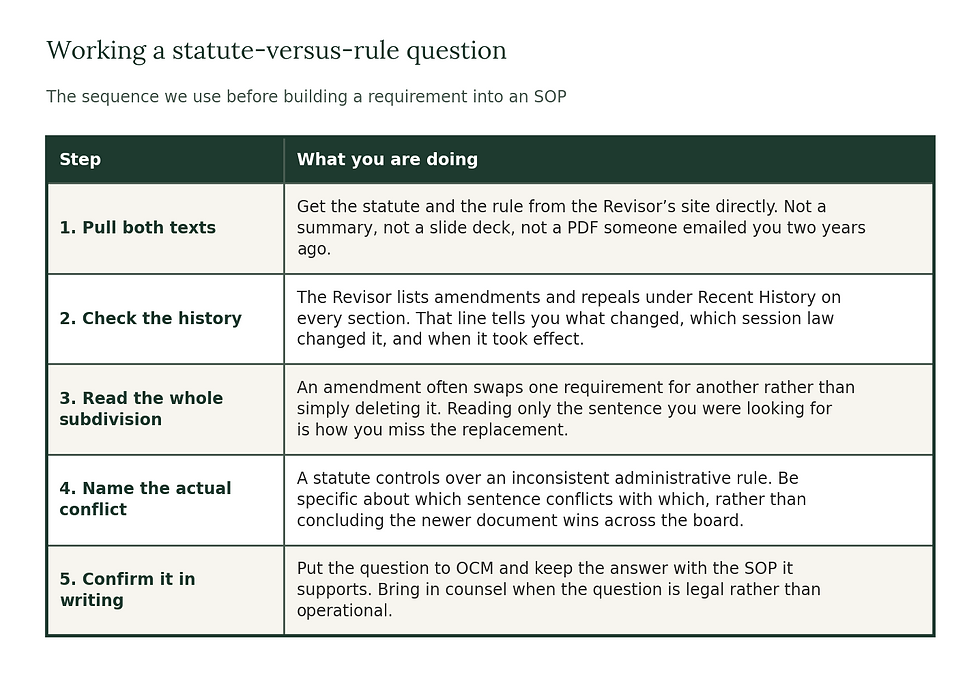
The first question is whether the statute and the rule actually conflict. If they do, the statute controls over an inconsistent administrative rule. But figuring out whether there is a genuine conflict, what changed, when it changed, and how the change affects the rule is where the work begins.
In this case, we did not want to make that determination based solely on our own reading.
So we went to OCM.
The Office confirmed the issue. Its written response read, in part:
“At the time the provisions of 9810.2300, subp. 9 were promulgated, statute required randomized delivery routes with multiple occupants. However, statute was subsequently amended by the Legislature to remove these requirements for randomized routes. Rules have not been amended since their initial implementation and obsolete rules are anticipated to be repealed when rules are next amended. OCM is required to comply with the law as written in Minn. Stat. Ch. 342. Currently, complying with statute requires that OCM not enforce the applicable rule provision.” Minnesota Office of Cannabis Management, written response to CannaPath, (9/19/2026) |
That is a useful clarification.
It also illustrates something that is easy to overlook in a new and evolving regulatory environment. The rule you can find on a government website is not necessarily the complete answer to the compliance question you are trying to solve.
What actually changed inside the vehicle
Here is the part that is easy to miss, and it is the part that matters most if you are moving product.
The Legislature did not simply delete two requirements and walk away. It traded one of them for a different one.
The old statute required two employees in every transport vehicle. The current statute does not. What it requires instead is that the vehicle be secured, meaning ignition off, all doors and storage compartments locked, and the operating keys or device removed, or else attended by a transporter employee at all times.
So a single driver is now permitted. A single driver who steps away from an unlocked vehicle with the keys in it is not.
If you read only the half of the statute that removed the old requirements, you would come away thinking the rules got looser. In one sense they did. In another, a new obligation landed in the same subdivision, and it happens to be the one an inspector can observe from across a parking lot.

Sometimes the hardest part is knowing what to ask
This was not a case where our client was looking for a way around a requirement.
Quite the opposite. They wanted to know what the requirement actually was before building their process around it, and that distinction matters.
Good compliance work is not about finding the least burdensome interpretation of a regulation. It is about identifying the requirement that applies to the business, then making sure the business can consistently follow it and demonstrate that it did.
Sometimes that means reading the statute. Sometimes it means reading the administrative rule that implements the statute. Sometimes it means looking at the history of both, because the Legislature changed the law after the rule was written.
And sometimes, even after all of that, the right answer is to ask the regulator.
That last part is particularly important.
We have attorneys we can involve when a question requires legal interpretation. We still contact OCM directly when it makes sense to.
There is nothing unusual about that. We think it is good compliance practice.
Legal counsel and compliance professionals are doing different jobs. An attorney may help determine what the law means and how a business should proceed legally. A compliance professional is looking at a related question. How does that requirement actually work inside the business? What needs to be documented? How should the process be written? How will employees know what to do? What happens when the real world does not look like the example in the rule?
Sometimes you need all of those perspectives.
The bigger lesson
Minnesota’s cannabis regulations are still developing. Statutes change. Rules take longer to update. Guidance evolves. Website materials can lag behind legislative changes. And businesses are left trying to operate in the middle of all of it.
That does not mean the system is unworkable.
It means compliance sometimes requires more than finding a rule and reading it literally.
It requires someone to stop and ask whether the pieces still fit together.
In this situation, the answer became much clearer once we looked at the statute, compared it with the rule, considered the timing of the changes, and then confirmed the issue directly with OCM.
That is the part of compliance work that is easy to miss from the outside.
Knowing the rules is the starting point. Knowing which rule still matters, whether it is still consistent with the law, and when it is worth putting the question to OCM in writing is the actual work.
One more thing worth saying
OCM answered our question and answered it clearly. The Office also offered to look at any document on its own website that does not reflect the current law.
That is not a small thing. It is worth remembering on the days when it is easy to be frustrated with a regulator that is building a program while the program is already running. We have come a long way in this state. There is still distance to cover, but we are getting there.
If you are working through one of these
If you run transport, or if you are writing an SOP around any requirement you found by reading a rule, it is worth checking whether the statute behind it still says the same thing. Most of the time it does. When it does not, you would rather know that now than while an inspector is standing in your parking lot.
That kind of verification is a good chunk of what we do here. If you hit one of these and would rather not sort it out alone, reach out.
-Drew
And, as always, businesses should consult qualified legal counsel for legal advice, and may want to seek clarification directly from OCM when a question involves the application of Minnesota cannabis law to their specific circumstances. OCM has emphasized that its responses are informational and that enforcement decisions are made by applying the law or rule to specific facts on a case-by-case basis. |
Sources
Minn. Stat. § 342.36, subds. 5 and 6 (2023 c 63 art 1 s 36; subd. 5 repealed and subd. 6 amended by 2025 c 31 ss 108 and 62, effective May 24, 2025).
Minn. R. 9810.2300, subps. 8 and 9 (adopted and effective April 14, 2025; not amended as of this writing).
Minn. Stat. § 342.46 (parallel exemption for lower-potency hemp edible retailers).
Written response from the Minnesota Office of Cannabis Management, September 19th 2026 Statutes and rules change. Verify current text at revisor.mn.gov, and confirm how a requirement applies to your operation with OCM.