Minnesota Cannabis Testing Update: The New Rules for Product Transfers and Remediation

By Drew Duffy, MHA, FACHE, Founder & Managing Director, CannaPath Regulatory Solutions
Last reviewed: October 9, 2026
A cannabis batch does not always go from production to testing to a passing result to the retail shelf.
Sometimes a business needs help processing product. Sometimes a batch fails testing and the operator needs to determine whether an authorized remediation pathway is available. In those situations, the question is not only what may be done to the product, but how it can legally move between licensed businesses to receive the necessary services.
Minnesota made an important change in this area during 2026. On September 4, the Office of Cannabis Management published Guidance Memo GM-2026-05, explaining how licensed cannabis and hemp businesses must transfer product to a third-party processor for services such as remediation.
The guidance is worth understanding because it changes an operational process that businesses previously handled through a small sale followed by a buyback. It also establishes specific documentation and Metrc requirements that operators need to account for before moving product.
For a business that is already managing production costs, testing expenses, and inventory that cannot yet be sold, getting this process right matters.
First, the question everyone asks: where is the backlog?
If you clicked on a Minnesota cannabis testing update, there is a good chance this is what you wanted to know. So, let's deal with it before anything else.
Earlier this year it was bad. Operators were reporting waits of several weeks on routine compliance panels, and one cultivator's two strains took 49 days from submission to result. The state had very few labs doing full-panel work, and the market was adding licensed businesses faster than the labs were adding capacity.
Then it got worse before it got better. Legend Technical Services left the cannabis testing program over the summer. OCM said the lab was no longer authorized to test after security and testing requirements went unaddressed, and the variances the state had granted to help with the backlog had expired. Legend's own explanation was that economics did not work under the current framework.
Capacity has been added since. True North Analytical opened in Roseville on September 1, built specifically for cannabis and hemp rather than adapted from another line of work, and has said publicly that it intends to hold a ten-day turnaround.
As of this writing, OCM lists five licensed cannabis testing facilities.
That number is better than the one we had in the spring. It is also the wrong number to plan around.
Count the authorizations, not the labs.

Two of the five are authorized across the full compliance panel. One cannot run residual solvents or terpenes. Two are limited to potency and microbial, and one of those is only on finished product. So, if what you need is a complete compliance panel on flower, the number of places that can do it for you is two, not five.
Now the part you will not find in a published report.
What we are hearing from operators is about three weeks, start to finish. Not ten days. Three weeks. And there are signs the newer capacity is already taking on more than it can clear on the timeline it opened with. On a recent call with a store owner and a lab, the turnaround being quoted was 16 to 20 days.
Be clear about what that is and is not. It is what CannaPath is seeing and hearing from the operators we work with and talk to, as of this writing. It is not a published figure. OCM does not release turnaround data, and this is a working read from a handful of operators rather than a statewide measurement. Treat it as a field report, not a statistic.
It does line up with what the authorization table shows. Two labs carrying the full-panel load for a market that keeps adding licensed businesses is going to produce a queue. Adding a facility that can only run potency, and microbial does not relieve pressure on the panel that actually gates a release.
So, the honest answer on the backlog is that it is better than it was in the spring, it is not solved, and ten days is not what operators are experiencing right now.
Plan on three weeks and be pleasantly surprised. Do not assume that a longer list of licensed labs means more capacity for the specific panel your product needs and confirm with your lab that they are authorized for every analyte on it before you ship a sample across the state. Ask them for their current turnaround in writing when you book, not their standard one.
That is the capacity picture as of the date of publication. The rest of this article is about a different change, one that affects what happens when a batch needs to go somewhere other than a lab.
What changed?
Before the legislative change took effect, businesses arranging paid or contracted processing services sometimes used what the industry called a penny sale. The product was sold to the third-party processor and then bought back after the processing service was completed.
The reason was narrower than most people realized. Minnesota prohibited cannabis and hemp businesses from giving away flower or products. Every transfer therefore had to be attached to a sale, even when nobody involved intended a sale at all.
So the industry invented one. A penny changed hands and the paperwork worked.
The 2026 legislative changes altered that framework. Under Minnesota's updated statutory authority, qualifying good-faith transactions for the sale of goods or services between cannabis and hemp businesses at fair market value are permitted. The new authority became effective May 26, 2026.
OCM's September 4 guidance explains what that means operationally. Businesses no longer have to sell product to a third-party processing provider and buy it back simply to obtain processing services.
That is useful, but it should not be interpreted as permission to move regulated product without appropriate records. The updated process has its own requirements, and the fact that the transaction no longer needs to be structured as a sale followed by a purchase does not eliminate the need to document it correctly.
The important change is the transaction structure. The obligation to maintain regulatory control and records remains.

The new transfer process uses Metrc
OCM's Guidance Memo GM-2026-05 requires transfers for processing services to be recorded in Metrc.
The applicable transfer type is Processing. When creating the transfer manifest, the initiating business must include a completed Service Transfer Form as a PDF attachment. OCM uses that form to receive notice of product transfers for processing services, commonly known as toll processing.
The business initiating the transfer in Metrc is responsible for submitting the form.
This is a distinct step, not a substitute for the ordinary transfer documentation or the requirements applicable to the product itself.
The distinction is important because an operator might understand the business arrangement with the processor perfectly well but overlook what must happen in the tracking system. A signed service agreement does not by itself complete the required Metrc process. Nor should an operator assume that a product can be moved simply because both businesses agree on the work to be performed.
The transfer must be recorded according to OCM's instructions, with the appropriate transfer type and required supporting form.
There is one more requirement that is easy to miss, because it does not appear in the guidance memo at all. It appears in Metrc's own bulletin.
A Processing transfer requires an authorized transporter.
You cannot put a failed batch in the back of your own vehicle and drive it across town to a processor. That is a logistics problem and a cost that must be arranged before the product is ready to move, and it catches small operations, because a business without its own transport arrangement must find one while a time-sensitive batch sits in quarantine.
The other thing worth knowing is that the transfer types changed underneath everyone. The new types went live in Metrc on September 4, 2026, and the discontinued types were removed on September 23. As of this writing, an operator who has not looked at a transfer manifest since the summer will not find the screen they remember.
It is worth reviewing the current procedure with whoever manages your Metrc activity before the first transfer. If the business has never used the Processing transfer type, that is something to learn before a time-sensitive batch is waiting for services.

Note what the table shows about the Processing row specifically. It is the only transfer type that requires the Services Form PDF. It requires a transporter. It does not require a record of sale price, which is the whole point of the change, because there is no sale.
Two of the transfer types on that list, Recall/Return and Virtual, require OCM approval before they are used at all.
If you are reading this and realizing you are not certain which transfer type your last few manifests used, that is worth checking today rather than during an inspection. Scout™, our compliance gap checker, reads your existing procedures against the current requirements and tells you where the gaps are. It is at cannapath.org/sentinel.
Remediation still requires OCM's approval
This is the part that deserves particular attention from cultivators and manufacturers dealing with failed laboratory results.
The new service-transfer process does not replace Minnesota's product-testing and remediation requirements. In particular, a license holder transferring product for remediation must have a remediation plan approved by OCM before initiating the transfer.
That requirement is separate from the Service Transfer Form.
The transfer form documents the movement of product for processing services. The remediation plan establishes the approved remediation approach. One does not replace the other.
The approval itself runs through OCM's remediation request form, which sits on the product testing section of their site. The license holder submits the proposed plan. OCM approves it or does not. Explicit approval is required before remediation begins, not before the product is sold, and not at some later point when the paperwork is being assembled.
After remediation, the product has to be retested. The point of the retest is to confirm the contaminant is actually gone. If it passes, the product can be sold. If it does not, the operator is back to a disposition decision with more money spent and nothing to show for it.
If a batch fails testing, the operator must still follow the applicable failed-batch procedure, including the requirements governing quarantine, notification, the available response pathway, and the final disposition of the product.
Minnesota does not treat reanalysis, retesting, remediation, and corrective and preventive action as interchangeable responses. Which options are available depends on the circumstances and the specific failure.
A business cannot treat the new transfer guidance as a general authorization to send failed product to a processor and decide what to do with it later.
The required approval has to come first.
This is particularly important for small operations because an unsuccessful batch can create immediate financial pressure. The product represents resources that have already been committed to cultivation, manufacturing, labor, and other expenses. A business naturally wants to recover what it can.
But the financial pressure does not change the order of operations. Sending product somewhere for remediation before obtaining the required approval can create an additional compliance problem on top of the original testing issue.
A sound procedure should make the distinction unmistakable. Employees and managers must know when a batch is simply moving for a contracted processing service, when remediation is being proposed, what approval is required, and who is responsible for confirming that approval before a transfer begins.

Not every failed test requires remediation
Here is the part that almost nobody knows, and it is the one piece of good news in this article.
If the only failing result is total yeast and mold, or total aerobic microbial content, and the product is flower, the batch may not require remediation at all.
OCM shares a corrective and preventive action plan form with license holders whose product meets those criteria. If the office approves the CAPA, the product is released for sale.
That is a materially different outcome than a remediation plan, a transfer, a processing service, and a retest. It is faster, it costs less, and it keeps the product in your own building.
It also does not happen automatically. A CAPA is a real document describing what went wrong and what you are changing so that it does not happen again. If your quality assurance procedure has no CAPA process behind it, you are not in a position to produce one quickly while a batch sits in quarantine.
So the practical question when a result comes back failing is not just "can we remediate this." It is "which pathway is this failure actually on," and the answer depends on what failed and what the product is.
Know which one you are on before you start arranging a transfer.
Processing services and remediation are not the same thing
There is another distinction worth preserving in your documentation.
OCM's guidance describes pre-treatment as a process intended to remove or reduce potential contaminants in a batch before compliance testing. Remediation is a process to remove or reduce a contaminant or excess cannabinoid in a batch of regulated product.
Those activities may involve processing, but they are not identical from a compliance standpoint.
The stage at which the product is being handled matters. So does the purpose of the work. A business arranging a service before compliance testing should not automatically treat that arrangement as equivalent to the remediation of a failed batch.
Likewise, a processing agreement should not be used as a substitute for determining whether a particular procedure is authorized under the applicable standards and the business's approved plans.
The operational question is straightforward: what work is being performed, why is it being performed, and what regulatory requirements apply to that work?
Answering that before the product moves makes the paperwork more meaningful and reduces the possibility that a business will have to explain an undocumented decision later.
The service agreement should explain what happens to the product
The regulatory transfer requirements are only part of the relationship between the business sending product and the business performing the service.
The parties should also understand the commercial arrangement. What processing service is being provided? What is the agreed compensation? Does the service involve a transfer of ownership, or is it a toll-processing arrangement in which the processor performs work without taking ownership of the product?
OCM describes toll processing as processing services supplied by one cannabis or hemp business to another without a transfer of product ownership.
That distinction belongs in the business's documentation, rather than being left to assumptions. The agreement should make clear what the processor has been engaged to do, what happens to the product during processing, how the work is documented, and how the finished or returned material will be handled.
The parties should also establish how they will communicate if the work cannot be performed as planned or if an issue arises with the product. If the work involves remediation, the agreement and operating procedures must remain consistent with the approved remediation plan.
These are practical controls, not just contract details. A business needs to be able to connect the original batch, the reason for the transfer, the services performed, the associated records, and the ultimate disposition of the product.
If an inspector asks what happened, the owner should be able to follow that sequence without trying to reconstruct it from a series of emails and recollections.
What to do before your next transfer
The best time to update your procedures is before the business needs to move product for services.
Review the current Metrc process and make sure the person responsible for transfers knows when the Processing transfer type applies and how the Service Transfer Form must be attached. Confirm that the business has a process for identifying the nature of the service and determining whether the product is subject to an additional approval requirement.
Settle the transporter question now rather than later. If you do not have an authorized transporter arrangement, finding one is not a same-day task, and a batch waiting on remediation is not the moment to start calling around.
If the transfer involves remediation, build in a verification step so that the required OCM-approved remediation plan is confirmed before the transfer is initiated. That confirmation should be documented, not merely assumed because someone recalls discussing the matter with another person.
The same procedure should identify who maintains the service agreement, who tracks the transfer, who confirms the required approvals, and who follows the product through the service and subsequent testing or disposition.
The written procedure also needs to reflect the actual Metrc process being used. A paragraph written before the new transfer type became available may no longer describe how the business should carry out the transaction.
That is a good reason to review the relevant inventory control, quality assurance, testing, and recordkeeping procedures rather than adding an isolated sentence to a document and assuming the problem is solved.
The change is specific, but the documentation around it needs to be consistent.

A new transfer mechanism does not remove the testing obligation
Minnesota's September guidance gives cannabis and hemp businesses a clearer mechanism for sending product to third-party processors for services. That is a meaningful operational development, particularly for businesses that need to arrange processing or remediation without relying on the previous sell-and-buy-back approach.
It does not remove the underlying testing, approval, tracking, or disposition requirements. A transfer for services is still a regulated movement of product. Remediation still requires the applicable approval before the transfer begins, and the product must be handled in accordance with the requirements that apply to it.
The distinction between a permitted transfer and an authorized product disposition is worth keeping front and center.
For a small operator, getting the process right can mean fewer avoidable delays, more defensible records, and less confusion when product needs to move between businesses. It also makes it easier to explain what happened to a batch from the first decision through its final disposition.
If you have already written procedures for responding to failed testing, review them against this guidance. Your existing procedure may accurately describe quarantine, notification, reanalysis, retesting, and remediation, but still need an update to address a transfer to a third-party processor for services.
For related background, see CannaPath's existing articles on what to do when a Minnesota cannabis batch fails testing and how long cannabis testing takes in Minnesota. This article addresses the newer service-transfer question; the other guides cover the broader testing timeline and failed-batch response.
Where your procedures probably stand right now
Most written procedures in Minnesota still describe the old process.
That is not a criticism of the operators who wrote them. The rule changed in May, the guidance arrived in September, and the Metrc screens changed underneath everyone two weeks after that. A document written in good faith eighteen months ago is simply describing a process that no longer exists.
Real world example — We had an owner operator use Scout last week for this issue. A quality assurance SOP that walks through the failed-batch response in careful detail, names quarantine and notification correctly, and then instructs staff to "arrange a sale of the affected batch to the processing partner and repurchase upon completion." Everything around it is right. That one sentence now describes a workaround that the law replaced. We were able to provide the correct wording so that the client’s QA mod is now back in compliance. But it shows how a simple adjustment in how we do things can throw us into compliance drift, since we only provided the information, and where it belongs there was no additional charge for the client.
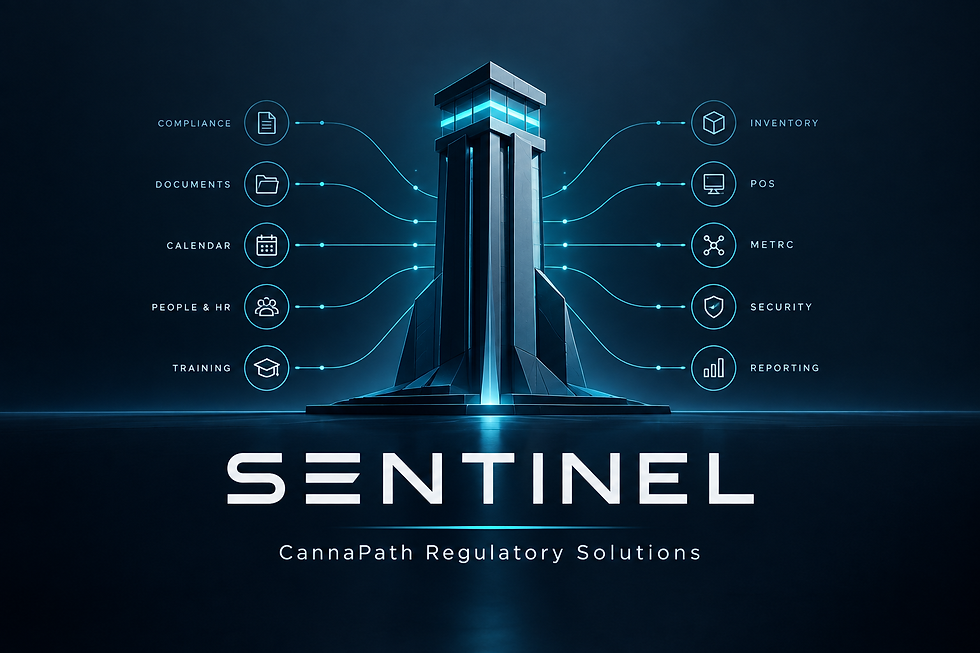
CannaPath is building Compliance Sentinel™, and the short version is that it puts the whole operation in one system. If your security system supports remote viewing, and most do, two live camera feeds sit right on the dashboard. A compliance calendar tracks your license dates and your employees’ dates, because the training that lapses is usually a person’s and not the company’s. Several POS vendors are participating, so sales and inventory land there too. Alongside all of it is a full library of operational forms you can use as they are or put your own logo on. Sales, inventory, security, people, deadlines, and documents, in one place instead of six. To be perfectly clear this is not AI. this is software we have been developing for the last year. Now this will have an AI assistant that can help you run a report, or help you figure out which employees need their annual training, We wanted a single place for people to get a snap shot of their business. Sentinel will be ready in March of 2027, testing in the real world has already begun.
Scout™ is the first piece of it you can use right now, and it costs $99. Send it a policy, or a full module along with the supporting documents, and Scout reads what you have against what Minnesota actually requires. You get back the gaps it found, what it would take to close each one, and instructions to close it yourself if that is the route you want. You also get a price for us to do it for you, with your $99 deducted from it, because you should not pay twice for the same problem. Scout is at cannapath.org/sentinel.
And if you get into something and need help sorting it out, we are here for you. We would rather help you understand the process before a problem develops than see you trying to untangle it after the fact.
-Drew
Sources and further reading: OCM Guidance Memo GM-2026-05: Guidance on Transferring Product for Services, Metrc Support Bulletin MN_IB_0073: Transfer Types, OCM Remediation Requests, OCM's Cannabis Technical Authority, Minnesota Statutes, section 342.23, subd. 5, and Minnesota Rules, part 9810.3100, subp. 9.
This article is general compliance information, not legal advice. Rules change. Verify current requirements with OCM before transferring product or conducting remediation.