Well, This Wasn't on Our 2026 Bingo Card!

Some exciting news from CannaPath Regulatory Solutions, and why the next ten days could change quite a bit.
Never in a million years did we imagine we'd be writing an announcement like this.
When CannaPath Regulatory Solutions opened its doors, we had a fairly straightforward mission: help Minnesota's cannabis businesses navigate an incredibly complicated regulatory environment without making an already expensive undertaking even more expensive.
We wanted to build something different. A compliance consulting firm that understood the realities of operating a small business, treated clients like people rather than account numbers, and remembered that the whole point of compliance is to help organizations operate safely and successfully.
We had some ambitious ideas about technology, too.
But an international artificial intelligence hackathon?
That wasn't exactly on the original business plan.
And yet, here we are.
We're incredibly excited to announce that CannaPath's founder and managing director has been hand selected to participate in the Meta Global AI Developer Hackathon, taking place October 26 through November 4, 2026.
Yes, that Meta.
And yes, we're still a little surprised ourselves. Meta has said they have looked over millions of submissions, they have hand selected some, and the rest of the winners will be announced on Sunday Oct 25th.
Beyond the thrill of being selected, we want to explain why this opportunity means so much to us, what we're hoping to accomplish, and why we believe the next ten days could have a significant impact on something we've been working toward for quite some time.
But to understand that, we need to go back a little further.
Sometimes Life Takes You Somewhere You Never Expected
Before CannaPath existed, our founder, Drew, spent more than two decades working in healthcare compliance, risk management, and organizational performance improvement.
Much of that career involved helping healthcare organizations navigate complicated regulatory requirements, develop effective compliance programs, and create systems that allowed employees to focus on delivering quality care while maintaining their regulatory responsibilities.
It was meaningful work.
But as sometimes happens, life had other plans.
Following a lymphoma diagnosis, our founder found himself facing a very different set of challenges. Serious illness has a way of changing how someone looks at the future, particularly when the future suddenly feels a little less predictable than it once did.
We aren't sharing that for sympathy.
Quite the opposite.
Sometimes the most difficult experiences lead people to reconsider what they want to accomplish with the time and opportunities they have.
For our founder, that meant returning to something that had always been important throughout his professional career: helping organizations and the people working within them succeed.
That desire helped shape ClearPath Compliance, our healthcare compliance consulting business, and eventually CannaPath Regulatory Solutions.
Different industries, certainly.
But the same underlying philosophy.
Good compliance shouldn't depend on how much money an organization has available to spend.
And perhaps more importantly, organizations shouldn't have to choose between operating responsibly and remaining financially viable.
Unfortunately, that is a choice far too many smaller organizations face.
The Problem We've Been Trying to Solve
If you've worked in healthcare compliance, you already know that regulatory management can become an enormous undertaking.
Even a small hospital or medical clinic may be responsible for maintaining hundreds of policies, procedures, training records, regulatory documents, and internal controls.
And that's before we get into inspections, corrective actions, incident reporting, personnel requirements, and all the other activities necessary to demonstrate compliance.
Large healthcare systems often have entire departments dedicated to these responsibilities.
Smaller facilities generally don't.
Now consider what we're seeing in Minnesota's cannabis industry.
Small business owners are expected to understand licensing requirements, inventory controls, employee training obligations, product safety standards, security procedures, and an extensive collection of other regulatory responsibilities.
Many of these business owners have invested their life savings into opening their doors.
They don't necessarily have the resources to hire full-time compliance professionals, purchase expensive software platforms, or retain consultants every time a regulatory question arises.
Yet the expectation to comply remains.
And it should.
We've never believed that being a small organization should excuse someone from meeting their regulatory responsibilities.
But we've also never believed that compliance should be unnecessarily complicated or financially out of reach.
That distinction is important.
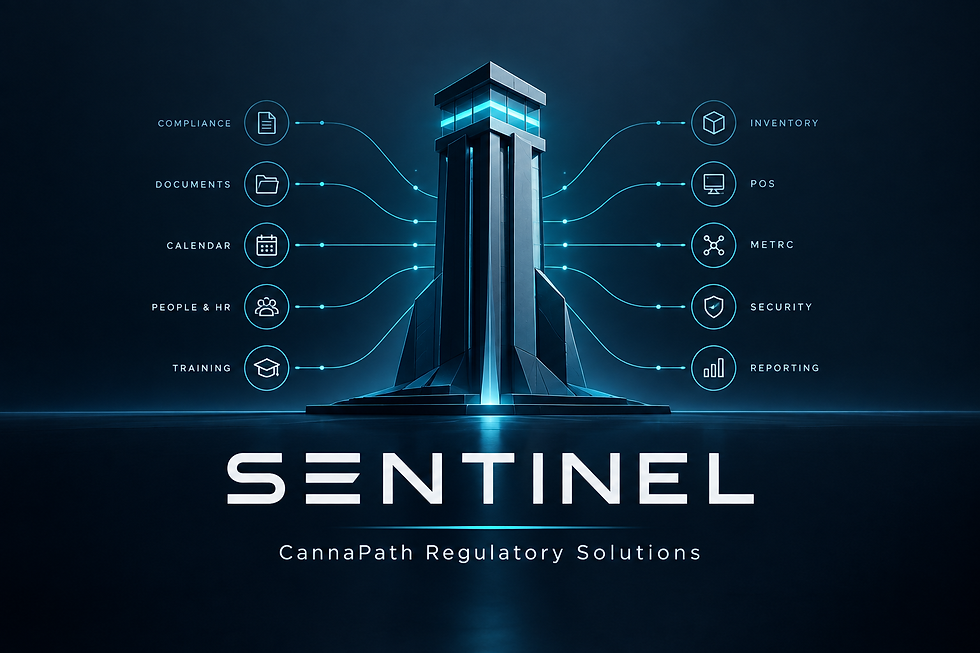
It's also what led us to begin developing Sentinel.
What Is Sentinel, and Where Are We Today?
Some of our clients have already heard us talk about Sentinel, and a few have experienced parts of what we're developing through Scout.
Sentinel is our broader compliance management platform, designed to help organizations connect the many activities required to maintain an effective compliance program.
Rather than simply storing policies or generating reminders, the long-term goal is to create a system that helps organizations manage the relationships between regulatory requirements, operational procedures, employee training, documentation, internal controls, and corrective actions.
Scout, one of the tools being developed within that broader vision, has already begun operating in a limited capacity.
Its purpose is to assist with reviewing compliance documentation, comparing information against applicable regulatory requirements, and identifying potential issues that deserve professional attention.
The intent has never been to replace compliance professionals.
In fact, we believe that would be a terrible idea.
Artificial intelligence can be extraordinarily useful for identifying patterns, organizing information, and highlighting potential inconsistencies.
But regulatory compliance requires judgment, context, and accountability.
Those responsibilities still belong to people.
And that's how we're building these tools.
Technology should support professional judgment, not pretend to replace it.
Now, we want to be transparent about something else.
Although development of Sentinel has been underway, creating a comprehensive software platform is expensive.
Very expensive.
Like many small organizations developing new technology, we've had to make decisions about what we could reasonably accomplish with the resources available.
Some components progressed. Scout began operating. The larger Sentinel platform continued to take shape through planning, design, and initial development.
But we also reached a point where expanding development at the pace we wanted simply wasn't financially practical.
So we slowed down.
Not because we'd lost confidence in what we were building.
Not because the project wasn't moving in the right direction.
And certainly not because we'd abandoned it.
We slowed development because we weren't willing to put the financial future of the business at risk simply to move faster.
Sometimes responsible business management means recognizing that the resources needed to do something properly aren't yet available.
And we'd much rather acknowledge that reality than pretend otherwise.
Which brings us back to this rather unexpected opportunity.
Why This Hackathon Could Change Our Timeline
The Meta Global AI Developer Hackathon presents an opportunity to accelerate work that might otherwise take considerably longer to complete.
During the event, participants will work with development tools and resources, explore emerging AI capabilities, and build functioning demonstrations of their ideas.
For our founder, the event is especially meaningful because it could help overcome one of Sentinel's largest development challenges: the expense of turning a well-developed concept and its existing components into a more fully integrated platform.
We want to be very clear about what that means.
We aren't suggesting that ten days will be enough to complete Sentinel.
They won't.
We aren't suggesting that participating in a hackathon will eliminate the need for future development, testing, security reviews, or professional oversight.
It won't.
And we're certainly not suggesting that a prototype will be ready for organizations to depend upon in their daily operations immediately following the event.
That's not how responsible software development works, particularly when the intended users operate in heavily regulated environments.
What we do believe is that these ten days could allow us to accomplish development work that might otherwise have taken months to reach with our existing resources.
Our immediate goal is to develop a functioning prototype demonstrating several of Sentinel's foundational capabilities and showing how those capabilities work together within a compliance management environment.
That prototype would provide something particularly valuable: a working foundation that can be tested, refined, expanded, and eventually demonstrated to potential development partners and investors.
In other words, we're not trying to build everything in ten days.
We're trying to make meaningful progress toward something we've already spent a great deal of time developing.
And if we're successful, it could change our development timeline dramatically.
Why We're Starting With Healthcare
Now, some of our cannabis clients may be wondering why our primary demonstration during the hackathon will focus on healthcare.
It's a fair question.
After all, CannaPath is a cannabis compliance consulting organization.
So why are we building a healthcare demonstration?
The answer is actually quite simple.
Healthcare provides an ideal environment to demonstrate what Sentinel is designed to do, while cannabis helps demonstrate why the underlying technology could be useful well beyond healthcare.
Our founder's professional background is in healthcare compliance, and that experience provides a strong foundation for developing and evaluating the system's core functions.
For the hackathon, our primary demonstration will focus on a small healthcare environment, specifically a 25-bed critical access hospital and associated smaller medical clinics.
These organizations provide a meaningful example of the problem we're trying to solve.
They operate within extensive regulatory frameworks, manage substantial documentation requirements, and must maintain effective oversight of many interconnected activities.
Yet smaller healthcare facilities frequently lack the administrative and financial resources available to major health systems.
By focusing on this environment first, we can demonstrate how Sentinel's foundational functions might help an organization manage regulatory obligations, employee responsibilities, documentation, and compliance activities within a connected system.
But here's where the second part becomes important.
And Why Cannabis Is Just as Important to the Demonstration
Once we've established how the system works within a healthcare environment, we intend to demonstrate how that same underlying foundation can be adapted to Minnesota's cannabis regulatory framework.
This is an important part of Sentinel's long-term vision.
We're not interested in building completely separate software systems every time we enter a different industry.
We're interested in developing a common compliance management foundation that can support different regulatory environments without requiring the entire system to be rebuilt.
Think about it.
A hospital needs to maintain employee training records.
So does a cannabis retailer.
A medical clinic needs to document corrective actions.
So does a cannabis cultivation or manufacturing operation.
A healthcare organization must maintain policies and demonstrate that employees are following them.
Sound familiar?
Of course, the actual regulatory requirements are different, sometimes dramatically so.
And we're not suggesting that compliance with one industry's requirements automatically translates into compliance with another's.
It doesn't.
But many of the processes organizations use to manage those requirements share common characteristics.
Documentation, accountability, training, internal controls, corrective actions, inspection readiness.
The rules change. The fundamental need to manage those rules does not.
By demonstrating Sentinel in healthcare first and then showing how its underlying capabilities can be adapted to cannabis, we hope to establish that we're developing something more versatile than a single-industry compliance application.
And there's another reason this approach matters.
If we can develop one strong technological foundation rather than repeatedly paying to build separate systems, we may be able to reduce development costs substantially.
Which brings us to something we feel very strongly about.
Because Someone Eventually Has to Pay for All This
Let's talk about something that doesn't get discussed nearly enough when companies announce exciting new technology.
Who pays for it?
Software development costs money. Skilled developers cost money. Infrastructure, security, ongoing maintenance, testing, and technical support all cost money.
Those are legitimate expenses.
But here's the thing.
When a company invests heavily in developing a product, those expenses frequently influence what it eventually needs to charge customers.
And sometimes those prices put otherwise useful technology completely out of reach for the organizations that could benefit from it most.
We've seen this happen in healthcare.
We're seeing versions of it in the cannabis industry.
A small organization discovers a platform that could genuinely help it manage compliance, improve efficiency, and reduce administrative burdens.
Then it receives the pricing proposal.
And suddenly that wonderful new technology isn't looking quite so wonderful anymore.
We don't want Sentinel to become another example of that problem.
From the beginning, affordability has been an important part of our development philosophy.
We're not trying to create the most expensive compliance platform on the market.
We're trying to create one that actually helps people.
And that means being thoughtful about development costs before they eventually become someone else's subscription fees.
Every dollar we don't unnecessarily spend developing Sentinel is a dollar we don't have to recover from the organizations that eventually use it.
That is one of the biggest reasons this hackathon matters to us.
If we can accelerate development using the opportunities and resources available during the event, we may be able to reduce the amount of outside development funding needed to move the project forward.
That doesn't mean Sentinel will be free.
It doesn't mean there won't be substantial costs associated with bringing the full platform to market.
But it does mean we have an opportunity to approach those costs differently.
And if that helps us eventually make meaningful compliance technology available to a small rural hospital, an independent medical clinic, or a Minnesota cannabis business without requiring them to empty their bank accounts to afford it, then we believe it's worth pursuing.
Because what good is developing technology to help smaller organizations if those organizations can't afford to use it?
What This Means for Our Clients
If you're a current client, the short answer is that nothing changes. Our compliance officers have volunteered their time at different points throughout the event, so day-to-day operations will continue as normal. Your questions will still get answered, and every commitment we've made stays in place.
The one exception is new clients. The hackathon runs from October 26 through November 4, 2026, and we'll pause new-client onboarding during those ten days. We'll keep accepting inquiries from prospective clients, and onboarding picks back up as soon as the event wraps.
Scout will remain available during the event. There's a chance we'll need to take it offline for a short window while we work. If that happens, you'll see a banner across the top of the Scout page, and the submit button will be turned off until it's back up. We'll keep any downtime as brief as we can.
We wanted you to hear that from us directly. And we hope you'll be just as excited as we are about what this could eventually mean for you.
We're Not Doing This Alone
Before we go any further, we owe some people a real thank-you.
When we shared this news with our team, the response was immediate. Our compliance officers are giving their own time to keep client work moving while our founder is heads-down. Our legal team has been in it with us from the start. And our subject matter experts, who cover every area of cannabis we work in, volunteered to put their knowledge directly into what we're building.
That matters more than it might sound. Software can organize information, but it can't invent expertise. What makes Sentinel worth building is the experience of the people feeding into it, and that experience belongs to them.
None of them were obligated to do this, and they all stepped up anyway. We're grateful, and we're proud to work alongside them.
We're Excited. We're Nervous. And We're Going to Give It Everything We've Got.
We would love to tell you we have every detail figured out. We don't. There will be technical problems, surprises, and moments when things don't go according to plan, because that's what building something new looks like. Being selected is exciting, but it doesn't guarantee we'll accomplish everything we hope to.
What it does give us is a chance to learn, to speed up development, and to show people an idea we've believed in for a long time. Most of all, it moves us closer to putting real compliance management technology within reach of organizations that have historically struggled to afford it.
We're not doing this because we think artificial intelligence is a magic fix for every regulatory problem. It isn't. We're doing it because we believe technology, built thoughtfully and used responsibly, can help people spend less time fighting administrative complexity and more time on the work their organizations exist to do. For a hospital or clinic, that means more attention for patients and the people caring for them. For a cannabis business, it means owners and employees can focus on running a safe, responsible, successful operation. Different industries, same purpose.
One Final Thought
When our founder started this journey, the plan wasn't to build a technology company. Honestly, we never intended to be a software anything. The plan was to put decades of experience to work for organizations that needed help. But the longer we did that work, the more clearly we saw how big the need was, and that's what started us down this road.
We will never be a software company. We're a compliance company, and our goal is to make compliance available to everyone and, more importantly, to help people understand it well enough to work within it every day. Sentinel is a tool toward that goal, not the goal itself. The tools are changing, the opportunities are getting a little bigger, and the road ahead looks different than anyone imagined, but the reason behind the work hasn't changed.
We believe smaller organizations deserve the same quality of compliance support and technology as their larger counterparts. The people working in them deserve tools that make their jobs easier, not harder. Doing something worthwhile shouldn't mean pricing it out of reach of the very people you set out to help. If this hackathon moves us even a little closer to that, it will have been time well spent.
To everyone who has supported CannaPath, trusted us with your business, cheered us on, or simply followed along, thank you. We're looking forward to sharing what we're able to accomplish.
And now, apparently, our founder has ten days to see how far he can take an idea that started with a simple desire to help people. There will be coffee involved. Probably an unreasonable amount.
As always if you need us, we are still here. Our clients will always be our priority. Reach out if you need anything,( hello@cannapath.org ) and the same rule still applies. We will get back to you within a business day.
Wish us luck, folks. We have a feeling this is going to be quite an adventure.
— The CannaPath Regulatory Solutions Team
Sentinel is a compliance management platform under development. Scout is currently operating in a limited capacity. Participation in the Meta Global AI Developer Hackathon does not constitute endorsement of CannaPath, Sentinel, or Scout by Meta. Any prototype developed during the event will require additional development, validation, and appropriate safeguards before being considered suitable for operational deployment.