What Successful Minnesota Cannabis Microbusinesses Are Doing Differently

Eight practices showing up across the operators building Minnesota's craft market.
By: Drew Duffy, MHA, FACHE CannaPath Regulatory Solutions · About a 9-minute read
The short answer. The Minnesota microbusinesses that look best positioned are not doing everything their license allows. They pick a lane, build a real local identity, integrate only the part of the supply chain that creates their margin, line up suppliers and lab capacity before they need them, run compliance as an operating system instead of a filing exercise, plan around cash timing rather than annual revenue, and treat “micro” as a business model rather than a stage to grow out of. |
What can be said honestly, and what cannot
Nobody can tell you which Minnesota microbusiness is the most successful. The adult-use market is barely a year into retail sales and there is no public financial reporting that would let anyone rank operators by profitability. If you see that claim somewhere, it is a guess wearing a suit.
What is available: OCM licensing and market data, Minnesota law as amended in 2026, and reporting on operators who have made it through licensing and opened their doors. Read across those and the same handful of habits keep showing up. That is what this piece covers.
Everything below reflects the rules as of August 13, 2026. Rules move. Verify with OCM before you spend money on any of it.
The record so far
What | Figure | As of |
First microbusiness license issued | Herb-Quest LLC, cultivation and packaging endorsements | June 18, 2025 |
First microbusiness open for adult-use retail | Legacy Cannabis, Duluth | Sept. 16, 2025 |
Cannabis business licenses issued | 118 | Dec. 31, 2025 |
Combined adult-use and medical sales | $122.5 million across more than 1.2 million transactions | 12 months ending Dec. 2025 |
Living plants in seed-to-sale tracking | Nearly 66,000 | End of 2025 |
Licenses issued against applicants | 240-plus of 3,541 | Mid-2026, trade reporting of OCM data |
Fully licensed full-panel testing labs | Three | After the June 2026 lab exit |
Cap on microbusiness licenses | None. The license type is uncapped. | Current |
The last row is the one people skip past. Microbusiness is uncapped, so your competition is not a lottery. It is everyone else who decided to apply.
What the license actually gives you
Minnesota's microbusiness license is unusually flexible. With the right endorsements you can grow, make concentrate, manufacture products, buy from other licensed businesses, package and label, sell wholesale and retail, and run an on-site consumption area. One retail location. Up to 5,000 square feet of indoor plant canopy or one-half acre of mature flowering plants outdoors (Minn. Stat. § 342.28).
That flexibility is the best thing about the license. It is also the trap. Owners read the endorsement list and hear “we can do all of this.” The useful question is narrower: which of these actually earns its keep in our business?

1. Pick a lane before you expand the product list
The clearest pattern is specialization, and it usually shows up as subtraction rather than addition.
Concentrate Labs, which farms as Roots & Resin Farms near Lindström, grew roughly 1,100 outdoor plants in its first season and built the whole operation around solventless rosin rather than selling flower. Social equity licensees, outdoor grow, one product philosophy. They have also been working toward doing their own extraction in-house rather than handing the defining step to someone else.
Legacy Cannabis in Duluth did the same thing from the retail side. When it rebranded from Legacy Glassworks and moved to Lincoln Park, it stopped selling tobacco and vapes. Its general manager was blunt about why: staying on the craft side of things meant giving up a category that made the shop very little money anyway.
In Minneapolis, Alysha Bellamy built Herbs and Herbs around craft cultivation, herbal knowledge, and 28 years of working as a chef, making elixirs, candies, and products that pair cannabis with plants like spirulina and lavender. Whatever else you say about that, nobody else is standing in that lane.
What this means for you. You should be able to say in one sentence why a customer drives past the other shop to reach you. Craft outdoor flower. Solventless. Low-dose. A specific community. A specific level of education at the counter. The particular niche matters less than whether it is clear. More products is not more value. |
2. Make “local” an operating decision, not a sticker
Big operators can buy a lot of things. What they struggle to buy is fifteen years of being part of a neighborhood.
Legacy started in 2010 as a glass shop in downtown Duluth, moved to the Lincoln Park Craft District in 2024, and in September 2025 became the first state-licensed microbusiness in Minnesota to open for adult-use sales. It opened with flower grown by the White Earth Nation under the tribal-state compact, still sells Minnesota-made glass, and organizes its public identity around community, education, and access.
None of that was manufactured by an ad budget. It came from relationships that existed before the license did.
What this means for you. Write down what you would lose if you picked up the business and moved it forty miles down the road. If the answer is “nothing much,” you have a location, not a local strategy. Local sourcing where the law allows it, local artists, neighboring businesses, classes, events, and showing up when nobody is buying anything all count. |
3. Integrate the part of the supply chain that creates your margin
The microbusiness license permits real vertical integration. That does not mean you should build a grow, a kitchen, an extraction room, a store, and a consumption lounge because the endorsement list has boxes for them. Every one of those is capital, payroll, and a separate set of procedures to maintain and prove.
Selective integration is the stronger move. Cultivation into a proprietary product into your own retail. Or craft cultivation into wholesale relationships. Or retail with a strong local brand and a carefully chosen supplier bench. A grower whose entire identity is solventless rosin should probably own the pressing step. That same grower has no obvious reason to own a storefront.
What this means for you. Own the step that makes you different or makes you money. Rent, contract, or partner for the rest, and revisit that decision once a year rather than once at buildout. |
4. Build the supplier and lab relationships before you need rescue
Minnesota is a closed-loop, tracked market, and every batch must clear a licensed lab before it can be sold. That single dependency has been the choke point since the market opened.
It got tighter in June 2026, when Legend Technical Services, the state's oldest licensed cannabis testing lab, stopped testing after regulators pulled its authorization. That left three fully licensed full-panel facilities serving the whole state. Cultivators reported finished product sitting and waiting for a lab appointment while the sales window moved. A small operator with one lab relationship and no fallback absorbs that delay directly in cash.
One piece of relief worth knowing: licensed businesses may transport their own compliance samples to a Minnesota-licensed testing facility without contracting a transporter, through Feb. 1, 2029, provided they meet OCM's conditions on manifests, vehicle storage, and approval. The authority started as a temporary OCM guidance memo and was written into law in the 2026 session.
Questions to answer before you have inventory that has to move:
• Who supplies you, and who supplies you when they cannot?
• Who transports, and are you set up to self-transport samples under OCM's conditions?
• Which lab, what is their current queue, and who is your second lab?
• How does a three-to-six-week testing wait change your production schedule and your payroll?
• What happens if a batch fails, and who pays for the remediation and the retest?
What this means for you. Every input in your business needs a named second option, written down, before the first one fails. Relationships built during a crisis cost more and deliver less. |
5. Run compliance as the operating system, not the paperwork
Before you are licensed, OCM wants four final plans of record: site, security, and operations; inventory control, storage, and diversion prevention; quality assurance; and accounting and tax compliance. Then a pre-license inspection against what you submitted. Then routine compliance inspections for as long as you hold the license.
The mistake is treating those documents as something the state wanted and you produced. A procedure that only exists to satisfy an inspector will not survive contact with a Tuesday.
A working SOP answers five questions on its face: who does this, when, how do they know it was done, what happens when it goes wrong, and where is the evidence. That last one is the difference between a compliant business and a business that says it is compliant.
This matters more in a microbusiness than anywhere else, because the same three people are doing everything. The owner is the manager. The manager runs inventory. Whoever runs inventory also trains the new hire. Informal knowledge feels efficient right up until the person holding it is out for two weeks.
The two-week test. Pick your most essential employee, yourself included. If the business could not run correctly with that person gone for two weeks, the process lives in a head instead of in the business. Document it, train it, test it, then update it when it changes. |
6. Model cash timing, not annual revenue
A good product does not protect you from running out of money. In cannabis, nearly every cost lands before the first legal sale: local approval, lease, buildout, security, equipment, license fees, insurance, payroll, training, inputs, packaging, testing. Revenue starts later than the spreadsheet says, and testing queues can push it later still.
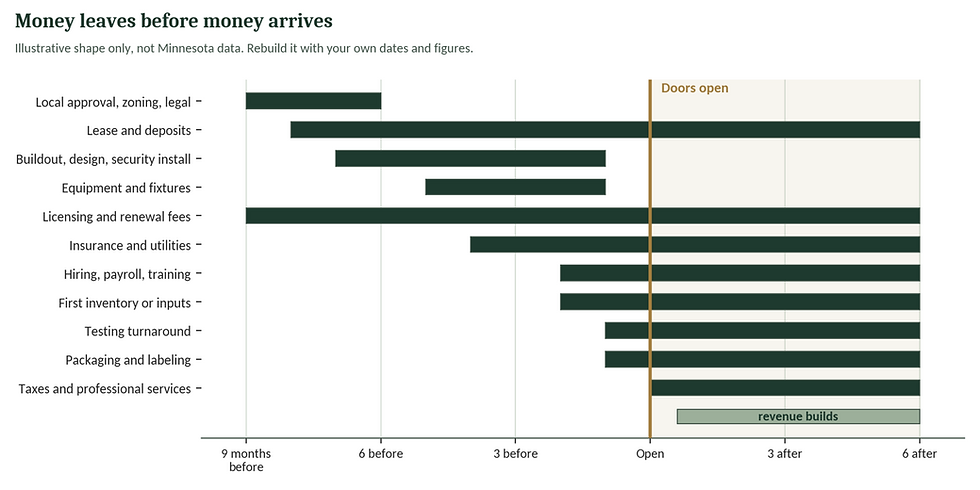
Minnesota does have startup capital aimed specifically at this license type. Through DEED's CanStartup program, nonprofit lending partners make loans to eligible new cannabis microbusinesses, from $2,500 up to $75,000, and as much as $200,000 with private matching funds. Priority goes to eligible social equity applicants. Useful, but it is a bridge across a timing gap, not a substitute for knowing where the gap is.
What this means for you. Stop asking what your annual revenue will be. Ask how many months you can operate if revenue arrives ninety days later than planned. That number is your actual business plan. |
7. Build more than one revenue path, all pointing at the same brand
This is not a license to sell everything. It means not building a business where a single product, a single supplier, or a single customer type decides whether you survive.
Legacy again: cannabis, hand-blown Minnesota glass, merchandise, events, education, online ordering and pickup. Different revenue, one identity. Compare that with five unrelated products sharing a shelf.
There is also a new door here. As of Aug. 1, 2026, the prohibition on holding both a hemp and a cannabis license is gone, and both businesses can occupy the same space as long as they share the same majority owner. For a microbusiness with a lower-potency hemp customer base already walking through the door, that is a second channel that reinforces the first rather than diluting it.
What this means for you. Each stream should make the others more credible. Craft cultivation feeding flower, wholesale relationships, a proprietary concentrate, education, and branded merchandise is one business. Five unrelated SKUs is five half-businesses. |
8. Stay small on purpose, and know where the exit ramp is
A Minnesota cannabis microbusiness does not have to be a mezzobusiness in waiting. When the model rests on quality, specialization, local identity, and the owner being genuinely present, more capacity mostly buys more payroll, more inventory, more management, and more ways to be wrong.
It is still worth knowing what the ladder looks like, because the 2026 law changed it. Starting Jan. 1, 2027, a microbusiness with a medical cultivation endorsement gets another 1,000 square feet of canopy, a medical retail endorsement allows a second retail location in areas of high medical need, and after two years with a medical cultivation endorsement a microbusiness may petition to reclassify as a mezzobusiness. Growth became a door you can choose to open later rather than a decision you have to make at buildout.

Two related changes worth having on your calendar. Preliminary approval now comes with an automatic six-month extension on request, plus a possible second six months if you are making good faith progress. And OCM cannot issue additional capped cultivator, manufacturer, retailer, or mezzobusiness licenses until July 1, 2027.
What this means for you. The question is not how fast you can get bigger. It is what size makes this specific business work. Expand when the model demands it, not when the license permits it. |
The pattern, side by side
Weaker approach | Stronger approach |
We can sell everything. | We are known for this. |
Build the biggest facility the license allows. | Build the facility the business can carry. |
Find customers after opening. | Build the community before opening. |
One supplier, one lab. | A named second option for every input. |
Write SOPs to get licensed. | Write SOPs your staff actually use. |
Forecast annual sales. | Forecast cash timing and months of runway. |
Add every endorsement available. | Add an endorsement when it creates value. |
Compete on price. | Compete on identity, quality, or experience. |
Treat compliance as paperwork. | Treat compliance as infrastructure. |
Assume growth equals success. | Define what sustainable looks like for you. |
Ten questions to ask before you add anything
Before another product, endorsement, employee, or square foot:
1. What are we actually known for?
2. Who is our ideal customer, specifically?
3. What makes us meaningfully different from the shop down the road?
4. Which part of our supply chain carries the most risk?
5. Which part of our supply chain creates our advantage?
6. How many months of operating cash do we have right now?
7. Could someone other than the owner perform every critical process?
8. Can we prove our inventory, quality, and compliance processes work, with evidence?
9. What does our schedule look like if testing takes six weeks instead of two?
10. Are we expanding because the business needs it, or because the license allows it?
That last one is the one that decides most of the others.
Frequently asked questions
Are Minnesota cannabis microbusinesses profitable?
There is not enough public Minnesota financial data to answer that across the market. OCM's Cannabis Market Monitor, launched in January 2026, publishes licensing, sales, product, and cultivation data monthly, but it does not report business-level profitability. Operators are also at very different stages, so an early opener and a business still finishing buildout are not comparable.
Can a Minnesota microbusiness grow and sell its own cannabis?
Yes, with the right endorsements. The license can cover cultivation, manufacturing, packaging, wholesale, and one retail location, along with on-site consumption of edible products.
How much can a microbusiness grow?
Up to 5,000 square feet of indoor plant canopy, or up to one-half acre of mature flowering plants outdoors. Beginning Jan. 1, 2027, a medical cultivation endorsement adds another 1,000 square feet.
Can a microbusiness have more than one store?
One retail location under the base license. Beginning Jan. 1, 2027, a medical retail endorsement allows a second location serving an area of high medical need.
Is vertical integration automatically better?
No. It can protect you from supply-chain gaps and improve margin, and it also multiplies capital needs, staffing, and compliance surface. Integrate the step that creates your advantage.
Do I have to hire a transporter to get samples to a lab?
Not through Feb. 1, 2029. Licensed businesses may transport their own compliance samples to a Minnesota-licensed testing facility if they meet OCM's requirements for manifests, vehicle storage, and approval.
What is the most common microbusiness mistake?
Trying to build the entire license at once. The endorsement list is a menu, not an assignment.
Where can a microbusiness find startup help?
DEED's CanStartup program funds loans to eligible new cannabis microbusinesses through nonprofit lending partners, with priority for eligible social equity applicants. DEED and OCM also run technical assistance and workforce programs.
CannaPath's takeaway
Minnesota did something unusual with this license. It did not create a small dispensary. It created the possibility of a small, locally owned, vertically integrated cannabis business, which most states did not.
The opportunity is not becoming a miniature version of a large cannabis company. It is building the thing large companies have real trouble being specific, local, responsive, and known by name. A large operator can buy scale. You can know your customers, your growers, and your product better than anyone in the room.
The operators most likely to still be here in five years are not the ones doing the most. They are the ones who decided what they were, wrote down how it works, and kept enough cash to survive the parts they could not control.
Before you go
Free, and actually free. Our readiness workbooks are in the free resources section at cannapath.org. No email, no form, no drip campaign. Download it and use it. None of this is cheap to get wrong, and doing it twice costs more than doing it slowly. If you get into something you would rather not sort out alone, we are here. Reach out at hello@cannapath.org or (952) 649-2946. |
Sources and further reading
• Minn. Stat. § 342.28 (cannabis microbusiness licensing and operations) and § 342.29 (mezzobusiness), revisor.mn.gov
• OCM, 2026 Legislative Changes to Chapter 342 (SF 4401 summary), May 2026
• OCM, Final Plans of Record questions and material change forms, mn.gov/ocm
• OCM, Cannabis Market Monitor and the January 2026 dashboard launch release
• OCM Guidance Memo GM-2025-06, transport of samples to testing facilities
• Minnesota DEED, CanStartup (Cannabis Industry Startup Financing)
• Star Tribune and MPR News reporting on the June 2026 exit of Legend Technical Services
• Star Tribune, Duluth News Tribune, and MPR News reporting on Legacy Cannabis Duluth, September 2025
• MPR News reporting on Roots & Resin Farms and Concentrate Labs, September 2025
• Minnesota Cannabis College, board biographies (Alysha Bellamy, Herbs and Herbs)
Figures and dates reflect what was published as of Aug. 13, 2026. Cannabis rules in Minnesota change faster than most, and OCM's own published lists sometimes lag the market. Verify anything you are about to build a decision on directly with OCM.


